
Pages 1 and 7 of Reverend Ridley's notebook, available online: OM79-32/17, William Ridley's notebook, State Library of Queensland
One of the earliest original items for Queensland Aboriginal languages is the 1855 notebook of Reverend William Ridley. This item was featured in the Spoken Exhibition 21 November 2019 -19 April 2020 and is an important part of the language revival puzzle.
William Ridley was a Missionary who had an interest in Aboriginal languages and customs. Many missionaries learnt the local languages as part of their role which required them to ‘save a black soul for Heaven’ – an unexpected legacy was religious texts, including hymns, translated into local languages. Ridley is best known for his work with Kamilaroi, but also undertook comparative studies of other languages in NSW and later Queensland.
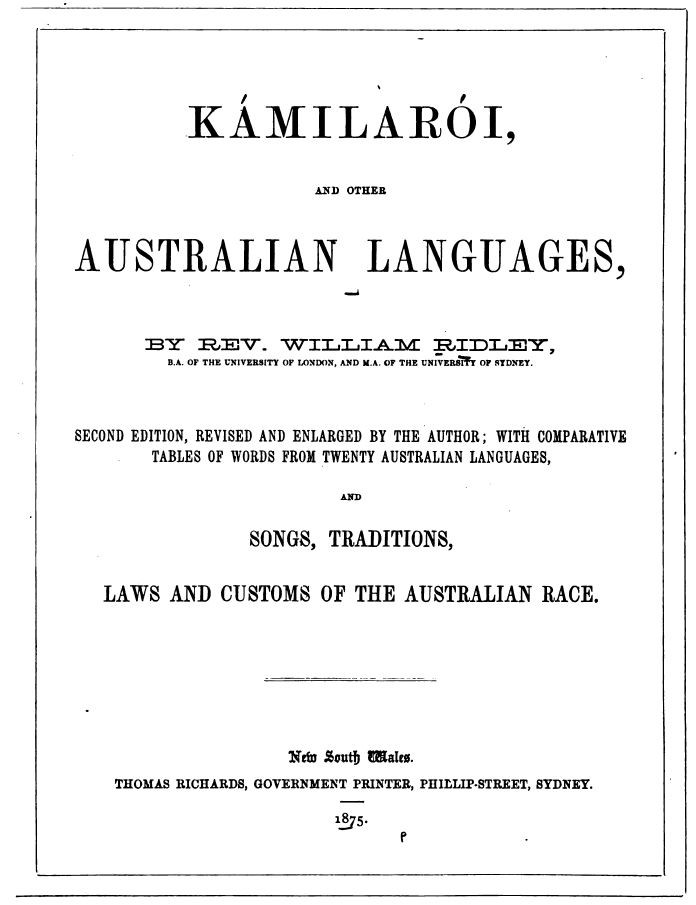
Kamilaroi and other Australian languages, Ridley. RBJ 499.15 RID
In 1855, Ridley undertook a journey to Moreton Bay, along the Namoi, Barwon and Condamine Rivers, taking notes on the customs and languages of Aboriginal groups along the way. Upon his arrival in Moreton Bay, Ridley presented a Report to the Moreton Bay Aborigines' Friends Society on the evening of Wednesday 21November 1855.
Ridley's journey to South-East Queensland was the basis for his Kamilaroi, Dippil and Turrubul publication which as the title suggests is a comparative linguistic study between Kamilaroi (aka Gamilaraay), Dippil (Wakka Wakka) and Turrubul (aka Turrbal) languages. The text contains words from the three languages relating to people, parts of the body, topography, plants, animals, numbers, etc. as well as a basic grammar and guide to pronunciation.
The work also contained cultural knowledge such as marriage lines, kinship groups, etc. Ridley's missionary work included several missionary trips along the river systems of North-West NSW and he established several key informants for languages. These included Charles Greenaway of Coolemungool Station on the Barwon River, James Davies (aka 'Duramboi') and Thomas Petrie of Durundur Station, Moreton Bay. These same informants also provided much of the language information recorded by Ridley in his notebook.
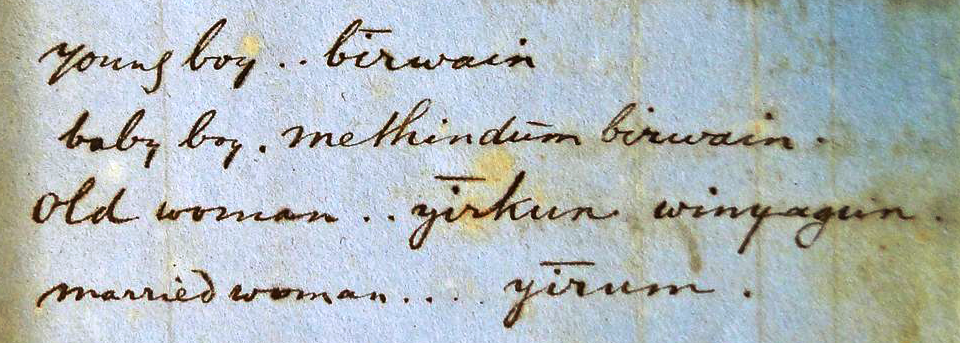
This image is an extract of list of words for people and kinship, also collected from Thomas Petrie at Durundur. OM79-32/17, William Ridley's notebook, State Library of Queensland
The digitised version is available online and represents an historical insight into the Aboriginal languages of South-East Queensland and North-West New South Wales. Dating from the 1850's Ridley's materials are extremely useful for language revival as his work documents Aboriginal words and sounds at the point of contact. Contemporary language workers can analyse these documents to establish the original sounds that were spoken and heard by others.
State Library extends an invitation for all Queenslanders to see these original materials first-hand and explore the many stories of Queensland languages.
- State Library of Queensland Aboriginal and Torres Strait Islander Languages Webpages
- State Library of Queensland Aboriginal and Torres Strait Islander Languages Interactive Map
Jarjum stories. A kuril dhagun showcase focusing on children’s books and Aboriginal and Torres Strait Islander languages. 19 October 2019-10 May 2020.
Spoken: celebrating Queensland languages. A major exhibition exploring the survival and revival of Aboriginal and Torres Strait Islander languages throughout Queensland. 21 November 2019 -19 April 2020.
UN IY2019 Links
- UN International Year of Indigenous Languages webpages
- UN International Year of Indigenous Languages resources
References and Further Reading
- OM79-32/17, William Ridley notebook, 1855
- Ridley, W. (1866) Kamilaroi, Dippil, and Turrubul: languages spoken by Australian Aborigines. RBJ 499.15 RID
- Ridley, W. (1875) 2nd ed, Kamilaroi and other Australian Languages. RBQ 499.15 RID
- Sydney Morning Herald, 14 December 1855. "Report laid before the Moreton Bay Aborigines' Friends Society, of a journey along the Condamine, Barwan and Namoi Rivers, by William Ridley, Missionary".
Desmond Crump
Indigenous Languages Coordinator, State Library of Queensland
Comments
Your email address will not be published.
We welcome relevant, respectful comments.