Part 5 - Rolling Out the Red Carpet: Skateboarding Icons and Everyday Heroes
By Dr Indigo Willing, 2025 John Oxley Library Honorary Fellow | 15 October 2025
Sunshine State’s Subcultural Game-Changers and Olympic ‘Roll’ Models

Dr Indigo Willing, 2025 John Oxley Library Honorary Fellow.
Dr Indigo Willing, 2025 John Oxley Library Honorary Fellow
I wish to acknowledge the Turrbal, Jaegera, Yuwibara, Kabi Kabi, Jinibara, Yugumbeh and Kombumerri People who are the traditional owners of the land this skateboarding research is based on in Queensland.
Skateboarding is an urban subculture and scene that has appealed to and welcomed youth and people from the margins for decades in Queensland. Moreover, its appeal has now expanded even further, with skateboarding shifting from its subcultural origins to now also being an Olympic Sport. The ‘Queensland Skate of Mind: Subcultural Game Changers to Olympic ‘Roll’ Models project emerges from my John Oxley Library Honorary Fellowship in 2025 to document this under-recognised and significant part of Queensland’s social, sport and cultural history. This project aims to provide an introduction to key aspects of what makes skateboarding in Queensland special and why it warrants further research. The themes introduced in a series of blogs and videos will encompass a range of stories, memories, ephemera and other contributions from the skateboarding community throughout my 2025 Honorary John Oxley Fellowship.
Thank you to Slam Skateboarding Magazine editor Trent Fahey (all issues are part of the collection at State Library of Queensland) and journalists Nat Kassel and Josh Sabini. Additional thanks to photographers Mike O’Meally, Wade McLaughlin, Robbie Cameron, Jack Cassidy, and Peter Sondergaard, Rachel Torti, Andrew Viles, Toby Mellonie, Jay Musk, Sarge Jhogenson, Daniel Vincent, Mike Lawry, Kane Stewart, Izy Duncombe, Sarah Huston, Andy MacKenzie, Scott Shearer, Mark Brimson, Stu Fogarty, Curtis Hay, Mitchell Roberts and many others. And a special thanks to my fellow We Skate QLD team members, Evie Ryder, Miljana Miljevic, Brooke Manning, Connie Leung, Jingjing Yang, Lil Turek and numerous members of the Brisbane and QLD skateboarding community for sharing their knowledge.
This blog is one of a 7 part series. To view the other blogs, click here.
Part 5 - Rolling Out the Red Carpet: Skateboarding Icons and Everyday Heroes
There are numerous skateboarders across the 1980s to 2000s to now who pushed Queensland skateboarding forward in technical and NBD (never been done) tricks to sharing the stoke with ‘steeze’ (skateboarding style), gaining sponsors and having impressive skate phtotos and parts in videos by both grassroots and big skate companies. This includes a generation of now older skateboarders such as Scott Shearer, who in his twenties was one of the first local skateboarders to have his own signature professional skateboard with the Kwala Skateboards in Queensland run by Andy MacKenzie. Shearer later went on to achieve an MA in Social Planning from The University of Queensland and now advises councils on how to better plan spaces for play for young people.

Bearing Skateboarding Magazine. Article on Scott Shearer. Photo at QLD Museum stairs. Aaron Rowe looking on in the background. No 1. (2000). Bearing skateboarding magazine. Brisbane: Brisbane City Council on behalf of Bearing skateboarding magazine. John Oxley Library, State Library of Queensland.

Bearing Skateboarding Magazine. Article on Scott Shearer. No 1. (2000). Bearing skateboarding magazine. Brisbane: Brisbane City Council on behalf of Bearing skateboarding magazine. John Oxley Library, State Library of Queensland.
Alan Petersen is another well-respected skateboarder from the 1990s. Although from Fresno in the USA, he later toured Australia and moved to Brisbane, sharing a house with Andy MacKenize. Petersen first made his name with American icons such as Natas Kaupas and SMA. He would later be a part of Kwala Skateboards and the subculture of street skating in Queensland. Andy Mackenzie states “Alan is the real deal. One of the genuine orginators of modern street skating, but still an all-terrain ripper” (Slam Magazine, Issue 203, 2025, pg 32). MacKenzie and Petersen would also run a distribution company called Duty Now. Petersen also raised a family in Redcliffe and who after a break due to injury, made the decision to continue to skate stating “skateboarding has really saved me. It’s like a rebirth” (Slam Skateboarding, Issue 203, 2025, pg 32).


SWIPE TO VIEW PHOTOS
Alan Petersen. Slam Skateboarding, Issue 203 (2015). Pages 29-33. Interviewer: Max Olijnyk. Photography: Darren Kirby. Anon (1980) Slam. Burleigh Heads, Qld: Morrison Media Services. John Oxley Library, State Library of Queensland.
Shane Cross (22 August 1986 – 7 March 2007) was also a skateboarder from the Queensland skate community who gained international respect and a solid fan base. Born on the Gold Coast, he stood out for his skateboarding but also his mischievously warm and fun-loving personality. Articles and videos in his memory are regularly shared in magazines, including Slam Skateboarding where he was voted Skater of the Year in 2005, and Volcom’s 2007 video Let’s Live.

A Special Tribute to Shane Cross. Cover, Slam Skateboarding. Issue 132 (2007). Anon (1980) Slam. Burleigh Heads, Qld: Morrison Media Services. John Oxley Library, State Library of Queensland.

A Special Tribute to Shane Cross. Slam Skateboarding. Issue 132 (2007) pages 32 – 33. Anon (1980) Slam. Burleigh Heads, Qld: Morrison Media Services. John Oxley Library, State Library of Queensland.
Shane would be the most naturally talented skateboarder ever to come out of Australia. He was always so light on his feet and he could do pretty much anything he wanted to on his skateboard. He just made a huge impact on skateboarding in Australia. https://www.theage.com.au/national/skaters-lost-without-gifted-cross-20070309-ge4dno.html
Trent ‘Tbuns’ Riley is another skateboarding legend from Queensland who is remembered by the whole skate community for his exceptional style, skills and love of his scene. He was recognised in the Slam Skate Hall of Fame in 2022 (https://www.slamskateboarding.com/item/5015-trent-riley-hall-of-fame-2022). A special website and fundraising campaign called TBUNS has been set up by the Riley family in his memory and to support young people. https://www.tbuns.com.au/ A skate memorial and ramp was also dedicated to his memory at Morayfield Skatepark in 2025. A video TBUNAFOREVER from Pat Gemzik and Ethan Miller’s filming for BNE was also featured in the Skateboarders Journal in March 2025 (https://theskateboardersjournal.com/bne3-trent-riley-tbunaforever/) showcasing his remarkable talent in 2020 and 2021 with Louis Riley also featured.

Trent ‘Tbuns’ Riley was voted into the Slam Hall of Fame in 2022.
Trent TBuns Riley. Treasury video part filmed and edited by Harry Pascoe (2021).
BNE3 - Trent Riley - TBUNAFOREVER video, filmed and edited by Pat Gemzik (2020-2021).
Slam Skateboarding in 2022 wrote:
It’s with great honour, that we announce Trent Riley as the Hall of Fame inductee for 2022. With two video parts and three covers released in 2021, plus the large majority of votes, T-Buns couldn’t be more deserving of the award…He lives on in the memories of his family, friends and the greater Australian skateboarding community…Trent was full of surprises, along with endless style, creativity and talent. We will remember him always!
https://www.slamskateboarding.com/item/5015-trent-riley-hall-of-fame-2022

Image Jake and Izy Duncombe. Slam Skateboarding. Issue 216 (2017) pages 58-59. Words and Photos by Darren Kirby. Anon (1980) Slam. Burleigh Heads, Qld: Morrison Media Services. John Oxley Library, State Library of Queensland.
That issue was before we were dating and married, that's pretty funny. This Slam issue, and that picture of Jake being on the opposite page!” - Izy Duncombe (nee Mutu) discussing an issue where she’s opposite her now husband Jake Duncombe.
Izy Duncombe has skateboarded for a number of companies including Billabong to Theeve Trucks and competed in national and international competitions such as the Van’s Park Series, Volcom’s Wild in the Parks, Bowl-a-Rama and Bowlzilla in Bondi. She received a ‘pro board’ (a deck with the skateboarders name on the graphic) from the F.S.C company in 2021, where her husband Jake Duncombe also had one. Slam Skateboarding stated “This makes her and Jake Duncombe Australia’s first married couple to share signature board status.” Originally from Aotearoa New Zealand she moved to Brisbane and then later the Gold Coast becoming a regular at Pizzey Park in Miami. She now lives in northern NSW where she coaches at Sugar Cane Skateboarding.
In her earlier years, Duncombe was inspired by women skateboarders she saw on the Internet and in magazines but didn’t know many others apart from individuals like Amanda France and Suzie Lay. Then she found the Girls Skate Australia network.
We made a couple of videos with Esther Godoy (the founder) and when we were doing a lot like Girls Skate Australia stuff. We definitely made a couple of really fun videos, which she would come up here, and we would do basically Queensland skateboarding tour.” - Izy Duncombe on filming clips with a dedicated women skateboarding group.
Women skateboarders often had support from men skaters friends and team members who were men, but could still face challenges. Duncombe remembers with one of her earlier sponsors:
I got like 10 items from the shop, which was pretty cool. And then they wanted to do some clips and took me out for a day. But they made me wear, like, a sparkly purple t shirt and just clothes I wouldn't wear. I had to skate in their clothes and get photos and it was like, this is a bit weird.” - Izy Duncombe, on being sponsored by a big company.
Izy Mutu Duncombe. Wild in the Parts. Volcom. (2015)
Izy Mutu Duncombe. Video by Braille Army.
Skateboarders such as Mike Lawry, a professional skateboarder based in North Brisbane, recall how their local skate scenes can be places of positive support, and how older skateboarders can also encourage and support them. Sam Goodall was once such of a person to Mike, driving him to spots and welcoming him into the Brisbane scene after moving from Launceston. There, Mike would see professional skateboarders such as Jon Lorcan and be inspired to push himself to new levels of tricks.
Redcliffe had a strong scene. We all lorded [Jon] Lorcan. Lawry was always at reddy Park…Was sick times and lots of bangers went down…I left QLD and next min I see he's got tons of buttery clips all over the city. At the time, and currently I still get hyped to see his clips. Red or dead! - Sam Goodall, skateboarder.
Mike Lawry has achieved a number of sponsors and been on flow (given products) with both local companies and shops including New Edition (a former company by Kane Stewart), Skatebiz, Parliament Skateshop, Dogshop Skateboards to international companies such as Element, 5boro and Alien Workshop, the latter who he explained he admired as a ‘grom’. He states, “I remember I was already into aliens, I guess, which is funny, because I ended up on Alien Workshop”. He also discussed how he was sponsored in the days where skateboarders would more traditionally record ‘sponsor me’ videos to send to companies than get discovered on social media and Internet content alone.
I remember being so excited when Lawry got on the Herstwood team! All the crew knew him for a while and he was the perfect fit. Good bloke. Hard worker. This dude is dedicated and his ability to make technical tricks look so simple and very stylish shows his determination and experience on the board.” - Sammy Fullwood discussing Mike Lawry, his fellow Herstwood team member.
While skateboarding is entering a more wholesome and healthy era today with things like nutritican and physio to sobriety being socially acceptable, Lawry also described an era where drinking and partying and ignoring injuries were the norm. This included a time when he went to a skateboarding competition in front of Richard Flude (an award-winning skater and later Secretary of the Victorian Skateboard Association) and management from Element after “a very big night out”. Lawry states, “ I got there, and there's like, Richard Flude, Tommy Fynn, like all these dudes. I'm just so intimidated and scattered and full of anxiety. Anyway, I just managed, I don't know how, and in my state I just skated really good and won the competition”. Unfortunately due to visa complications, Lawry was unable to tour the United States with the Element team as part of his prize.
Lawry said in an interview with me that skateboarders can look like they have it all together but just because they skate well does not mean they do not experiences things like anxiety, depression, and other social challenges. However, he also reveals how an under-recognised source of empowerment can make a big difference, such as men helping other men. Along with Sam Goodall, he credits Rome Torti with helping his career by taking photographs of him and still bringing him into the Element team, and people like Kane Stewart for being one of his original sponsors and supporters. Having time out away from the city and people and places he was familiar with also gave Lawry a new energy and over the years he has been in numerous magazines, video parts and advertisements for various companies including DGK and Grizzly Grip. He states, “I just love skateboarding so much, I’m happy to still be doing what I do.” At 37, Mike is still on the Parliament shop team and filming parts with a special event in the works, and has recently joined the Dogshop Skateboards line up.

Mike Lawry. Advertisement for Alien Workshop by Project Distribution. Back cover of Slam Skateboarding. Issue 213 (2016/17). Anon (1980) Slam. Burleigh Heads, Qld: Morrison Media Services. John Oxley Library, State Library of Queensland.

Mike Lawry. Advertisement for Parliament Skateshop in Slam Skateboarding. Issue 213 (2016/17). Anon (1980) Slam. Burleigh Heads, Qld: Morrison Media Services. John Oxley Library, State Library of Queensland.
Various notably talented Queensland street skateboarders feature in a 2016 article on Brisbane skateboarding in Slam Skateboarding such as Pedro Day, Louis Riley, the late and revered Trent ‘TBuns’ Riley, Joel Wilshire, Mitchell ‘Mashy’ Howse, Ash Linaker, Pat Pollock, Jay Musk, Cam Holling, Nick Law, Mitch Morrison, Mitch Owens, Boyd Young, Dennis Durrant, Andrew ‘Beacho’ Beauchamp, Mike Lawry and more.
Many street and park skaters from the mid-2000s onwards have all played a role in bringing Queenslanders into the pages of skate magazines, to video parts, industry ads and podiums, Others have been a still important part of the social fabric and culture of local skateparks and scenes, and very often offering a ‘second’ family to locals or welcoming presence to visiting skateboarders from interstate and international locations. This includes many who I have got to meet at my local parks.
The skateboarding community shared how the following people (with more listed in previous or upcoming sections of this project) in Queensland are all a part of the fabric of its skate culture and scenes:
Kane Stewart, Michael Rogers, James Briody, Steele Evans, ‘Riz’, ‘Ghetto Pete’, ‘Percy’, Matthew Odgen, Harrison Mol, Callum Jay, Terry Flaskos, Ben Gillette, Chris and Conner Walsh, Turi Ramsey, Luke Singleton, Matt ‘Jobbo’ Jobson, Nikkos Marinos, Calvin Edwards, Louis James, Tessa Fox, Nikkos Marions, Calvin Edward, Manu Hepi, Brenton Hawkins, Aidan Condor, Brock Phillips, Bugsy, Lucas Tranch, Karl Bayldon, Matt Bates, Riz, ‘Azza’ and ‘Dave’, Nick Dunne, Ryan Emrich, Daniel Günther, Seamus Platt, Indigo Pesu, Hutch, Peanut Ryan Petith, Nick Dale, Marcus Warren, Kadir and Orhan Kiraz, Daniel Vincent, Sam Larkins, Jett Stanton, Harrison Lewinski, Mitchell Roberts, Matt Markland, Amanda France, Aimee Massie, Shari White, Shari Duffy nee Lawson, Izy Duncombe, Shanae Collins, Nikki Rose Wall, Brent White, Zac Jones, Jessie Brodbeck, Haylie Powell, Mikayla Senior, Taniah ‘T’ Mayers, Gus McKennah, Evie Ryder, Riley Pemberton, Mon Werkhoven, Clinten Davidson, Hayden Mcleod, Allanah Bruno, Matt Newkirk, Dallas Stevens, Jordan, Cam Hart, Brooke Manning, Miljana Miljevic, Connie Leung, Sarah Huston and many others.
Other Queensland skateboarders also shaping the subculture from the streets to skate competitions not listed in previous sections include skateboarders such as artist Marty Baptist (featured in Mike O’Meally’s photograph in Part 1 of this series), Steve Pender, Purush Wilson, Tim Regard, Darren Durrant (brother of Dennis), Mark Gaby, Sammy Fulwood, Adam Bala, Luke and Jarrod Rigby, Ivan Vargas, Nathan Jackson, Josh Rio, Joshua Weribone, Luke Barrie, Corey Nixon, Jarrod Ingus, Kota Tohata, Danny Fish, Zach Jones, Ash Wilcomes, James Cleary, Reef Condon, Tom Moffat, James Cleary, Taj Boyle, Dan Stevenson, Jack and Bugs Fardell, Jackson Pilz, Matthew Boggis, Nixon Osborne and others. Skateboarders who have competed as part of the Australian Olympics team for the Olympic Games, or for Street League, have coaching roles and schools, or have been part of the skateboarding qualifiers at World Skate, Skate Australia and Rumble Skateboarding are also discussed in a future section.
A talented younger generation of girls in competitions and gaining sponsorships to inspiring others to skate also includes big names such as Arisa Trew and Haylie Powell, to rising starts such Ella Ledingham, Abby Rose, Ruth Bo, Jadda Ward, Chihiro Young, Ivy Rafferty, Lulu Phoenix, Rogue Day, Coco Crafter, Eliza Pols and Pixie Richards. The rise of girls and women in world competitions to non-traditional skateboarding networks and initiatves is also explored in upcoming sections, with the focus on Yeah Girl, We Skate Queensland (formerly Girls Skate Brisbane) and Girls Skate Gold Coast as examples of community-led change.
Cam Holling filmed by Stu Fogarty
Dennis Durrant. All You Need to Know by The Bay Skate. Edited By Kane Stewart (2015)
The Berrics. Arrived. Tommy Fynn. Brisbane video. 2017.
Nixon Osborne. Creature video. Filmed/Edited by Ethan Miller: (2023)


SWIPE TO VIEW PHOTOS
Image story Brisbane Skateboarders. Slam Skateboarding. Issue 213 (2016/17) pages 34 – 53. Article by John Green. Photos by Wade McLaughlin. Anon (1980) Slam. Burleigh Heads, Qld: Morrison Media Services. John Oxley Library, State Library of Queensland.

Mitch Roberts Grab. Image courtesy Dr Indigo Willing.
Mitchell Roberts. West End DIY. Image used for Middle Store ad in Slam Magazine (2025) Photographer Jack Cassidy.


SWIPE TO VIEW PHOTOS
Jackson Pilz. Slam Skateboarding. Issue 214 (2017). Words: Max Olijnyk. Photograph: Wade McLaughlin. Anon (1980) Slam. Burleigh Heads, Qld: Morrison Media Services. John Oxley Library, State Library of Queensland.
New generations such as Matthew Boggis and Nixon Osborne also have pushed Queensland skateboarding ahead, and who are often featured in Slam Skateboarding to Thrasher Magazine.


SWIPE TO VIEW PHOTOS
Nixon Osborne. Slam Skateboarding. Issue 217 (2017,2018) pages 72- 73. Words: Max Olijnyk. Photograph: Wade McLaughlin. Anon (1980) Slam. Burleigh Heads, Qld: Morrison Media Services. John Oxley Library, State Library of Queensland.
Women, non-binary, and non-traditional skateboarders (those not as traditionally as recognised or included in the core skate scenes) have always been a part of the Queensland skateboarding scene. This includes current Olympians and world champions to a range of community leaders dedicated to gender equity. Two current Olympic judges are also from Queensland including social media influencer Aimee Massie from the Gold Coast and Sunshine Coast based Shari Duffy nee Lawson who was originally sponsored by the Drawing Boards skate team and a long-time coach for the Australian Skateboarding Community Initiative, now known as Rumble Skateboarding.

Image story Women Skateboarders. Slam Skateboarding. Issue 213 (2016/17) pages 34 – 53. Article by Nat Kassel. Photograph of Izy Mutu by Dave Swift. Anon (1980) Slam. Burleigh Heads, Qld: Morrison Media Services. John Oxley Library, State Library of Queensland.
Early coverage of women skateboarders in the ‘core’ skate media is rare but includes an article by Nat Kassel about Queensland-based Izy Duncombe nee Mutu and Nikki-Rose Wall along with April Caslick from NSW and Adelaide-based Kat Williams. Many other women, non-binary and non-traditional skateboarders were also their contemporaries such as Tenille Licari, Shari Lawson, Shanae Collins, Evie Ryder, Amanda France and Suzie Lay, plus other shredders in the Girls Skate Australia network who later joined them. These figureheads have now been followed by a younger generation of diverse skateboarders, including girls at the Olympic Games and X-Games (a number also discussed in other parts of this project). Earlier women from the scene according to Andrew Viles included Donna Lambkin and Jo Ann Harrison.
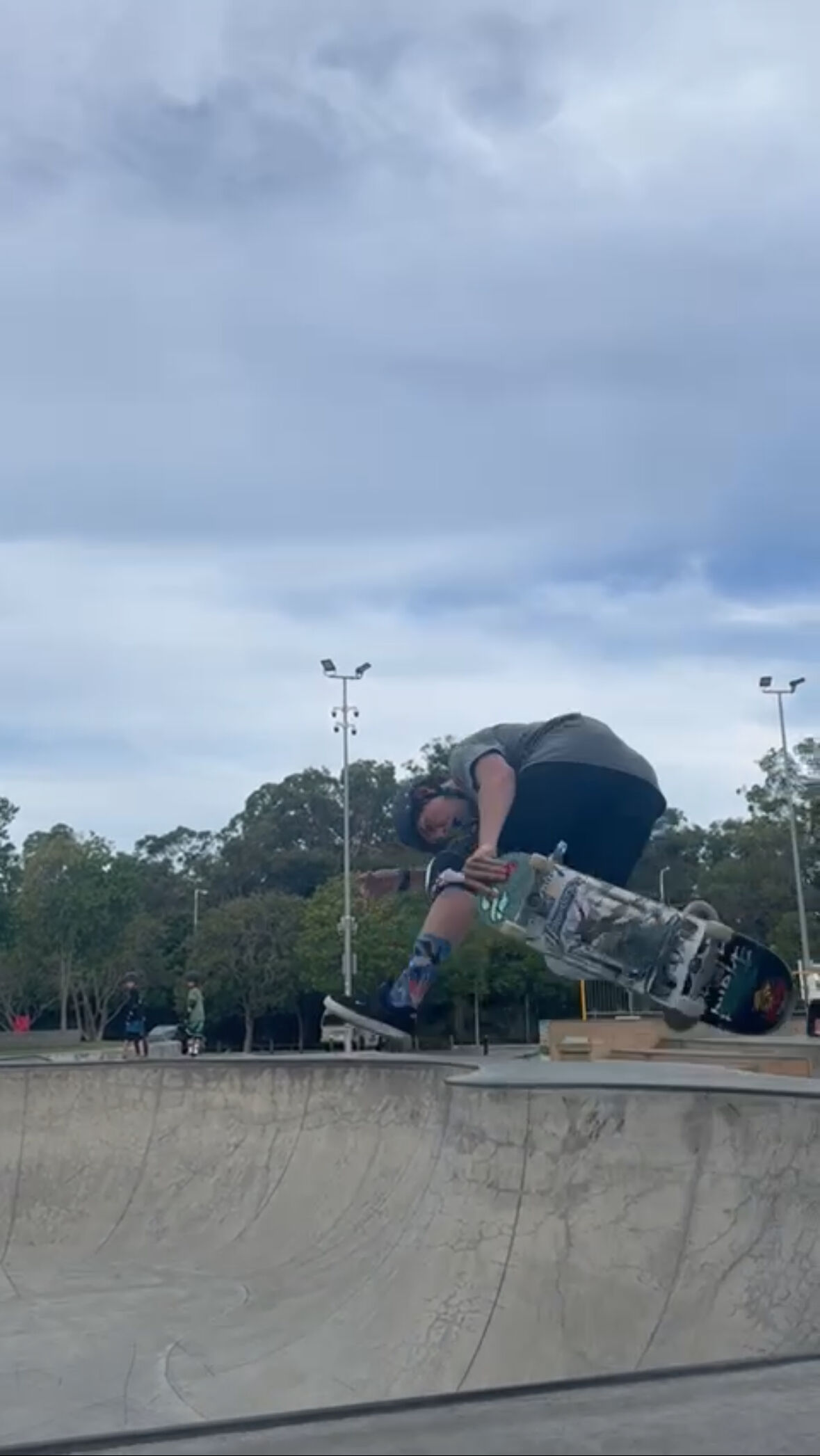
Caleb Brewer doing a backside judo air in the bowl at Pizzey (supplied by skater).
Everyday triumphs in skateboarding can also be understood through personal journeys, from overcoming injuries and taking breaks, to how older and more advanced skateboarders treat everyone at their local skatepark. The stories of Caleb Brewer, Sebastian Jordan and Joshua Weily, based on the Gold Coast, provide examples of how injuries can hold back even young and highly resilient skateboarders.
Brewer migrated from the US where he grew up in the heart of Californian skateboarding but now calls Queensland home. He states, “My favourite skatepark in Queensland right now is Pizzey. The bowl is super fun and easy to access. The community around the skatepark is lively, and everyone who skates there is motivated.” The environment is also one where everyone has plenty of role models and encouragement to progress. Brewer explains, “my favourite local Gold Coast skater who inspires me is Keegan Palmer because he’s from both San Diego and the Gold Coast. He’s been a role model for me most of my life, growing up in the same town and skating in the same parks.”
In 2019, however, he had his first of two serious accidents on a mountain bike that left him with a range of challenging injuries. On the first occasion, he was knocked out and had to have two rocks removed from his chin. He states, “I had to spend most of my summer homeschooling so I wouldn’t have to repeat, and I stepped on a skateboard while still only a few weeks out of the hospital.” Then, in the second accident in 2020, he had a fractured tibia and fibula just above the ankle, requiring surgery and having six screws and a plate in his right leg. Then, in 2022, he was struck by injuries again, but with a broken left leg while doing a flip from a trampoline in an adult gym. He describes how:
At this point, I had broken both my legs and had facial reconstructive surgery back-to-back to back. If I were landing skate tricks like that, it would be a good thing. But this one took more of a mental toll on me; the recovery time was longer, and my mental state was much worse. I spent more time at home, closing myself in my room to watch TV, play games, and sleep. At the same time, all my mates were surfing, skateboarding, and spending time together. It felt like the world was moving on without me, given that it would take 6 months to a year to recover.
Injuries can leave skateboarders without ways to positively burn their energy. The ‘down time’ to heal can be frustrating and place strains on skateboarders’ mental health. This is a side of skateboarding that is rarely discussed. Brewer still skateboards and does tricks but with more deliberation, discussing how, “there are days I don’t feel the same; when my legs hurt, it’s hard to motivate. But the local skateboarding and surfing communities…on the Gold Coast help me push to keep growing as a person inside and outside of sport.” His advice includes “for anyone trying to skate again after an injury, take it slow. There were plenty of times I made the mistake of getting back on a skateboard before I was ready, and I’ve come to regret it…listen to your body and take everything one step at a time.” Brewer is an example of how post-injury, you can still keep skateboarding and plan to do so for the long haul. He adds “my favorite thing about skateboarding is the feeling of finally landing a trick you have been battling with, and the community I have built around it. I don’t think I could live without skateboarding, even with all the battle scars that come with it.”
Sebastian Jordon is another young skateboarder at Pizzey who displays similar resilience and had to find inner mental toughness after a severe injury. He started skating at around 7 and has grown up enjoying Mackay and Pizzey as well as other Queensland skateparks. However in 2024, he explains that:
I was struck by a Ford Ranger dual cab with a trailer on, and it caused me to have two severe traumatic brain injuries, breaking both collarbones, my right shoulder blade, fracturing my skull, and a ligamentous injury to my spine. I was forced to relearn how to walk and talk again. I was in hospital for about 6 months and continued rehab at home for about 3 months, and then I had a support worker until December last year.
Despite the severity of his injuries, Jordan has worked hard to get back on his board. He describes how “when I’m skating, I feel like I can forget about my other stresses and burdens and I really enjoy hanging out with friends and learning new tricks with a healthy crowd.” In addition, he states, “Some advice I would give someone if they were coming back to skating after an injury would be to persevere through all setbacks, never give up and to always believe you can get through it.” For him, “Even though sometimes it’s especially risky with my injuries I refuse to quit skating as it brings me so much joy…Something I’m looking forward to with my skating journey at the moment would be learning 540s judo’s and a frontside stale fish."
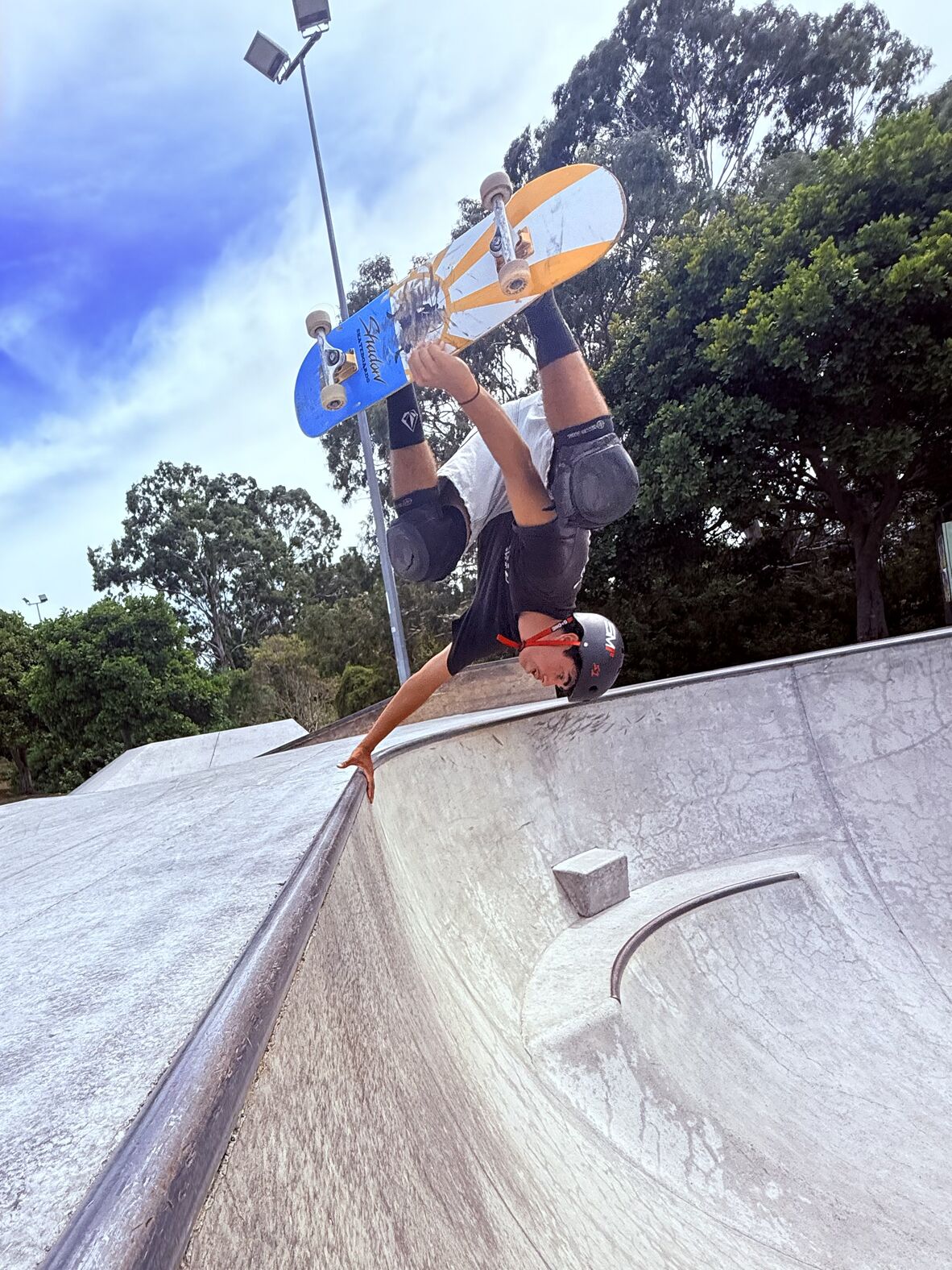
Sebastian Jordan, handplant at Pizzey. Photo supplied by skater.
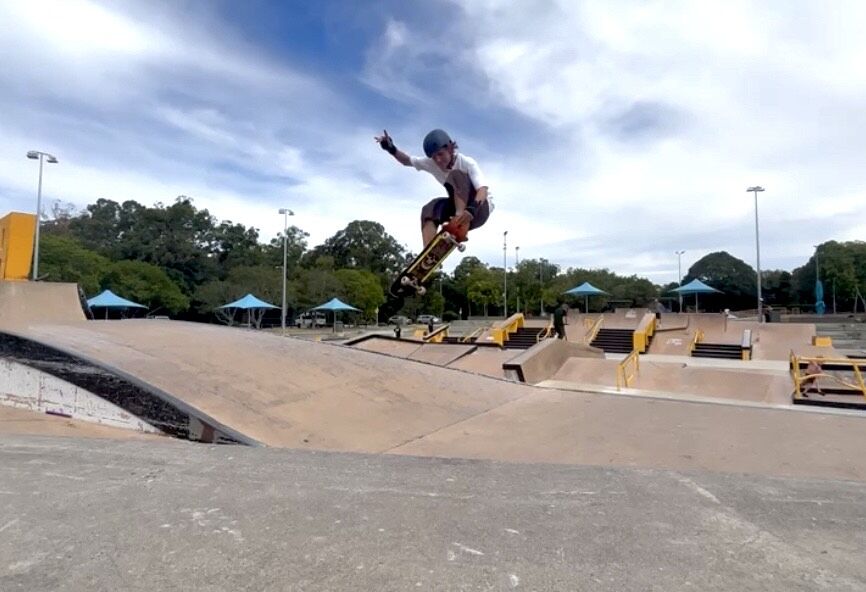
Joshua Weily skating Pizzey. Photo supplied by skater
Joshua Weily, also within the friendship group at Pizzey with Sebastian and Caleb, has been a skateboarder for ten years. He started when he was living in Hong Kong and growing up skating the streets of Sai Kung, a relatively small fishing village. His father raised him around skateboarding and shared stories of him skating in the 80s and meeting the Bones Brigade. Weily explains that his favourite skatepark is Pizzey and that his favourite tricks are tre flips and frontside airs, with his go to trick being boardslide rock n’ rolls. Also, no stranger to injury, he states: “I broke my wrist in two places and was forced to go into surgery to reconstruct my wrist. They ended up putting pins in my wrist. This forced me to do some online schooling, and I was off the board for 3 months doing rehab time on my own at home with doctor-advised movements. Getting back was difficult, as I was scared of having to go through the whole process again, but I invested in better gear and slowly started skating to my limits again. His advice to skateboarders coming back from injury is to “work slowly towards getting back into it and don’t push yourself at the beginning. Ease back in”. On why he keeps going, “I love how free I feel when I skate and the rush of landing a new trick, I also love the places it’s taken me and the people I’ve met”.
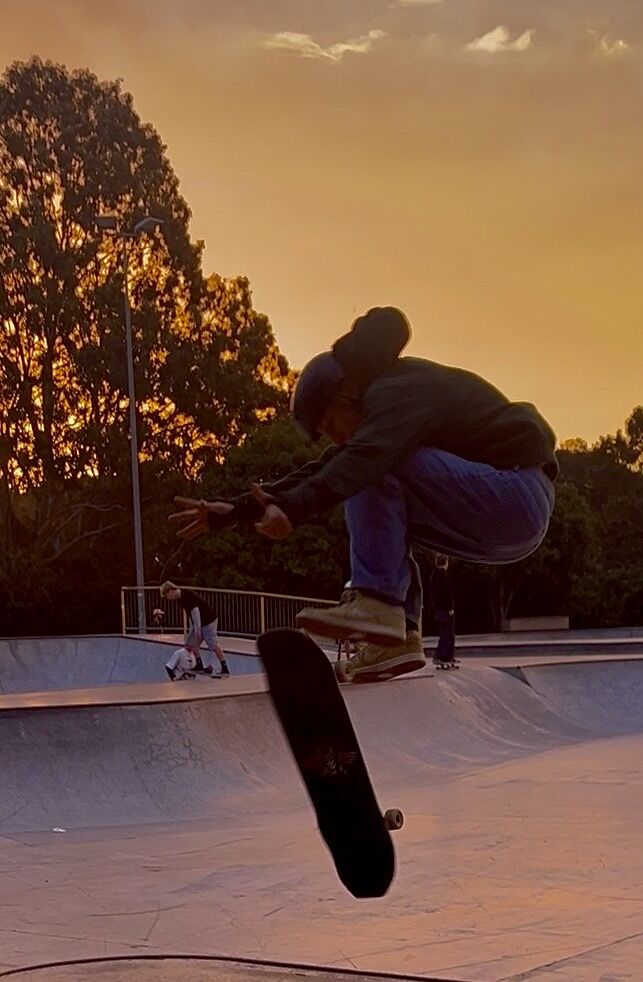
Joshua Weily skating Pizzey. Photo supplied by skater
The roles of ‘locals’ at skateparks in shaping the sense of identity and belonging of skateboarders are also an integral part of the culture and its positive social impact. Not everyone who is a local hero, icon, or well-liked identity has to be a professional skateboarder or competition skater. Sometimes it is friends, coaches, DIY builders, emerging artists, brand owners, program organisers, and people who just get involved and help out in their community.
On a visit to West End skatepark, regulars who keep the environment fun, creative, and inclusive include Jordan Baynie and his friend Damián Vásquez Villacrés. Baynie is involved with the Bloodbank DIY and spoke about how everyone has just volunteered and got in there to help with the build, supply concrete, and do the work together. Vásquez Villacrés, an artist originally from South America and now a Brisbane resident, discussed how sharing films and art exhibitions is also a way the community comes together to celebrate and appreciate one another.
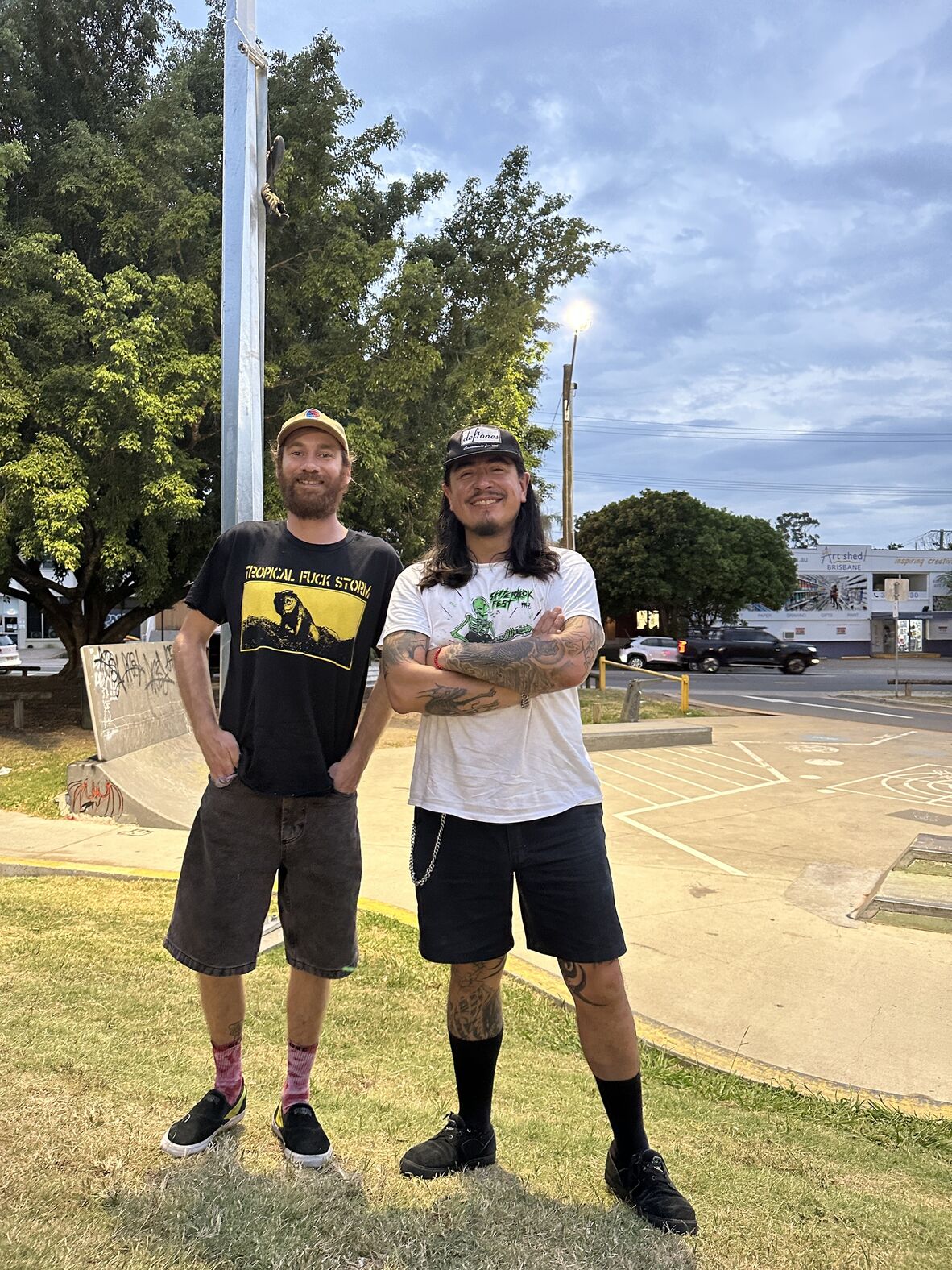
Jordan Baynie and Damián Vásquez Villacrés at West End skatepark. Photo by Dr Indigo Willing
Other West End locals Connie Leung, a volunteer with We Skate QLD, artist and skate coach and Jack Elmer, a skateboarder and founder of a DIY fashion brand using upcycled materials also embody the ways non-professional skateboarders are also a huge part of what makes Queensland skateboarding special. They explained in an interview together how important it is to welcome everyone to the skatepark and the life-long friendships that are fostered through regularly skateboarding together.
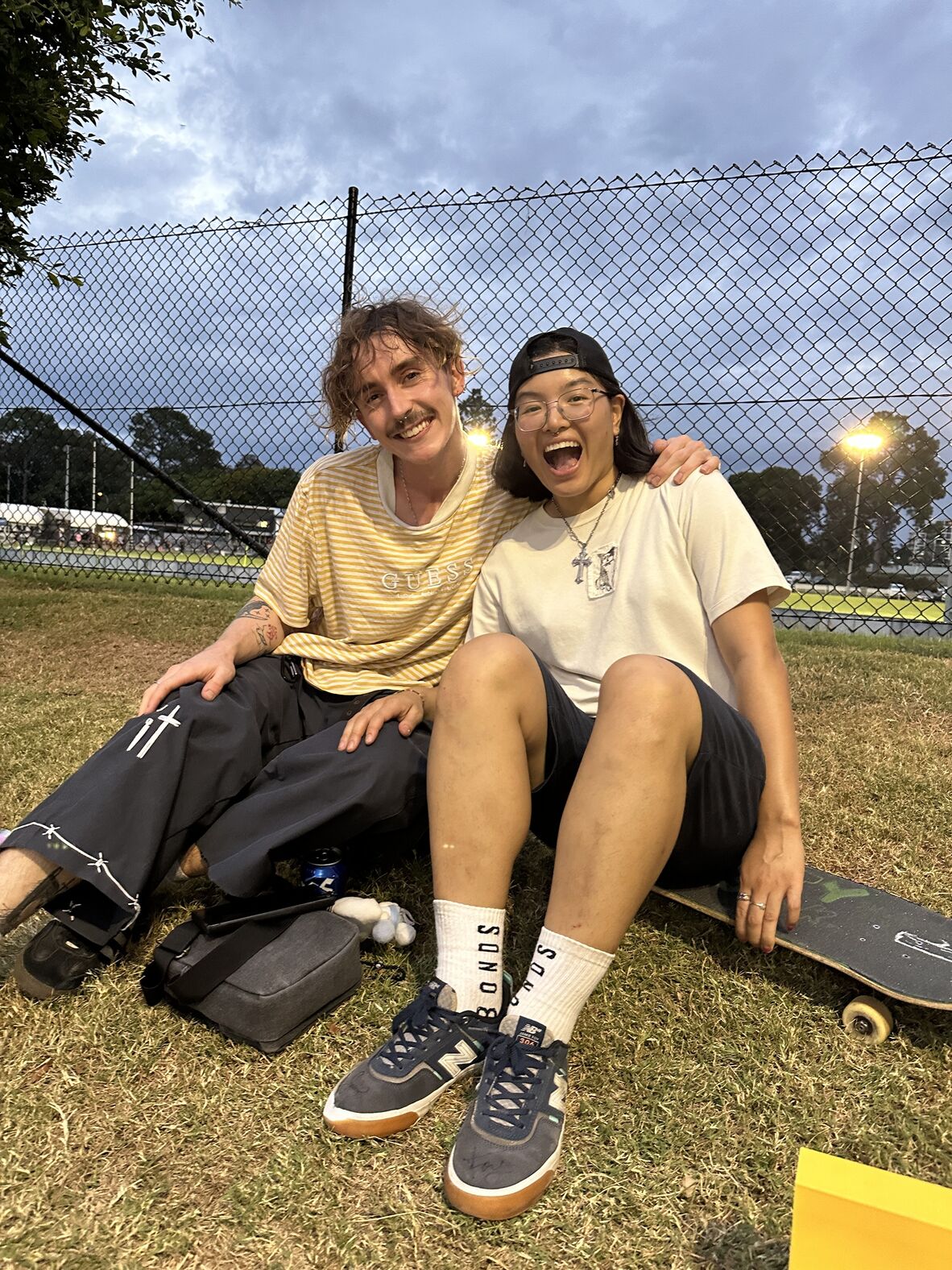
Jack Elmers and Connie Leung at West End skatepark. Photo by Dr Indigo Willing
At Paddington ‘Paddo’ skatepark, locals John Tonks and Robbie Cameron also describe how there is an A-list of Queensland skateboarders who thrive from local support, with many building up national profiles and some also having impressive international reputations. Tonks pointed out how local skaters in Paddo include well-known identities like Nixen Osborne but also the people behind the lens filming him like Ethan Miller and filmmakers like Zach Nolan. Cameron also describes how grass-roots competitions, such as the ones he runs at Dogshops for best trick clips also pushes everyone to keep progressing while celebrating where, and in their own style.
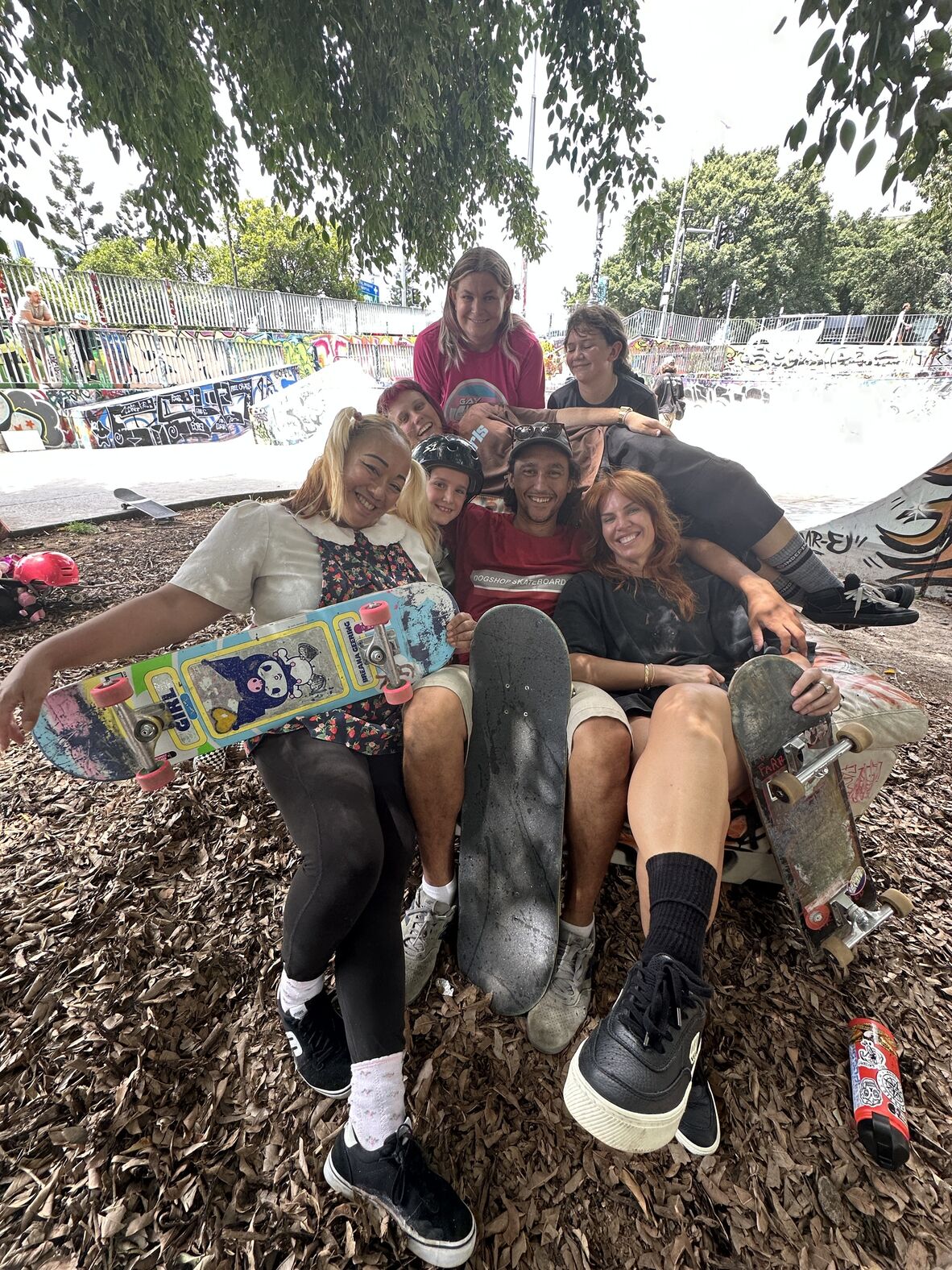
Robbie Cameron from Dogshop with team members Dr Indigo Willing, Evie Ryder and Miljana Miljevic from We Skate QLD and volunteer Dani with her family at Paddington skatepark. Photo by Dave Crane
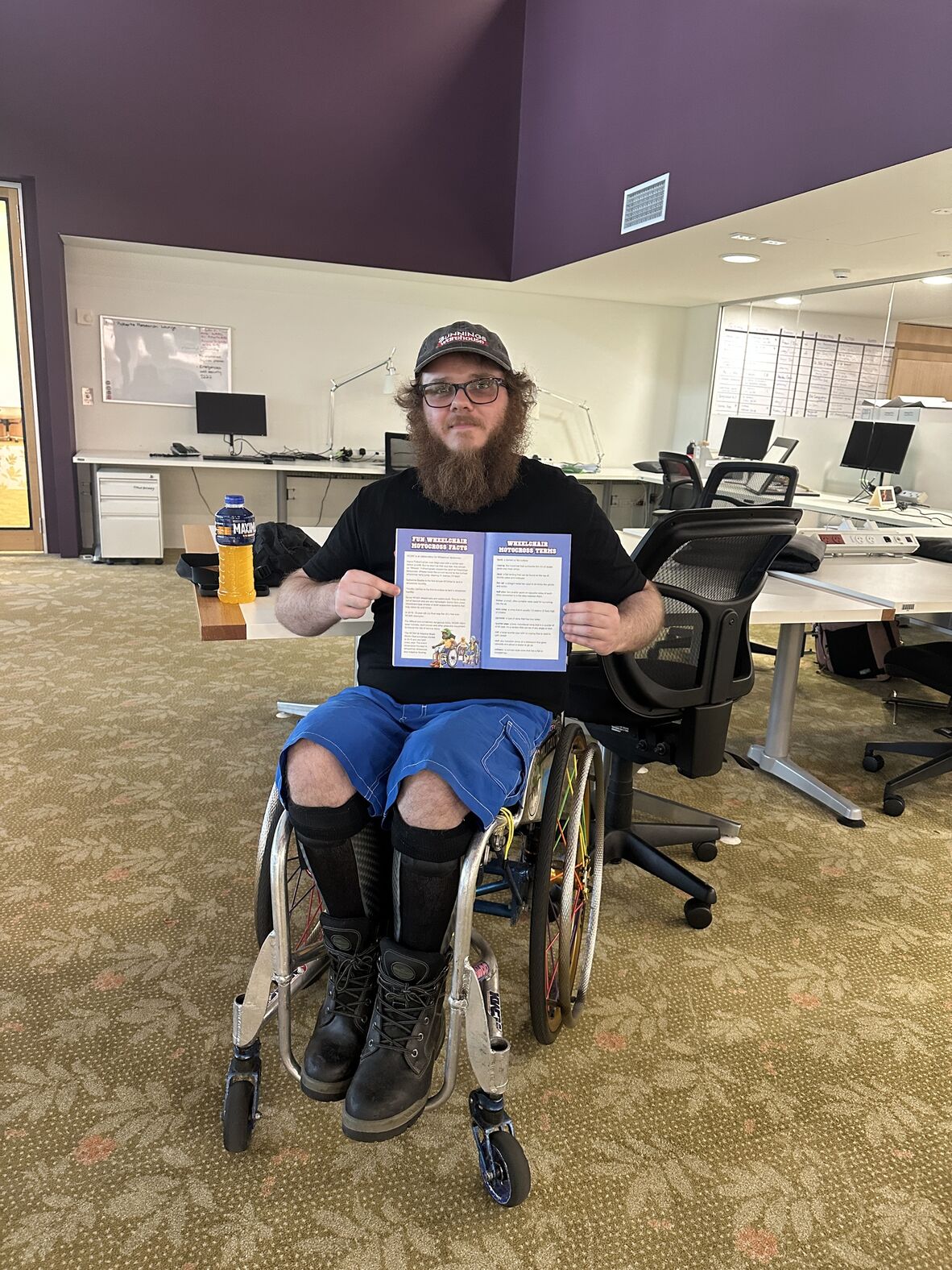
Timothy Lachlan with a graphic novel he features in, during a visit to the John Oxley Library, State Library of Queensland. Photo by Dr Indigo Willing
Timothy Lachlan, a professional wheelchair skater who founded WCMX and Adaptive Skate Australia on a visit to the John Oxley Library at State Library of Queensland discussed how everyday heroes are skateboarders who champion inclusion for those on the margins. He states, “Those who provide inspiration for me and who I look up to are the people who run We Skate QLD, and Gay Skate Brisbane. They are very community centered, bringing people together…It’s a very open, connected, chill environment. And that’s the sort of thing where I hope that culture can extend into skateboarding as a whole throughout Australia and the world.
When reflecting on initiatives he has been driving through his own organisation, Lachlan emphasises, “you know, working with disabilities, I want to make sure that I’m picking a park that’s got good amenities, so not just an accessible park, but somewhere that’s got toilets, water and shade. Because it’s not all about skating. It’s about sometimes just sitting down, having a yarn, but also making sure that beginners, in particular, know that they’re not expected to perform backflips or anything on the first day. It’s more about coming to the skatepark to just explore various terrain and movements and have fun.” Lachlan also adds “you know, if you want to learn how to do a wheelie, for example, we’ll work on wheelies. But it’s about just playing with movement and coming together and encouraging each other as mates. It’s about just getting out there and having fun with the wheels that you’ve got.”
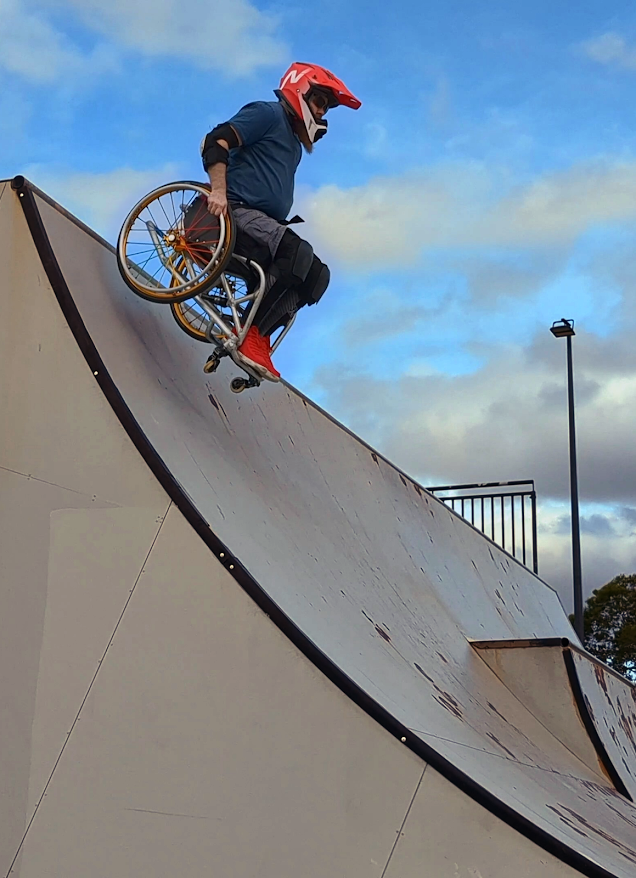
Timothy Lachlan dropping in ramp on WCMX wheelchair. Photo supplied by skater
This section presented a list of notable skateboarders in Queensland who have been professional and sponsored skaters to individuals at the parks and streets who have shaped their scene with their creative approaches, positive attitudes and efforts at community-building. As no list can ever be exhaustive, this project welcomes news and information about others known for their outstanding skating or contributions to the subculture in the Sunshine State. The next part of this project’s blog series explores non-traditional skateboarders who have pushed open the gate and welcomed a diverse range of people into skateboarding.
Dr Indigo Willing
2025 John Oxley Library Honorary Fellow
Read other blogs by Dr Indigo Willing (to be released weekly):
- Part 1 - The Early Subculture of Skateboarding in Queensland
- Part 2 - Queensland Skateboarding Zine-making Tradition
- Part 3 - Picture Us Rolling: Visual Storytellers in Queensland Skateboarding
- Part 4 - Good Company, Good Vibes: Queensland Skateboarding Businesses
- Part 6 - We Skate Too: Women, Non-Binary, Queer and Non-Traditional Skateboarders
- Part 7 - Queensland’s World-Class Competitive Skateboarders
To get involved in Skateboarding in Queensland, see We Skate QLD
Watch this video to explore Indigo's research project, and don’t miss the full video highlighting all the 2025 Queensland Memory Awards recipients and their inspiring projects.
Comments
Your email address will not be published.
We welcome relevant, respectful comments.