More to a photo: a glimpse into frontier violence
By Lucy Deemal, 2026 John Oxley Library Fellow | 27 August 2026
This blog was written by 2026 John Oxley Library Fellow, Lucy Deemal as part of her fellowship project, Two Stories, One Place: Aboriginal and Settler Memory in North Queensland.
I came across Jack’s albums while searching for photos of young North Queensland. Examining photographs from the people who came to be in possession of a camera in colonial era can be a confronting exercise for any First Nations person. The Queensland Government, pre-Federation, was a standalone colony of Britain. In the north, this region was catapulted into development aided by gold and mineral finds and legislation that allowed for district land to be claimed. Those in want of a parcel need only apply for it.
For First Nations people, the land they cared for and lived from for thousands of years was changing around them. Food, water and shelter sources had been taken away and many interactions with the new settlers or their belongings were met with rifles and that continued for many, many years.
Colonial settlement onto Bama country in Far North Queensland, began with the Palmer River gold rush in 1873 and changed history for our people forever. While it is difficult to truly imagine any period of history, advances in photography technology meant that a once hefty and expensive undertaking was now accessible. By the late-1800s, photos could be taken on the frontier. State Library of Queensland houses many of early Queensland’s photograph collections in the John Oxley Library.
One of those collections belonged to John Henry Paul Berthon, better known as Jack Berthon. Jack was a Welsh engineer, and after arriving in Australia in 1885 found himself working with Willoughby Hannam, Chief Engineer of the North. Jack was part of the team who worked on the Cairns to Herberton Railway, work that later took him further north to Cooktown.
But Jack wasn’t just an engineer – he was an artist, a performer, a director and later a businessman. His albums give insights into what life for a social bachelor in Cairns and Cooktown in the mid-to-late 1880s was really like. From what I can tell, Jack had a sense of humour, but his albums also reflect the attitudes and actions against First Nations people at the time – ones that still, today, we don’t often discuss.
Following Jack’s albums, he presents photos from a camp that show the bush tents moving with the camp as the railway line extended.
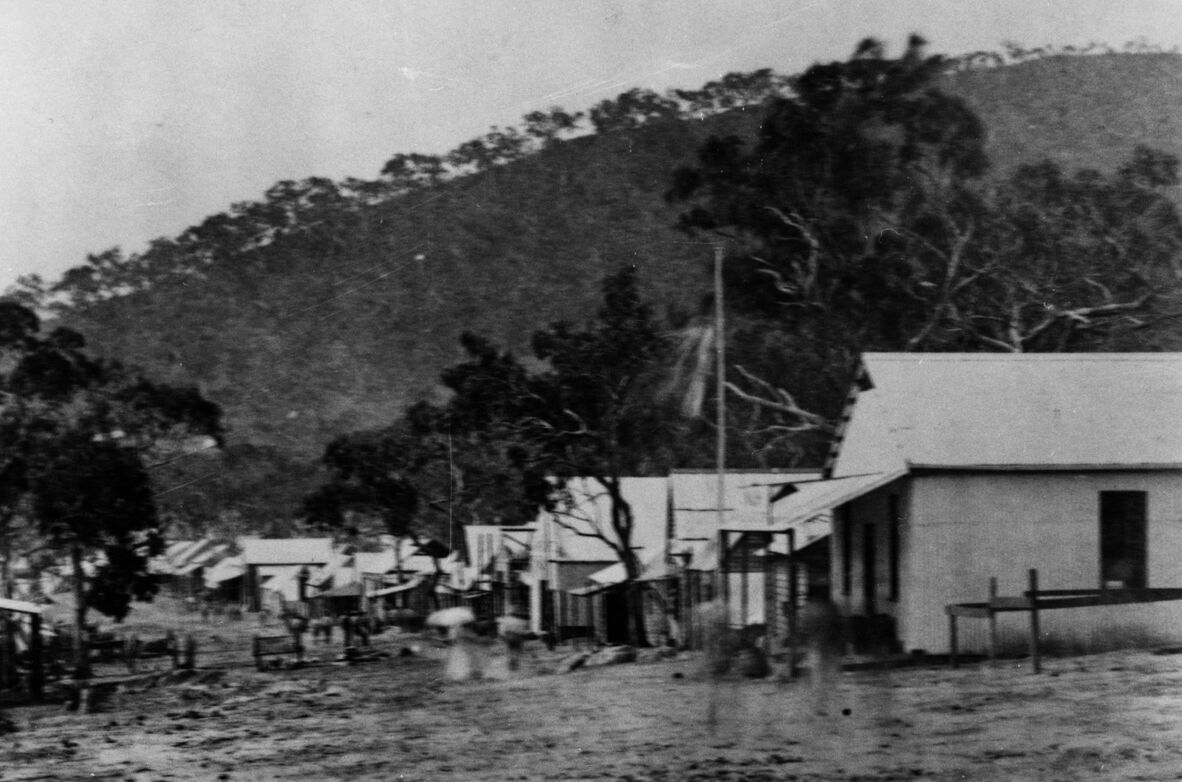
Charlotte Street, Cooktown, 1874. photographer unknown. John Oxley Library. State Library of Queensland. Negative number: 13531
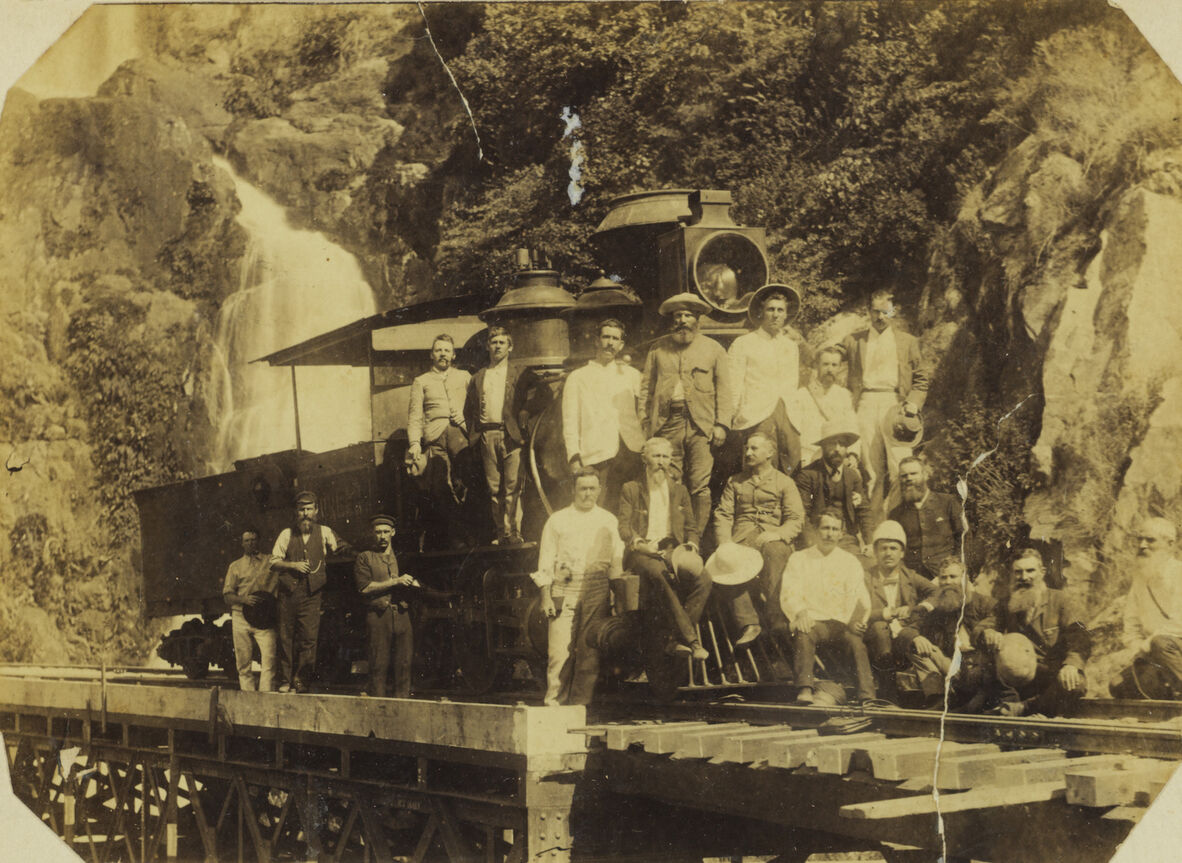
Group of men posing on a steam engine while testing the Stoney Creek Bridge of the Cairns railway in the 1880s. 29440, John Henry Paul Berthon Photograph Albums and Sketchbook. John Oxley Library. State Library of Queensland. Image number: 29440-0002-0010
Marred by misfortune, illness and tough conditions, this part of the railway line took workers 5 years to buld.
Jack offers glimpses into camp life, and what North Queensland looked like to those building it. "Cook's Town" on the banks of the Wallumbaal Birri, renamed the Endeavour River in 1770 by Lieutenant James Cook, would become the port for the new goldfield. Several tracks to the Palmer were tried but it was the Palmer Road (now Endeavour Valley Road) from Cooktown across rugged open cut ranges that became the main thoroughfare.
With 30,000 people making their way through Cooktown to the Palmer River, the region was booming. By 1879, it was determined a railway from Cooktown to Maytown on the Palmer River Goldfields was needed, and plans were drawn up.
The first section was completed in 1885 and Jack’s work as a Railway engineer brought him to Cooktown around the time that Section Two was being constructed. This part of the line continued west from Palmer Road through rugged hillside, through an area now part of Rinyirru National Park.
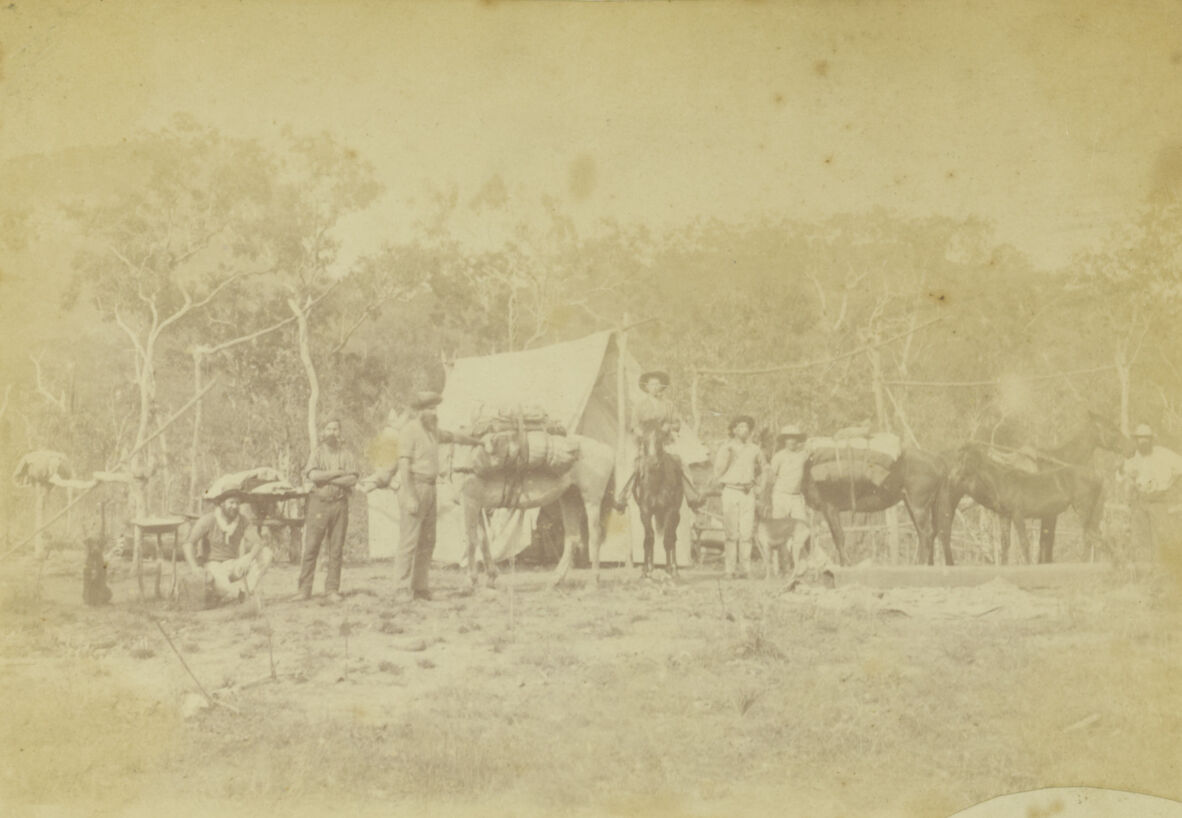
Group of surveyors shifting their camp around the Cooktown railway in 1887. 29440, John Henry Paul Berthon Photograph Albums and Sketchbook. John Oxley Library, State Library of Queensland. Image number: 29440-0002-0043
Learn more about the Cooktown Railway in our collections.
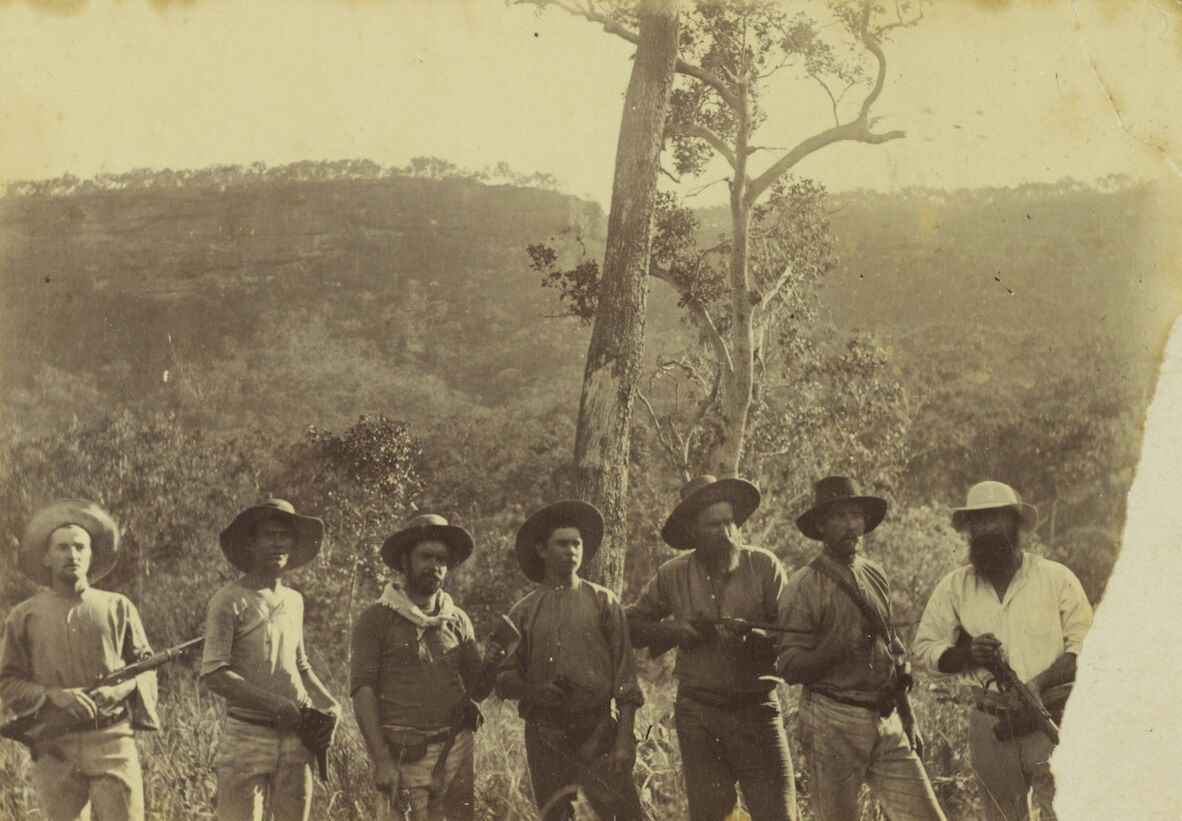
Employees of the Government Railway Camp on the Cooktown railway in 1886. 29440, John Henry Paul Berthon Photograph Albums and Sketchbook. John Oxley Library, State Library of Queensland. Image number: 29440-0002-0125.
John Henry Paul "Jack" Berthon stands on the far left.
This is a portrait. Posed. And there is Jack on the left. All of these men are armed. Protecting themselves and camp…. From whom? Taking a closer look at the album in full, the caption reads "Traces of blacks near camp. Our defence force".
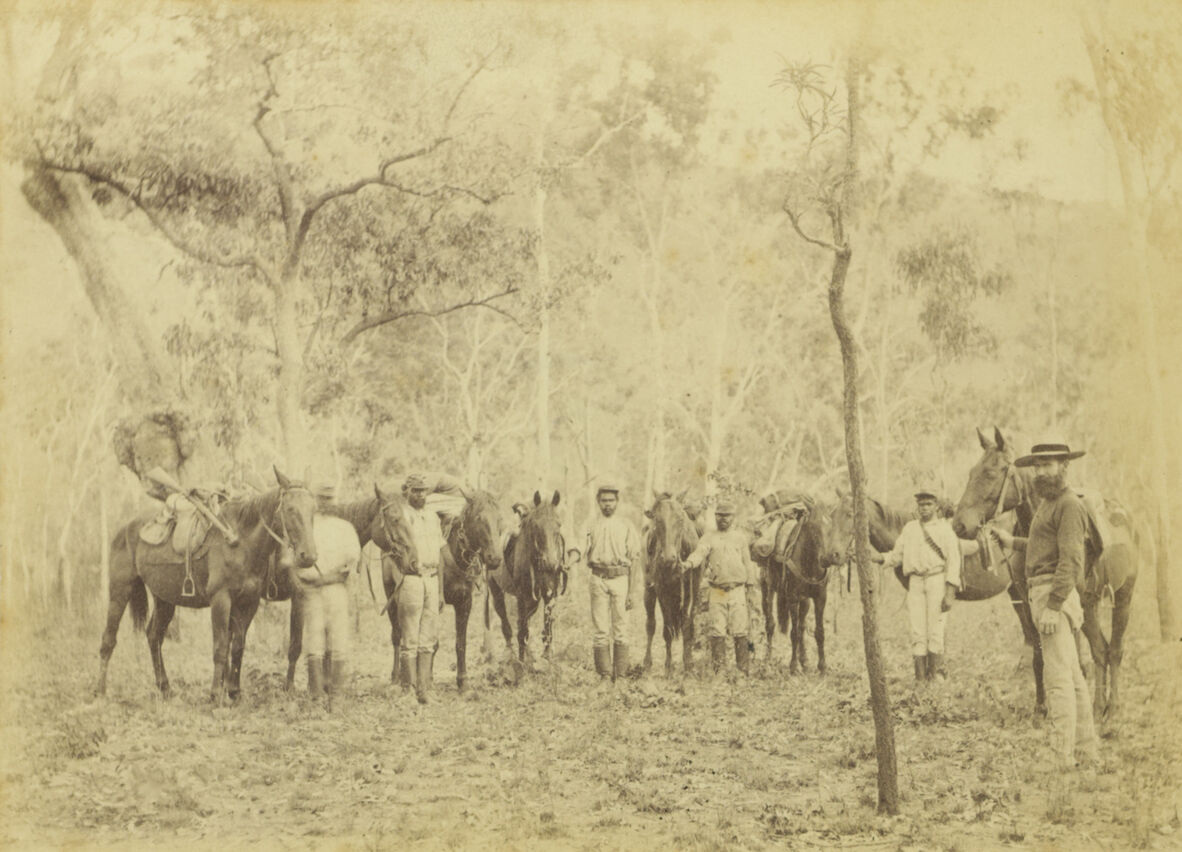
Black troopers of North Queensland visiting Berthon's Camp, with Jocelyn Brooks in command. 29440, John Henry Paul Berthon Photograph Albums and Sketchbook. John Oxley Library, State Library of Queensland. Image number: 29440-0002-0101.
Read more about the Queensland Native Mounted Police in State Library's catalogue.
Continuing through the collection – we see that a call for reinforcements appears to have been heard. Protection for settlers in Far North Queensland came in the form of a dangerous, paramilitary force, the Queensland Native Mounted Police (NMP). The NMP were under the employ of the Queensland Police, a group of ‘troopers’ who were coerced into the force and led by a white officer. These officers led expeditions to disperse First Nations people troopers were armed and uniformed. NMP Camps were established across the region and moved with the frontier.
Jack’s photographs show us a visit from the NMP troopers with their Officer Jocelyn Brooke. Brooke was an NMP Officer in the Cook region from 1881 to 1888, most of the time with responsibility for the East Normanby NMP, the one closest to Section 2 of the Cooktown to Laura Railway line.
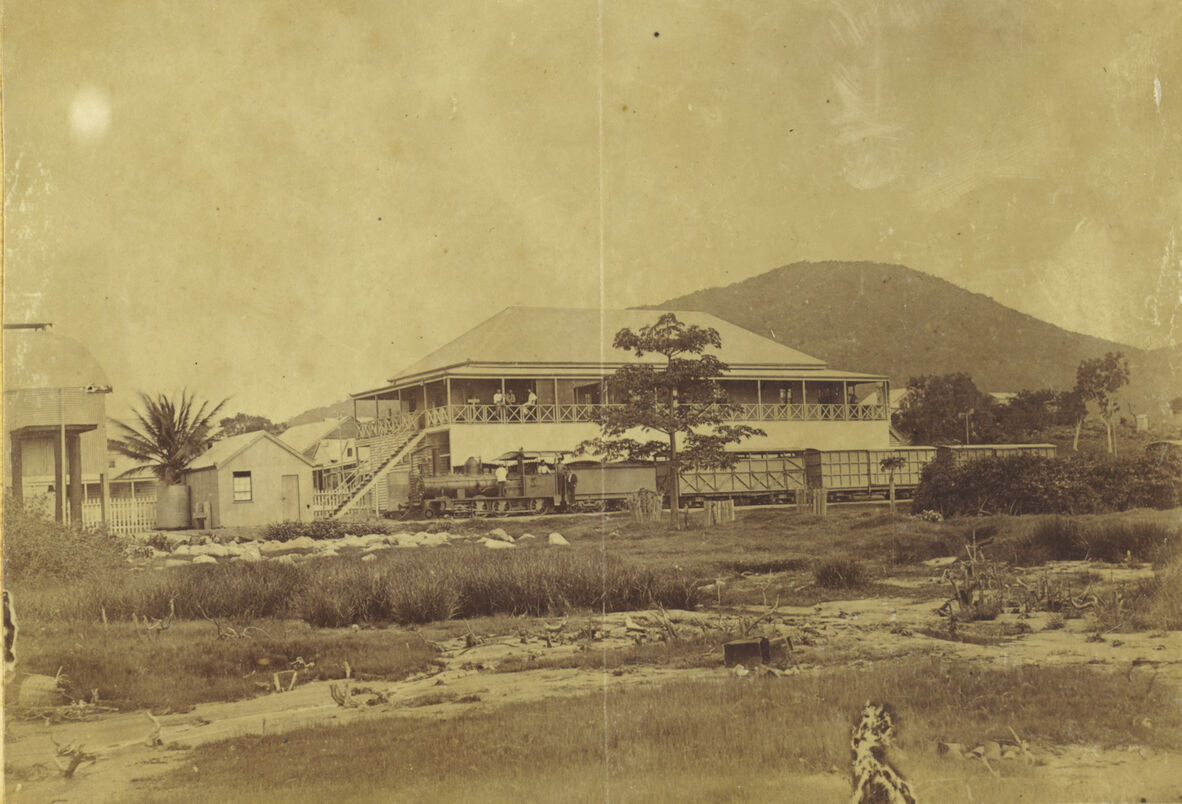
Cooktown Railway Station, ca.1887. 29440, John Henry Paul Berthon Photograph Albums and Sketchbook. John Oxley Library, State Library of Queensland. Image number: 29440-0001-0028
Individually these photos capture moments in Jack’s life, but together they reveal something more about North Queensland undergoing rapid colonial expansion. One where settlers, police and First Nations people occupied the same landscape, but with very, very different historical narratives.
Libraries aren’t just for books. They hold Queensland’s memories. A caption, a note or photograph can change how we understand our history.
Lucy Deemal, 2026 John Oxley Library Fellow
The John Oxley Library Fellowship is proudly supported by the Queensland Library Foundation's President’s Circle patrons
Sources:
- Berthon, John Henry Paul. John Henry Paul Berthon Photograph Albums and Sketchbook 1885-1898
- Frontier Conflict and the Native Mounted Police in Queensland. Database. Access: https://database.frontierconflict.org/home
- Cooktown and District Historical Society
Other State Library blog posts:
Comments
Your email address will not be published.
We welcome relevant, respectful comments.