Architect Aaron Peters: imagining a city in State Library’s great rooms
By Janine Lucas | 26 November 2026
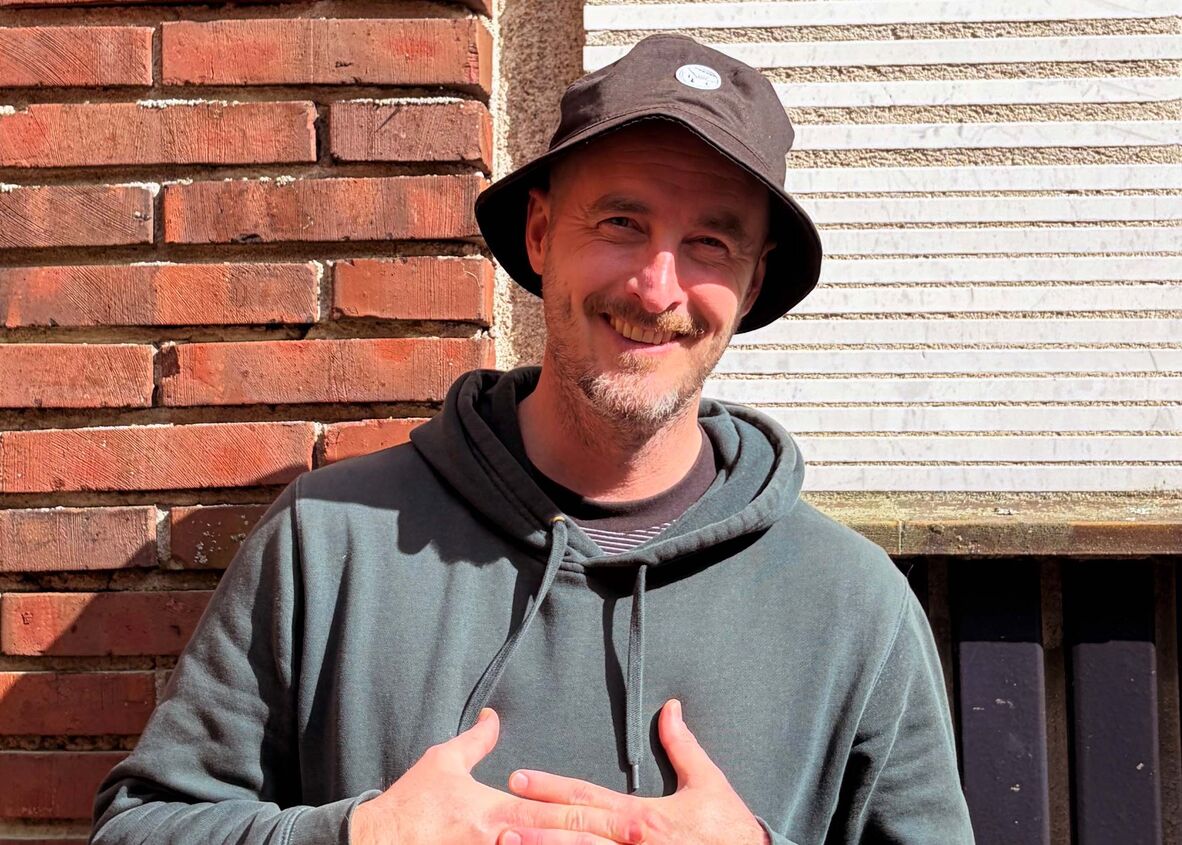
Architect Aaron Peters: 'Understanding the city requires studying its historical form to understand what’s been lost and what might be recovered.' Photo supplied.
Aaron Peters has admired the grand civic spaces of State Library of Queensland from several perspectives over the years: student, architect, writer and dreamer.
Its spaces and collections are a favourite source of inspiration for the Redcliffe-born architect, who still approaches the world with the curiosity of the boy who grew up on the Sunshine Coast building forts and tree houses with salvaged materials dragged from behind the garage.
Aaron moved to Brisbane in 2000 to study architecture – or would have studied it, had he filled out the university application forms correctly: 'Instead, I ended up in a landscape architecture course, then ran out of money and dropped out, spending a year selling pens and delivering paper to qualify for government assistance. Eventually I managed to transfer into architecture and never looked back.'
With Stuart Vokes, Aaron is a partner in Vokes and Peters, an award-winning practice that is known for residential projects and has delivered everything from vet clinics and hospitals to a neighbourhood centre and a library.
'I’m primarily drawn to State Library for its spaces and the atmosphere,' Aaron says. 'We talk a lot about great rooms and how each city has only a few. In Brisbane, several of those great rooms are in one building, State Library.'
This month marks the 20th anniversary of the Millennium Library Project, which transformed the Robin Gibson-designed 1988 building into the vibrant cultural hub we know today. Aaron talks about what he loves about State Library, its architecture and collections:
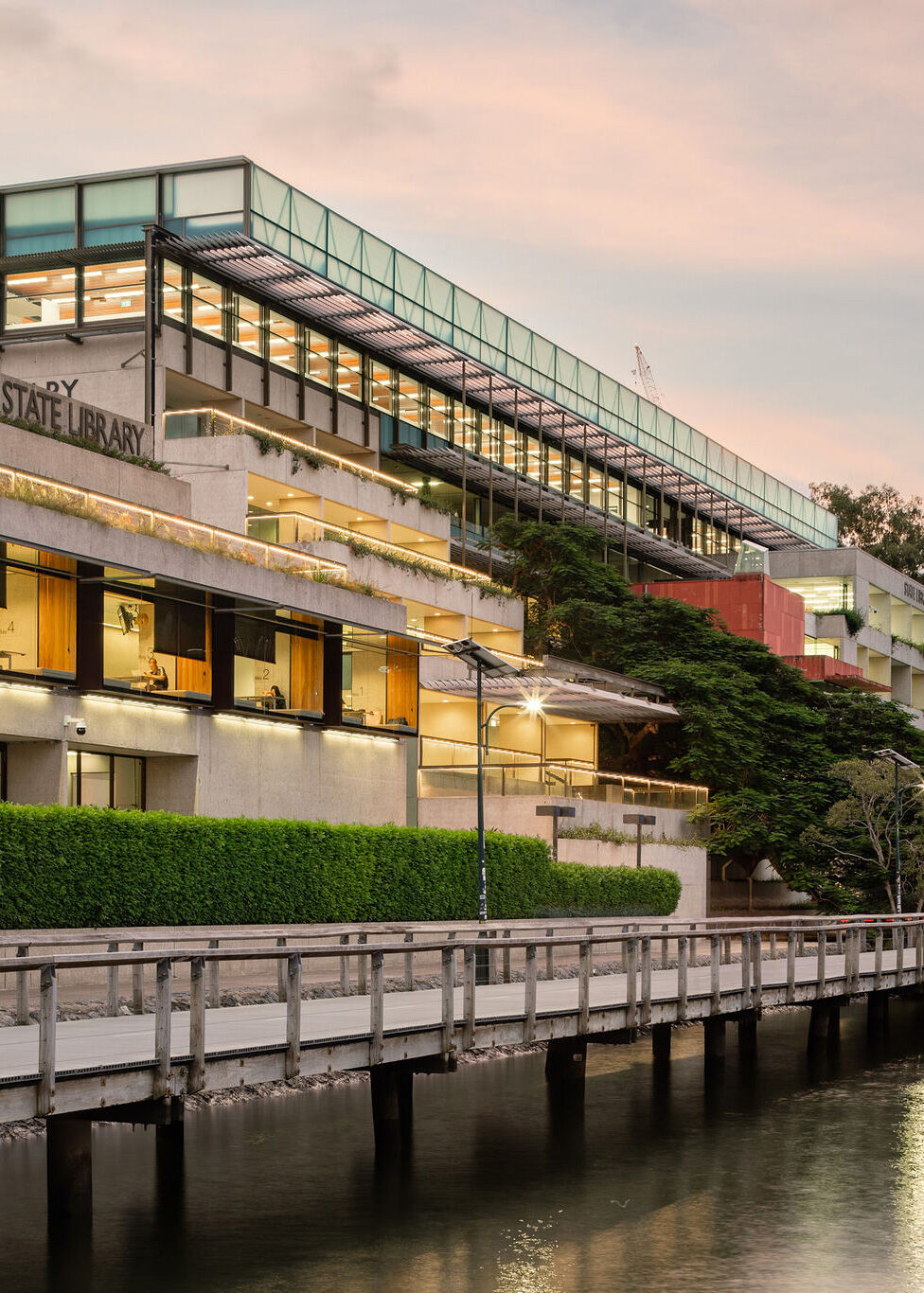
State Library of Queensland sits in the heart of Queensland Cultural Centre. Photo by Joe Ruckli.
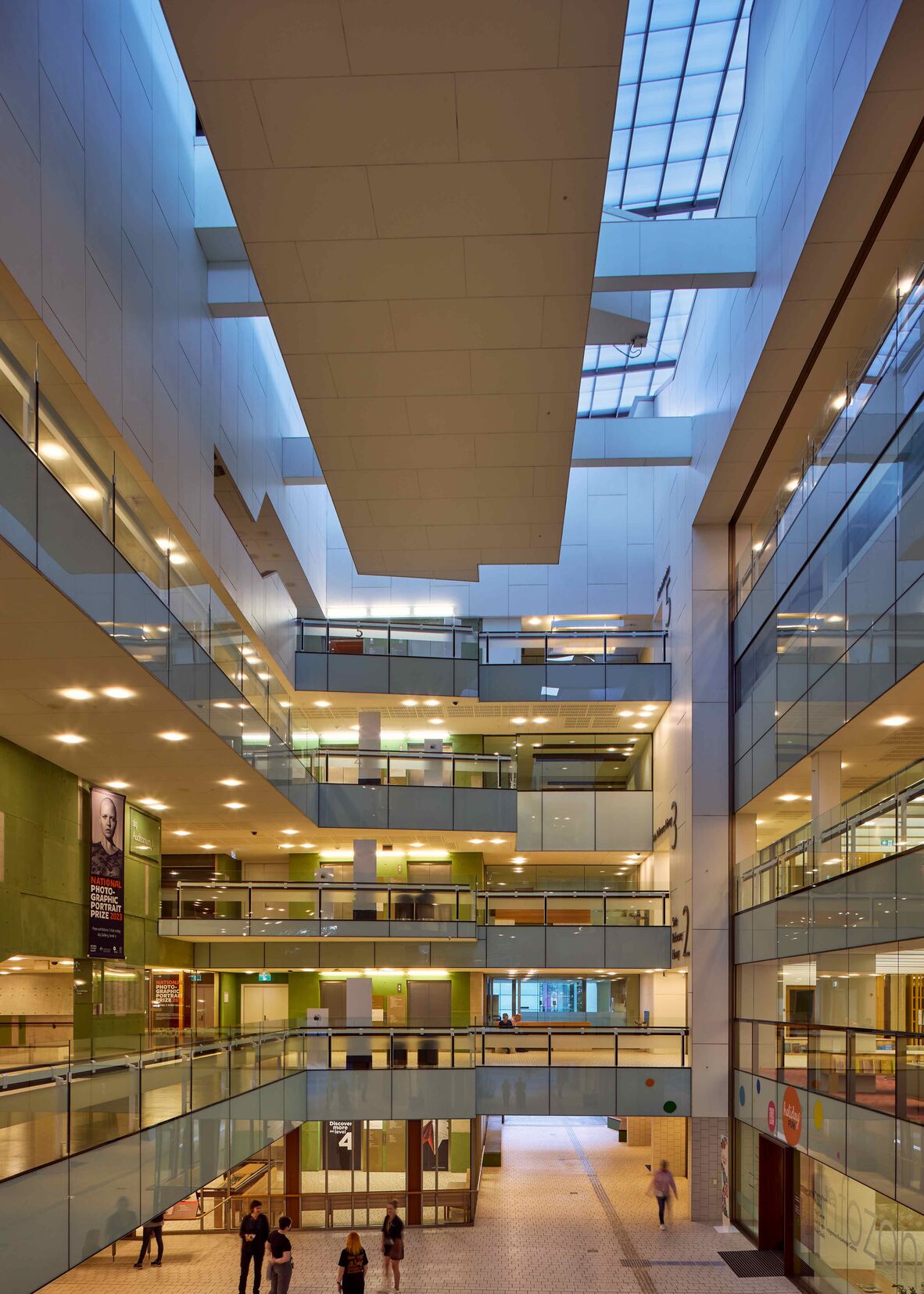
State Library of Queensland, viewed from the Knowledge Walk. Photo by Joe Ruckli.
'I should have been horrified ...'
'My mum was a teacher librarian who encouraged a love of reading. It’s probably why I also adore libraries. I remember visiting the previous incarnation of State Library on class excursions in high school, and it was one of my favourite places in the city. I liked that it was quiet and hard to find, but with a panoramic window onto the river and CBD. There was something about that contrast, the juxtaposition of an intimate world of ideas, looking out onto the towering skyline and streaming cars on the expressway that felt expansive in both dimensions.
'I should have been horrified when they announced the redevelopment, but the "new" State Library remains one of my favourite places in Brisbane. Donovan Hill’s design has opened the building up literally and figuratively. One of the most common criticisms of the redeveloped building was that it felt ‘domestic’. I think that’s precisely why it’s an outstanding piece of public architecture; there’s a space to accommodate every scale of civic life.'
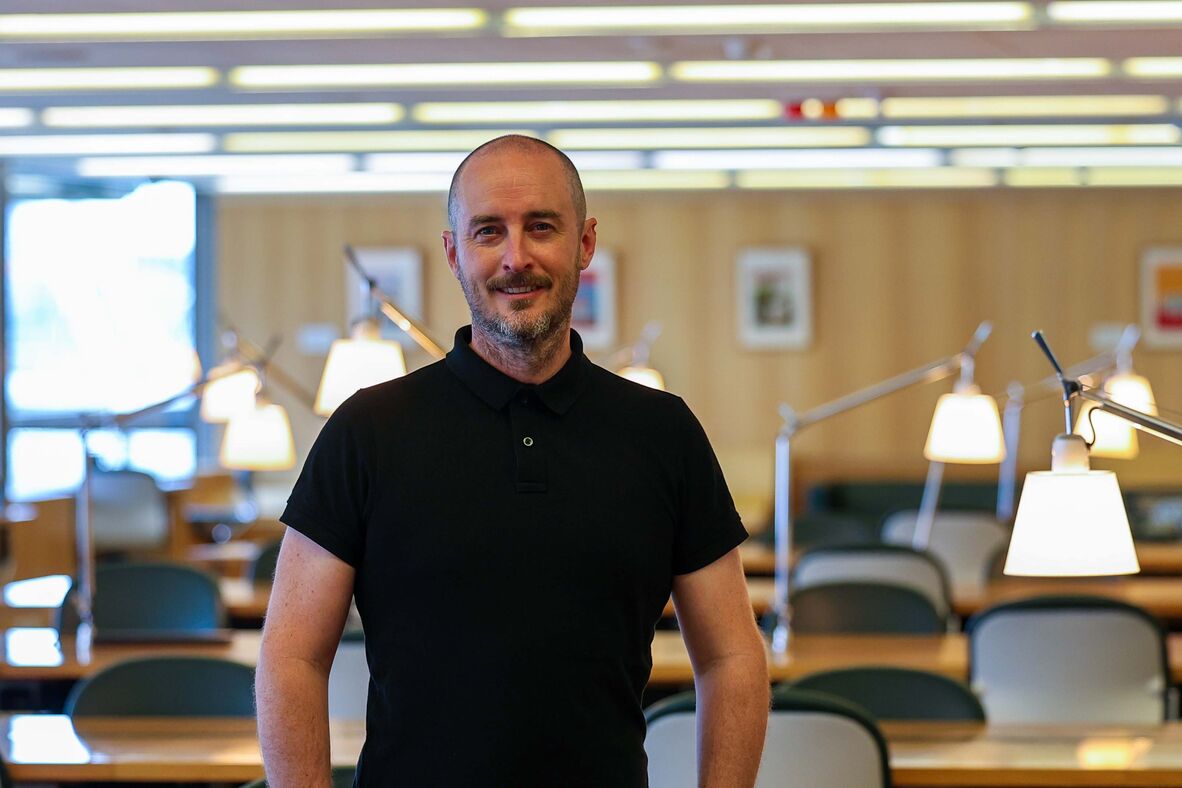
Architect Aaron Peters in the John Oxley Library Reading Room at State Library of Queensland.
Garret life at the library
'As much as I enjoy the beautiful terrace, atrium and all the other spaces in the building, I still hanker for a garret overlooking life, and the John Oxley Library, tucked away in the top corner, is the best room in the building for sinking into your work.'
'When I have a quiet task, like completing the book of essays we published a few years ago, or working on my PhD, finding a suitable place to work is part of the payoff. I think the thought of spending more time at State Library helped convince me to embark on those projects.
'In the past few years, I’ve developed a routine: walking along the river from my house, pondering what I might write about that day, then a few minutes watching people move through the atrium before moving to one of the small study alcoves on level 4 until the John Oxley opens its doors. When I need a break, I stare at the city for a while. That seems to draw my navel-gazing back out into the world, situating my thoughts in something bigger than myself.'
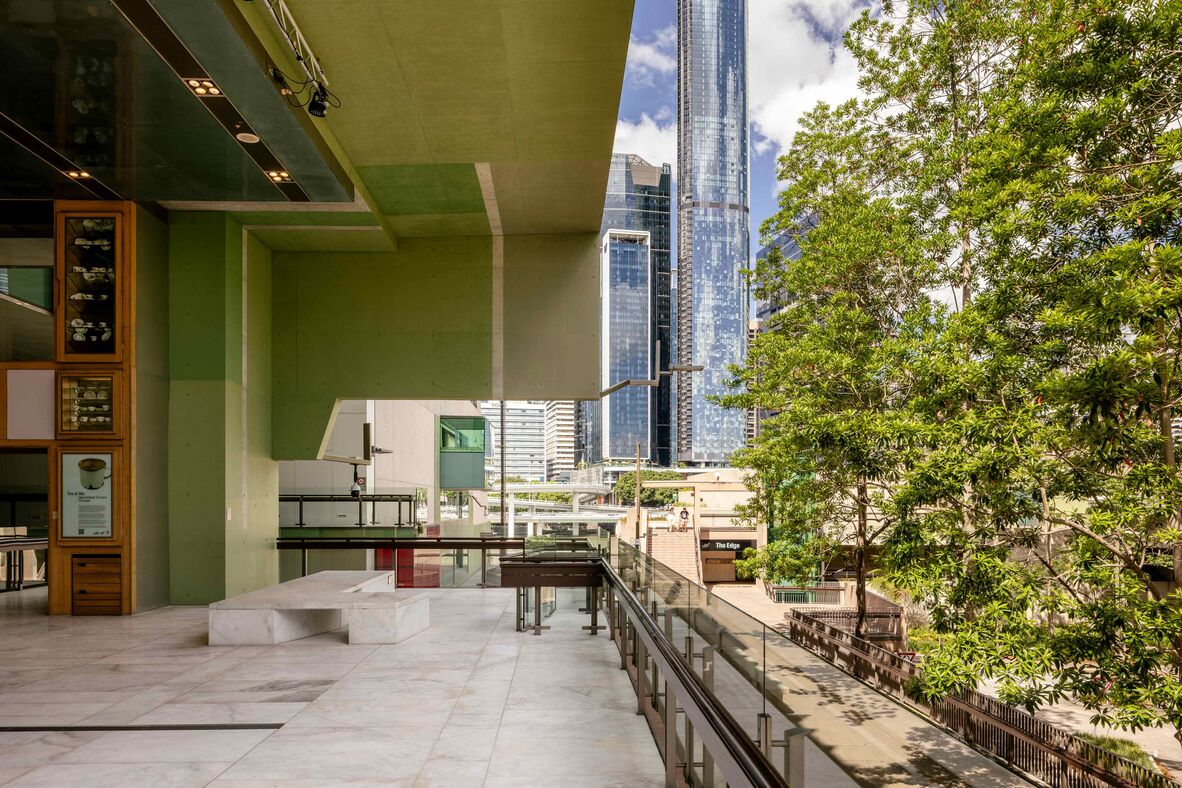
The Queensland Terrace, State Library of Queensland. 'We talk a lot about great rooms and how each city has only a few. In Brisbane, several of those great rooms are in one building, State Library,' Aaron says. Photo by Joe Ruckli.
What came before
‘I’ve been a student browser, just hanging around the book stacks, gravitating towards a particular topic and pulling books off the shelf, almost at random. After the redevelopment, the Asia Pacific Design Library was a great resource, particularly when I would discover local design content, which is relatively scarce in Brisbane, like the end-of-year catalogues produced by the School of Architecture at UQ. You’d find your old lecturers pictured in their first year, wearing a silly hat, or something like that.
‘I like the sense of continuity that comes from that, being reminded of where you fit in, and of what came before. More recently, I’ve been sending my students there, both for the collections and for the building.’
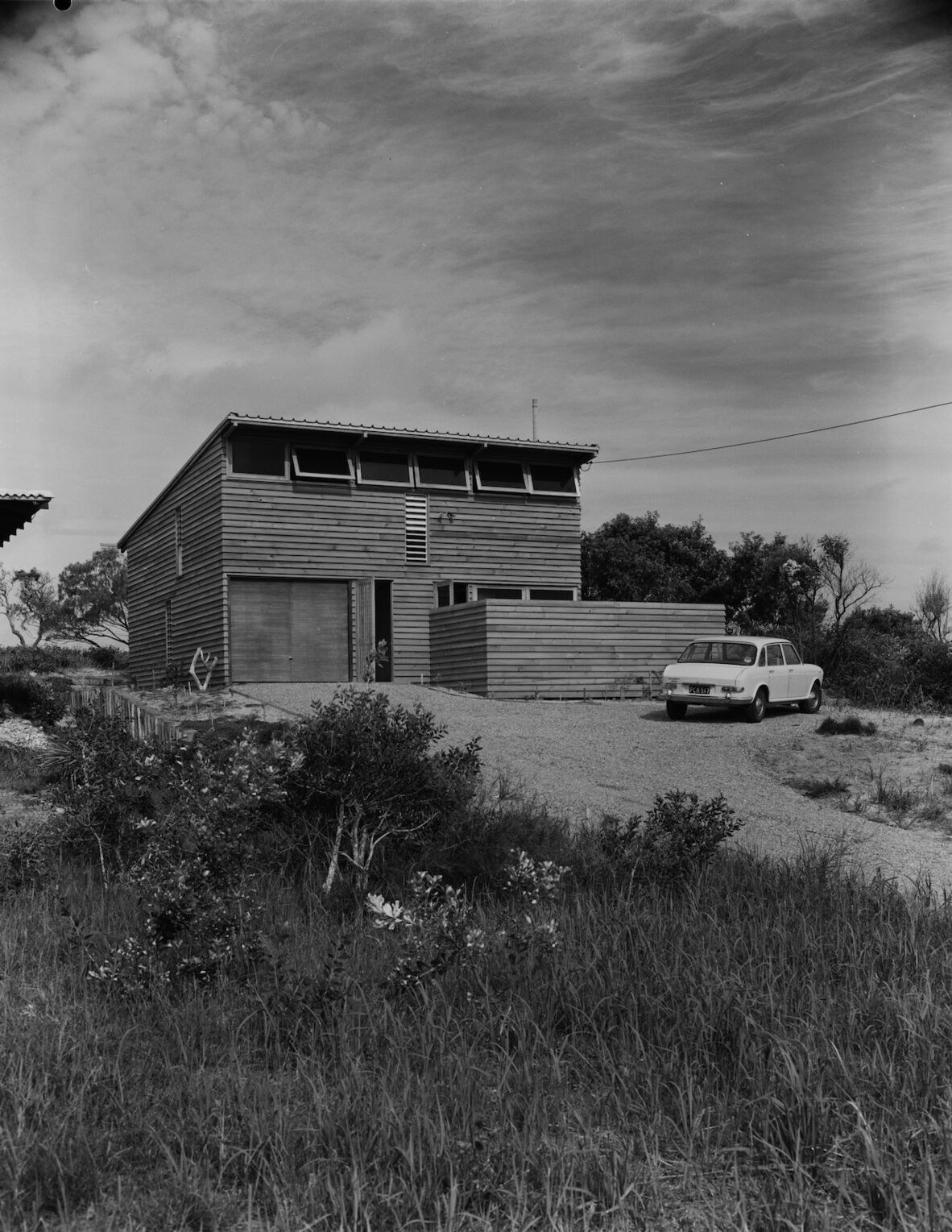
Wilson residence, Dicky Beach, Caloundra, 1970, Richard Stringer, John Oxley Library, State Library of Queensland. Image 1350-06.
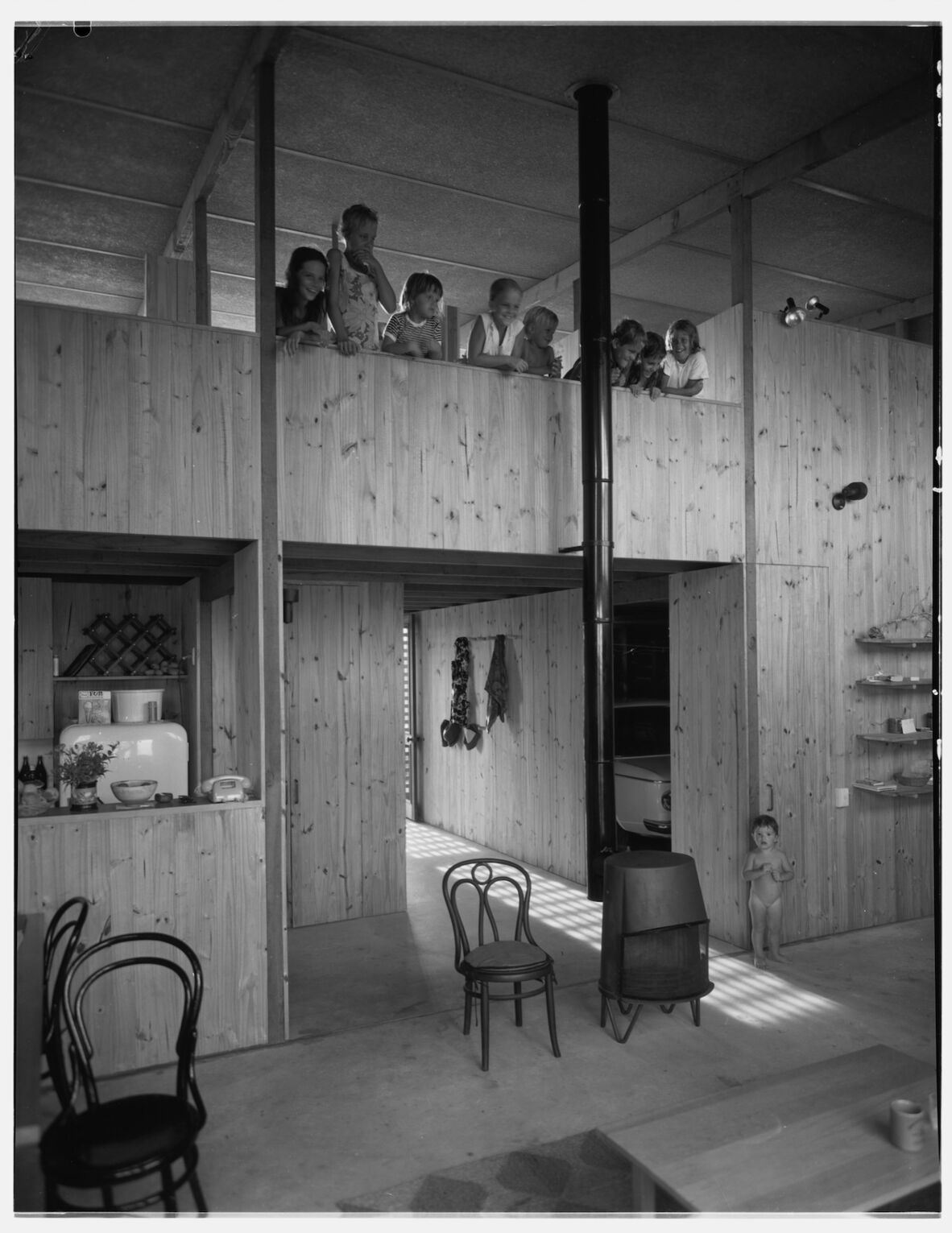
Wilson residence, Dicky Beach Caloundra, 1970, Richard Stringer, John Oxley Library, State Library of Queensland. Image 1350-03.
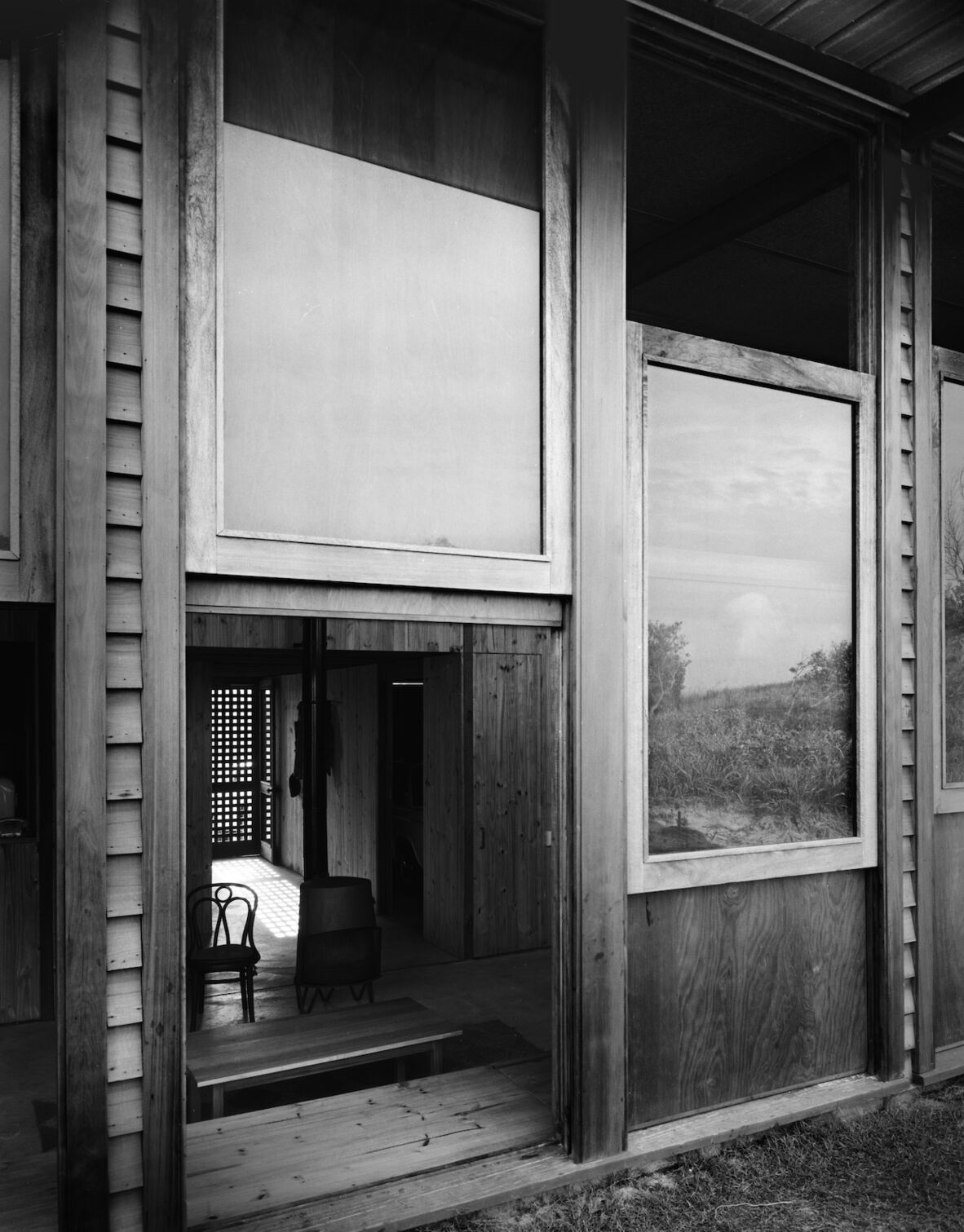
Wilson residence, Dicky Beach Caloundra, 1970, Richard Stringer, John Oxley Library, State Library of Queensland. Image 1350-002.
Architecture collections: seeing things anew
'I particularly enjoy and use Brisbane's historic photography in the library collections. Understanding the city requires studying its historical form to understand what’s been lost and what might be recovered. Richard Stringer’s archive is a brilliant example of this. It catalogues relatively recent history, but with the rate of urban change, many of the buildings and landscapes he recorded have been lost.'
'Richard trained as an architect and photographed the work of prominent local practices, including one of my favourite houses, John Railton’s Wilson Residence at Dicky Beach (a building I wrote about in our essay collection, Migrations from Memory), but I find his records of industrial landscapes, ruinous buildings, now familiar landmarks under construction (or newly completed), and vernacular timber structures equally beguiling.
'The black and white images often emphasise surface texture and the harsh relief you get in the Queensland sun. They also have a wonderful capacity to render things anew, like you’re seeing them for the first time. That’s important for my creative practice, seeing things anew. It jolts me out of complacency and reminds me why Brisbane is a special place worth celebrating.'
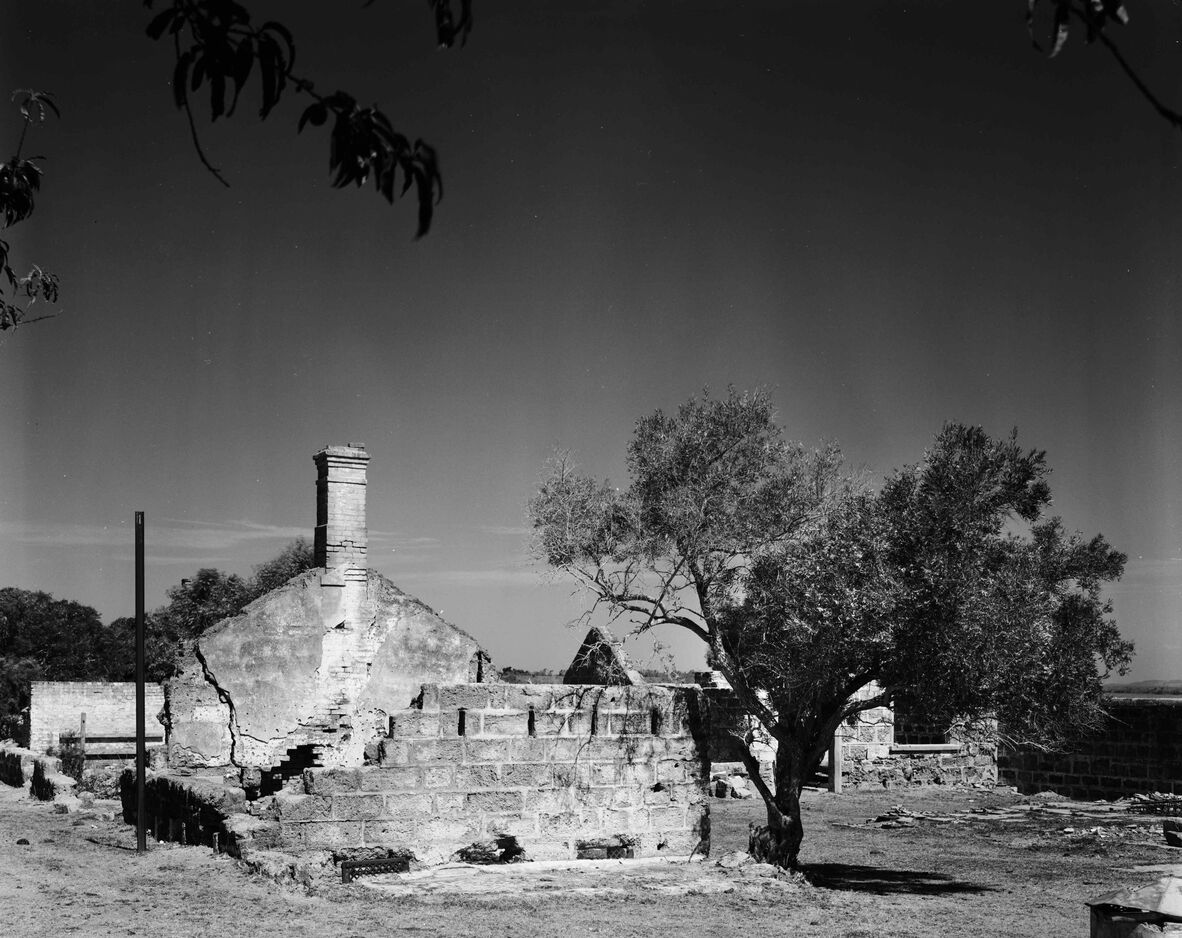
St Helena Prison, 1977, Richard Stringer. John Oxley Library, State Library of Queensland. Image 3267-005.
Stripped back: St Helena Island prison
'Richard’s photos of the prison on St Helena Island in Moreton Bay are particularly special. When I first started working with Stu, we would take office trips out to picnic in the ruins. That place is like a time capsule, and it feels outside the city, despite being only a short boat trip away.'
'Ruined structures like those at the former prison site are instructive. They’re stripped of so many of the attributes a functional building gets loaded up with. You’re left with only the essentials: walls that shade the grass, openings that frame the sky or the horizon, or maybe a tree. You start to contemplate the fundamentals of enclosure amid this vast landscape of sea and sky.
'Many years later, we held an event in our Garden Variety talk series on the island, and the artist Judy Watson spoke, silhouetted against the stone walls as about 80 people lay on the grass with the stars overhead. It was one of those career moments you have to pinch yourself about.'
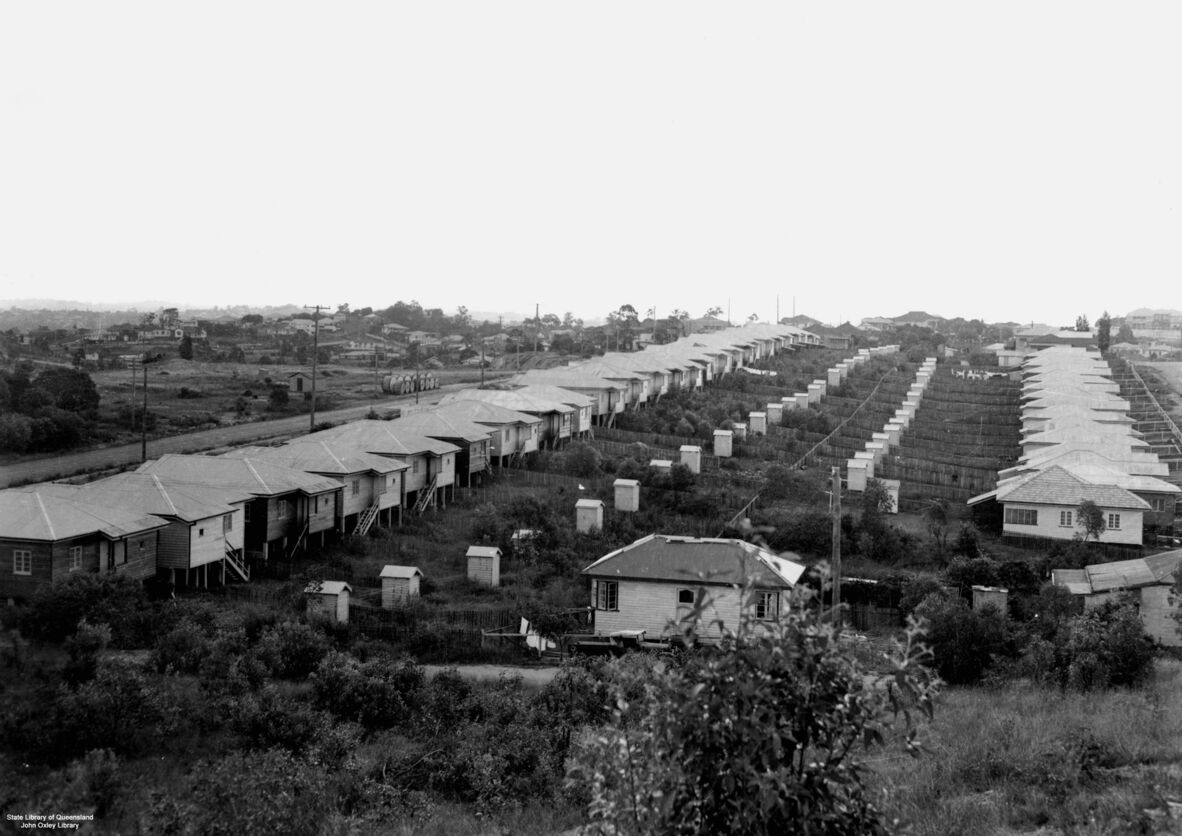
Housing commission houses at Norman Park, Brisbane, Queensland, c. 1950, John Oxley Library, State Library of Queensland. Neg no 59985.
'An expedient sort of place'
'State Library's collections have helped shape my sense of what Brisbane is, the kind of place I belong to. I often use an image of houses in Norman Park, taken in 1950, in my lectures, along with a quote from Professor John Macarthur, in which he describes Brisbane as an ‘expedient sort of place’.
'The photo shows rows of almost identical, modest timber cottages and their backyards, each with its little outdoor toilet in the back corner. The road appears unsealed, and there’s no kerb or channel. That image gives you a profound sense of what this city was, and you can extrapolate from it the kinds of circumstances and attitudes that have brought us to where we are now.
'Knowing where we came from, and who came before, is essential for placing us and our work in context. I feel like we’re flying blind without that. In practical terms, resources like the Corley Collection are really fun and helpful when you’re researching a new house you might be working on. Those photos often show the building before it was modified, revealing the structure's underlying logic and giving you clues about what a renovation could reclaim.'
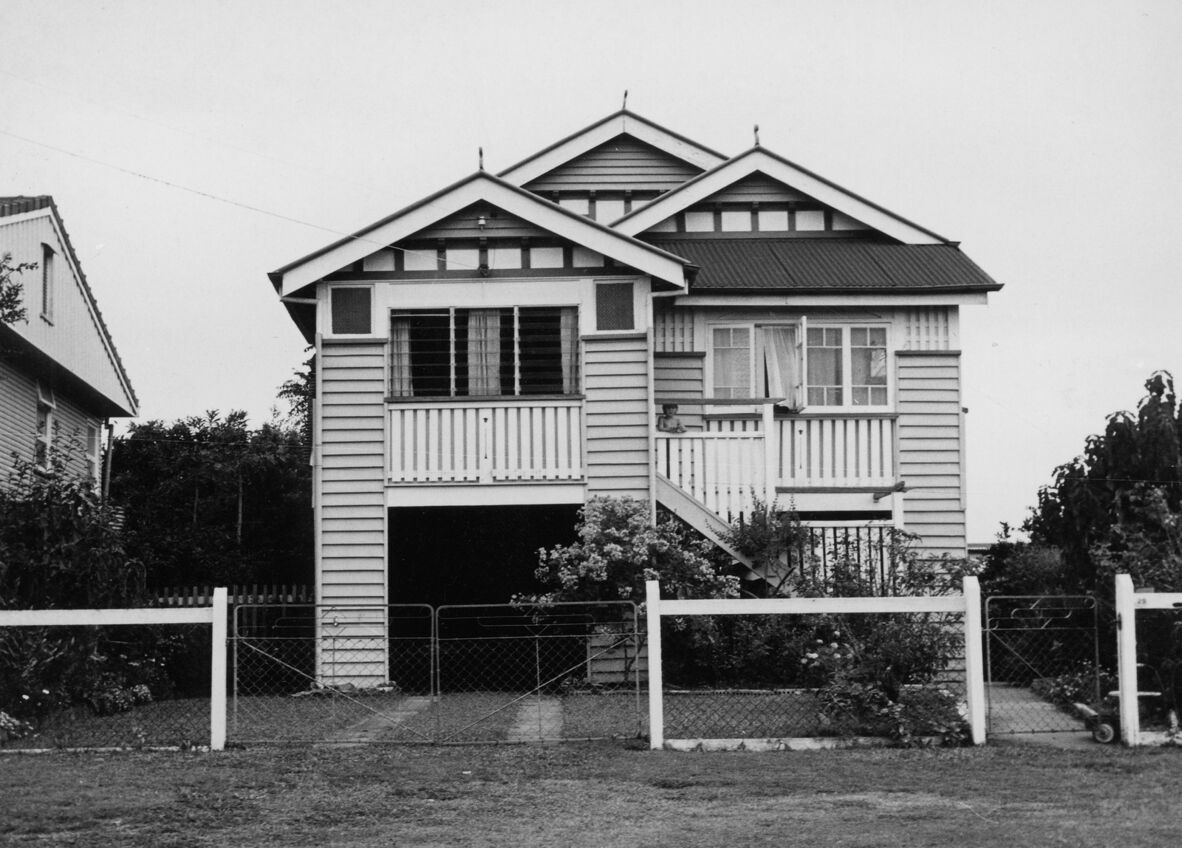
Avondale Avenue, Annerley, c. 1970, Frank Corley (1913–95), John Oxley Library, State Library of Queensland. Image 6169-2975-0003.
The evolution of Queensland architecture
'We’ve come a long way from outdoor toilets. The opportunities to build have been extraordinary for many ‘new’ architectural practices, like ours. We’ve ridden a wave of prosperity that has transformed the suburbs, but that prosperity has come at a cost, partly because it has exacerbated economic disparity within our society and, in an urban sense, diminished Brisbane’s suburbs' built fabric.
'Those open, generous frontages and verdant backyards we see in historic photographs are increasingly rare. Timber houses, with their large gardens, are so easy to prise apart, lift, move, expand, or demolish, and yield easily to market metrics. I worry that many of our houses have become bloated and unremarkable, and architects have to acknowledge their complicity.
'So when I say the library's archives help me think about the value of the city, what’s been lost, and what can be recovered, this is what I mean. Our neighbourhood can be a vital place of industry, recreation and exchange – civic places for growing vibrant communities.
'Our architectural self-image has long been one of informality, economy and practicality, largely built around the iconic timber house. But that image relied on an abundance of open space and was conditioned by the beautiful inconveniences of the creaky, austere Queenslander. I think we’ve lost some of that appetite for inconvenience, and we’ve certainly lost the abundance of cheap land and resources.
'We almost certainly need to become a city of many more apartment dwellers. With that comes an urgent need for shared public amenities: parkland, transport networks, libraries. More "great rooms" in the city.
'So we’re at an inflection point. Thankfully, I believe we have an abundance of talent and knowledge for doing things well, partly because we can look to the past. People have crafted amazing places to live for millennia; we just need the will and courage to believe it can keep happening.'
Discover State Library's architecture collections, Asia Pacific Design Library Collection and Corley Explorer collection of 1960s and 70s Queensland home photographs.
Richard Stringer architectural photographer digital story, 2019
Comments
Your email address will not be published.
We welcome relevant, respectful comments.