A relative unknown: Goondiwindi, Einstein and the 1922 eclipse
By Chris Currie | 27 March 2026

For one day in 1922, Goondiwindi became the most important place in the universe. Read the extraordinary story of telescopes, tin sheds and the race to prove Einstein right.
While many of us today struggle to understand Albert Einstein’s Theory of General Relativity, at the time of its publication in 1915 it was such a groundbreaking concept that even his fellow physicists were unable – or at least unwilling – to entertain it.
The controversial idea (which built on Einstein’s 1905 Theory of Special Relativity) not only upended decades of accepted assumptions about space, time, matter, energy and gravity, but its central prediction – that the gravitational pull of massive objects could literally change space and time – were incredibly difficult to confirm.
One opportunity identified by some scientists and astronomers was to observe stars during a total solar eclipse, taking photographs of the stars beside the darkened Sun then comparing them with the same stars on an ordinary night.
By recording the difference in light deflection, it was hoped Einstein’s theory could be proved – giving a reading twice that predicted by Newton’s law of gravity.
The First World War prevented experiments during the 1915 eclipse, but scientific observations in 1919 from the island of Principe in Africa’s Gulf of Guinea agreed with Einstein’s predictions. Nonetheless, more confirmation was needed, and in 1922 the world’s attention shifted to an upcoming total solar eclipse, and – surprisingly – to the relatively unknown Queensland town of Goondiwindi.
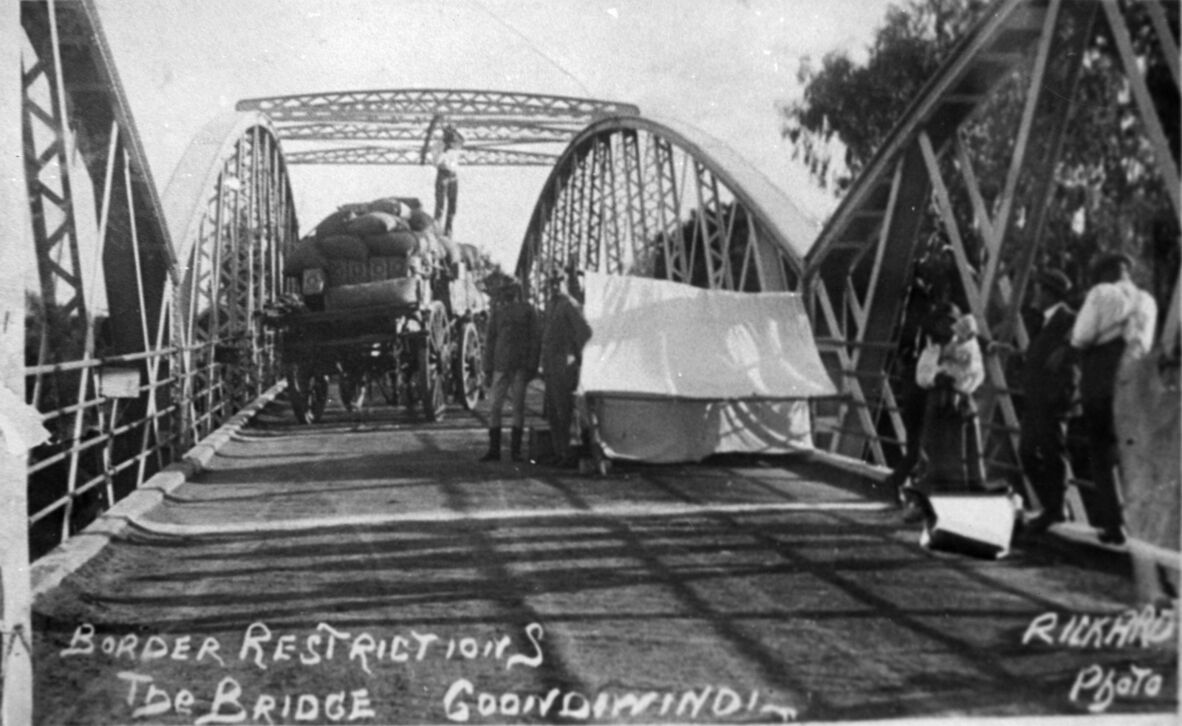
Temporary border inspection control on the Macintyre Bridge, Goondiwindi, ca. 1919.
Where on earth is Goondiwindi?
Most famous today as the home of famed racehorse Gunsyd, ‘The Goondiwindi Grey’, in 1922 Goondiwindi was a small town most notable for its location on the Queensland and New South Wales border, on the northern banks of the Macintyre River.
Where Goondiwindi stands today is part of country traditionally owned by the Bigambul people. The Bigambul language region includes the landscape within the local government boundaries that extend to the towns of Yelarbon and Texas continuing north towards Moonie and Millmerran.
Chosen as one of 14 border posts after Queensland’s separation from its southern neighbour state, Gundy – as it is affectionately known by locals – was also a guarded border crossing during the 1919 outbreak of Influenza.
In the year leading up to the eclipse, much excitement was made about the role this small town would play in the major scientific event, so much so that several publications were produced in anticipation, including the comprehensively titled A short history of Goondiwindi and The Macintyre : together with explanatory matter and useful information concerning the Solar Eclipse which will occur on Thursday, September the 21st, 1922, compiled by Edgar Browne, reportedly the grandson of one of the town’s colonial ‘pioneers’ Samson Marshall.
‘Besides being on the centre line of the zone of totality,’ wrote Browne, ‘the flat nature of the district and climatic conditions which prevail comprise attributes which make Goondiwindi the “queen of observation stations”.’

The shaded band shows the predicted path of the moon's shadow across Australia.
A line of totality – the world converges
In the world of eclipses, the term ‘line of totality’ refers to the path of the moon’s shadow as it passes between the earth and the sun. In 1922, the line – predicted to be around 180 km wide – would pass directly over Australia.
After traversing the Indian Ocean, the line would cross at Condon on Western Australia’s north-west coast, travelling across Central Australia before landing at the New South Wales and Queensland border before passing into the Pacific Ocean.
While the path would travel over several Queensland towns including Cunnamulla, Warwick and Stanthorpe, by far the best position would be at Goondiwindi, whose flat terrain, accessibility by rail and favourable climactic conditions made it an ideal place to view the eclipse.

A fold-out map from The Total eclipse of the sun, issued by the Commonwealth Bureau of Meteorology, held in State Library’s collections, showing the path of totality.
The country's finest astronomical minds tended to agree. Representatives from observatories and universities from Sydney, Melbourne and Brisbane planned to attend the event. The head of the Chief Scientific Party was Government Astronomer of New South Wales Professor William Ernest Cooke, whose Sydney Observatory team included academics from Sydney University. This team would attempt to verify Einstein's theory.
Alongside would be parties forming a joint observation station comprising Melbourne Observatory, Melbourne University and the University of Queensland, led by Observatory Director Dr Joseph Baldwin.
About 200km to the east, members of the New South Wales branch of the British Astronomical Association – along with a phalanx of photographers from the Sydney Mail – gathered at Stanthorpe, where visibility of the eclipse would also be very fine.
Waiting at Western Australia’s Wallal station to greet the eclipse were representatives from India, along with a North American contingent from the Carnegie Institute (under the direction of a Mr Coleman, to take ‘magnetic observations in co-operation of a great scheme embracing the whole earth’), the University of California’s Lick Observatory and Toronto University.
Others gathered at Cordillo Downs in South Australia, as well as Christmas Island, where a party from Greenwich Observatory waited.
According to Total solar eclipse : visible as total or partial throughout Australia by C. A. Macfarlane – published in Brisbane as a popular guide for amateur observers – 'on one of the Malden Islands [The Maldives], is a party of German and Dutch scientists, including Professor Einstein’.
There are other passing reports that Einstein ‘of relativity fame’ would himself being present to witness the eclipse. While a Dutch-German party was present on Christmas Island, there is no evidence that Einstein accompanied them (and in fact no eclipse was seen at Christmas Island due to bad weather).
Through a glass, darkly
The public was understandably excited to view the eclipse in person, but newspaper reports warned that the eclipse should not be viewed with the naked eye, recommending instead looking through a pre-exposed photography plate, photographic film or glass smoked with camphor.
Beyond possible blindness, cautions on front pages of newspapers extended to ‘Eclipse Neck’ and ‘Eclipse Nose’. Suffice to say, several other less scientific methods were offered to the public.
A notice published in The Sydney Morning Herald on the morning of the eclipse warned readers not to use chocolate wrappers to cover their eyes.

Let's get busy
Professor Cooke prepared notes for the public about what to expect when the eclipse began. He described the first visible phenomena as ‘the rising of the curtain’, indicated by a tiny black notch (‘the edge of the advancing moon’) that grows to cover the sun over the course of an hour.
When the sun is reduced to a crescent sliver by the moon, Professor Cooke wrote: ‘we must commence to get busy’ as the next three to four minutes would be ‘crammed full of interest.’
Phenomena in this short span of time would include:
- shadow bands (bright lines and dark bands visible on a white sheet or wall facing the sun)
- the moon’s shadow – ‘a tangible darkness advancing almost like a wall, swift as imagination, silent as doom’)
- Baily’s Beads – peaks and valleys on the moon’s surface causing bead-like flashes of sun); and
- a viewing of the chromosphere – a reddish pink hydrogen gas on the surface of the sun viewable only briefly, and only through the naked eye (Cooke recommended keeping your eyes closed for 5 minutes in advance, before placing one opened eye on the telescope).
Of most interest to scientists, Cooke stressed, would be the three and a half minute period where the full moon was ‘projected against the sun’s corona’. This was when scientists would make their vital scientific measurements in relation to the bending of the stars’ light.
‘Those precious three and a half minutes,’ he wrote, ‘are the ones for which professional astronomers travel half across the globe’.

Everyone in Goondiwindi was making the most of the eclipse.
All in readiness
Professor Cooke and mechanician D.A. Trigg arrived in Goondiwindi on 31 August, along with Dr Baldwin from the Victorian party, to begin taking photographs of the sky as a baseline with which to compare the eclipse results.
On advice of Astronomer Royal Sir Frank Dyson (who urged the expedition), Cooke had selected Sydney Observatory’s own astrographic telescope as the primary tool for the experiments. The astrograph, built in 1892, was nearly identical to telescopes used in the 1919 solar eclipse. Weighing in at several tonnes, it was transported by train to Goondiwindi before being mounted on two specially made timber and concrete frames.
To keep the telescope tracked to the earth’s rotation, Cooke had at his disposal a decades-old chronograph. For timekeeping, he adapted a repeating circle first produced early in the 19th century and in storage since 1847. He also brought his photoheliograph (a specialised telescope for photographing the sun) that was originally used during the 1882 Transit of Venus.
‘It was not altogether a satisfactory arrangement,’ Cooke later wrote, ‘but the best we could manage’.
The scientific parties established themselves and their improvised observatories in tents and makeshift buildings on the racetrack in the centre of Goondiwindi. The astrograph was housed in a galvanised iron shed with an opening in the roof for the telescope to project, and a canvas blind on the western side.

The temporary structure erected by the Sydney Observatory.
Unsurprisingly, accommodation in the small town was at a premium. Locals prepared ‘an unused church for campers’ and opened their houses, backyards and businesses to the new influx of visitors. Indeed, the Sydney University party set up their equipment in a backyard behind a bookmaker, and – according to writer S. Elliott Napier, dispatched to Goondiwindi by the Sydney Morning Herald – had their work almost immediately interrupted by a ‘semi-inebriated’ local hoping to place a bet.
‘What will happen if the “good thing” comes off and bettor calls to “collect” remains – like the Einstein theory – to be proved,’ he drily observed.
A local sports ground served as the location for most of the makeshift observatories as over 40 scientists crowded together in anticipation.
Extra trains from both sides of the border were scheduled to bring the estimated crowds into the small town, including many school groups. Newspaper notices from the Town Clerk advised visitors that during the morning they ‘may pull fish from the beautiful McIntyre [sic] River.'
“Few places have floated into fame as easily as the quiet little town of Goondiwindi, on the bank of the Macintyre River, separating Queensland from New South Wales.
Without any boosting, without any outlay, without any of those melodramatic tendencies which sometimes bring remote centres into the spotlight, Goondiwindi has won for itself a place on the new world's map, as one of the few towns which, weather permitting, will be within the area of the deep night-like shadow of the eclipse on September 21.” – The Brisbane Courier
The great voice in the sky
Enthusiasts took part in a week of ‘dress rehearsals’ before the big day to ensure everyone knew their part.
An interesting but vital amateur participant was Goondiwindi local and self-taught radio operator, Percy Shaw, who, besides operating a garage, ran a small profit providing homemade radio receivers (fashioned from old car horns and the lids of tobacco tins) to local cattle and sheep stations.
The previous winter Shaw had tuned in daily news reports from France, England, Germany, Panama and Japan. Now he was now responsible for connecting his home town to the rest of the world, allowing scientists across the globe to synchronise their critical observation timings and latitudes.
The exact beginning of the eclipse was to be broadcast over a large, mounted Magnavox speaker supplied by the Sydney Observatory team, allowing professionals and amateurs to register the exact beginning of the eclipse as well as precise timings for changing of photographic plates.

The day (before) the world stood still
Despite a fortnight of unusually inclement weather, by the afternoon of18 September, the sun shone ‘from a sky fleeced with fugitive clouds’, and the forecast for Thursday – the day of the eclipse – was for ‘clear, fine weather’.
Elsewhere in the state, precautions were being taken and opportunities seized for the brief band of darkness that was to cross Queensland. Trains were instructed to activate their lamps while running, and others to stop to allow passengers to experience the totality. Schools closed early, while Queensland Premier Edward Granville Theodore joked that allowing the Opposition to view the eclipse ‘would enable the Government quickly to get through its business’.
Final rehearsals and drills began in earnest, with every scientist practising their roles so no mistakes would be made during the crucial three and a half minutes that would make up the eclipse’s totality. At the Sydney Observatory station, Professor Cooke stated he had 100 photographic plates prepared, including 8 specially for the Einstein test. The Magnavox speaker was tested with an impromptu mandolin performance from a local musician.

Gundy: 1, Sydney: 0.
During a practice on 19 September, Cooke switched on the giant astrograph (or ‘Einstein Telescope’ as it was by then known), but it refused to function. Cooke and his team spent half an hour investigating the delicate instrument to no avail. Increasingly desperate, Cooke ordered the telescope’s clockwork mechanisms taken apart. During this process ‘a very small spider crawled out from between the clock contacts; after which everything progressed satisfactorily.’
On 20 September, Queensland Governor Sir Matthew Nathan arrived in town to a civic reception, and the unveiling of a new monument: the Goondiwindi War Memorial.
The same day, the Queensland Commissioner for Public Health issued a statement – arguably a bit too late – that most glasses sold in Brisbane for viewing the eclipse were ‘quite unsuited for the purpose’.
The Goondiwindi party stood at the ready with its astrographic telescope, hoping to produce on photo plates an answer to ‘the Einstein question’. Also present were photo-heliographs, spectroscopes, galvanometers, pyranometers, photo-electric cells, mirrors and an array of cameras, recording all manner of measurements. ‘One could not throw a stone along the main street,’ reported Napier, ‘without incurring the grave risk of injuring a professor.’
Such was the press interest in the eclipse that it was reported the local telegraph office had dispatched over 45,000 words during the 3 days leading up to the event.

School children in Sydney practise looking into the sky through smoked glass.
210 seconds
Forecast clear skies did indeed come to pass on Friday 22 September; the best weather all fortnight. 'A finer day,’ reported the Melbourne Argus, ‘could not possibly have been ordered’.
Visitors arrived at Goondiwindi on special trains and motor cars, and the residents celebrated an unofficial public holiday.
At around 2:30 pm, crowds cleared from the sports field and and positioned themselves behind fences as the scientists took up their synchronised positions.
The eclipse began only 12 seconds before the predicted time, at just after 3:05 pm. The show had begun. ‘There’s no Brisbane mail about this,’ said an onlooker, ‘she’s on time to the tick.’
As the totality approached, the weather began to cool, and stars, planets and constellations started to become visible (Venus, followed by Jupiter and Mars, and the Southern Cross).

Beyond the moon’s encroaching blackness, the corona shot out long streaks, and for a few seconds the shadow bands rippled across the land like ‘shades of light caused by a breeze on a wheatfield’ with a zigzag shape recalling ‘the curves made by a snake’s body’.
‘As the moon crept over the fiery globe of the sun,’ The Telegraph reported, ‘beautiful red and blue and yellow lights were visible on the borders of the sun and moon.’
Cheer after cheer accompanied the disappearing sun, before – with a flash, with a rush of the moon’s shadow – it suddenly and entirely vanished.
From the upper and lower edges of the corona shot streams of light, bending outwards ‘like the curved petal of a flower’.
Just after 4:10 pm, with cattle bellowing and birds falling silent in the surprising darkness, the scientists lit lamps and began their 210 seconds of work, years in the making.
Announcements rang out at regular intervals through the Magnavox, and the scientists performed their carefully choreographed dance. Between the time keeping, everyone watching was completely silent.
Professor Cooke capped and uncapped the lens of the astrograph as photographic slides were carefully taken in and out, while the photoheliograph recorded close-ups of the sun’s outer ring.
Governor Nathan watched through a special theodolite telescope, while the assembled crowd craned their necks and squinted into the pieces of coloured glass. In the main street, nearly 50 cars had been parked haphazardly and abandoned.
Only a few minute later, a dazzling flash. The stars had disappeared. The sun had returned.

S. Elliott Napier described the end of the otherworldly event in his diary as only a poet could:
‘At 5:15 p.m. the last vestige of the moon had disappeared from the sun's disc, and the eclipse was over. But deep-graven in the memory of everyone who saw it must remain the picture of that black and flattened moon, suspended there in space, and draped around it, flying outwards to the four winds of heaven, the softly gleaming shawl of the corona.
We have known – once – the “dim, mysterious light,” like that which “never was on sea or land,” the eerie shadow bands, the three hushed minutes of heart- shaking wonder; and if we shall know them again no more for ever, we shall at least never forget the marvel and the magic of them all. “We have lived and we have seen, and lo! there hath been vouchsafed unto us a great wonder.”’
An overwhelming shadow
The Sydney Observatory team returned home a few days later. Professor Cooke stated that everything went ‘remarkably well’, and that 8 photographs had been obtained for the Einstein tests, and about 6 dozen of the whole of the eclipse.
Unfortunately, this optimism would not last. While the photographs of the corona taken by the photoheliograph proved ‘excellent’, the same could not be said of the others.
‘Although the weather was fine,’ said Professor Cooke, ‘the definition was particularly bad.’
In a lecture the next month at Sydney’s Millions Club, Cooke, perhaps freed of expectations, bemoaned the quality of the technology at his disposal, describing Sydney Observatory as ‘a museum of antiquities’.
The 30-year-old chronograph – after working perfectly in trials (save for the spider) – had failed at the worst possible moment during the eclipse, distorting all but 2 of the slides. ‘I had not the necessary instruments to do the work,’ he is reported to have said.
In March 1923, Cooke made the sad admission during a lecture that his party had been ‘unsuccessful in securing satisfactory photographs’ and would be unable to test the correctness of the Einstein theory.
Despite making the decision to discount his inconclusive calculations, Cooke noted that his party ‘had recorded in pictures the complete history of the eclipse, which would prove of considerable astronomical value.’
Only a month later, astronomer William Wallace Campbell vindicated Einstein’s theory by comparing results from Lick Observatory’s remarkably clear measurements at Wallal, Western Australia, with photographs of the same stars taken three months earlier in Tahiti, at the same latitude.
In November 1923, the results from Cordillo Downs also confirmed the theory. In a telegraph sent to his colleague Sir Frank Dyson at the Royal Observatory in London, Cambell wrote WE NEED NOT REPEAT EINSTEIN TEST NEXT ECLIPSE.
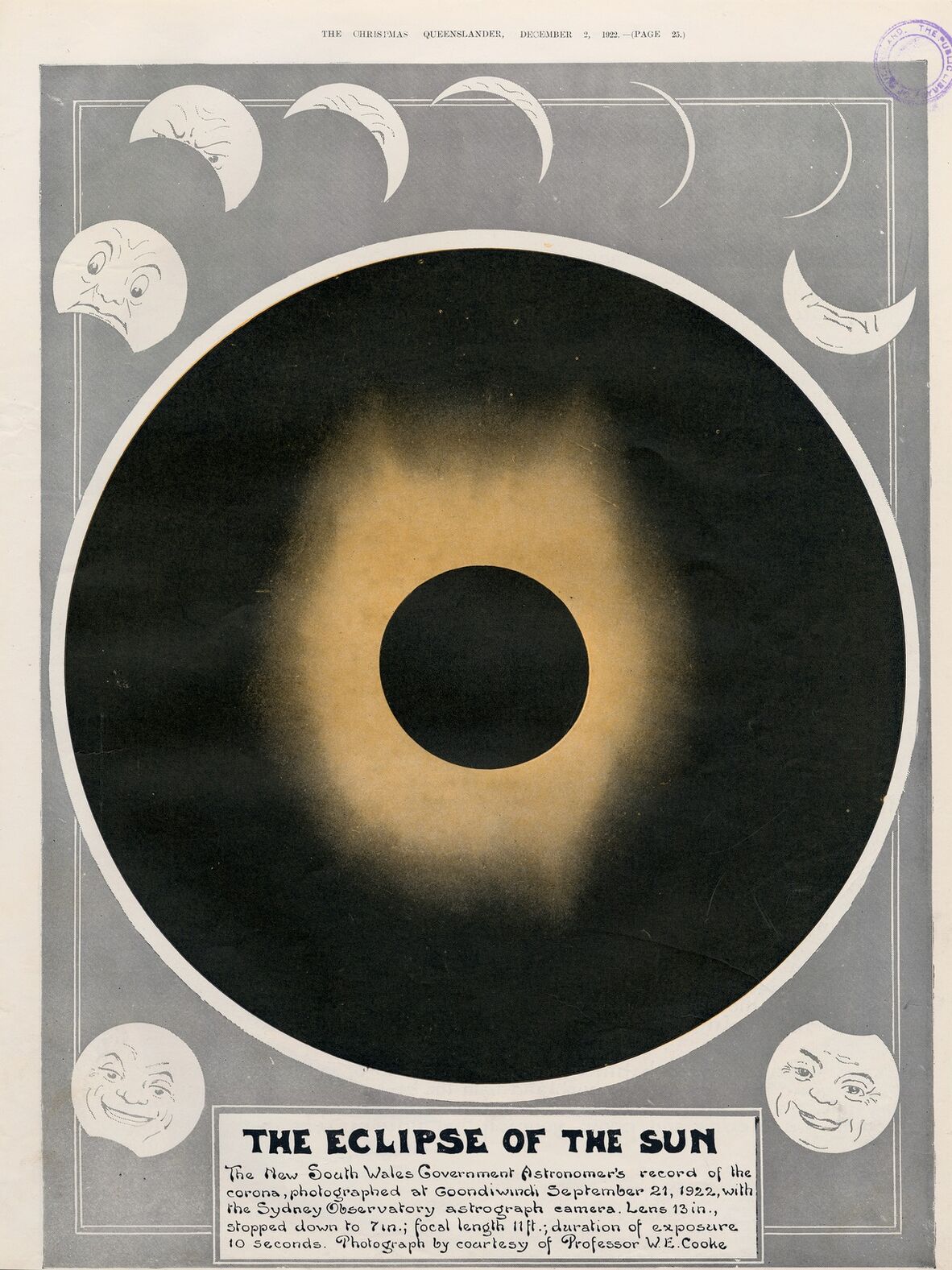
The New South Wales Government Astronomer's record of the corona, photographed at Goondiwindi September 21, 1922 with the Sydney Observatory astrograph camera. Lens 13 in., stopped down to 7 in. ; focal length 11 ft. ; durations of exposure 10 seconds. Photograph by courtesy of Professor W.E. Cooke.
A place in the sun
For a few minutes in its long history, one small Queensland town became one of the most important places in the world.
Professor Cooke’s astrographic telescope operated in lockstep with 18 others across the earth conducting the very same “Einstein Test”, viewing the same sun and stars as some of the world’s best scientific minds.
It’s fair to say that the work undertaken at Goondiwindi was part of a scientific endeavour that was – figuratively and literally – an astronomical success. Our understanding of the earth and the universe around it had crossed the ‘borderland of speculation’ into a world of greater knowledge.
Professor Sidney Skertchly, writing in the Brisbane Courier two weeks after the eclipse, summed up what it meant:
‘Look upon this eclipse as something personal and sacred. It comes to you: you do not need to seek it from afar; you are favoured ones, so do not abuse your trust. Londoners have not seen a total eclipse for over 200 years, and will not see one for about 200 years. Even travellers get but few chances.
‘I have wandered over the greater part of the world, and have never seen one. Let us be grateful, too, and not envy those who, by special seeking have seen several. After all, the joy of life would not be chilled by what we have not seen, but kept aglow by what we have.’
Resources
- A century ago, Australia was ground zero for eclipse‑watchers – and helped prove Einstein right, The Conversation website, accessed 27 March 2026
- A short history of Goondiwindi and the Macintyre, together with explanatory matter and useful information concerning the solar eclipse which will occur on Thursday, September the 21st, 1922 / compiled by Edgar Browne, 1922, Edgar Brown, Goondiwindi : Goondiwindi Argus, John Oxley Library, State Library of Queensland.
- Cooke W E (1922) ‘The total solar eclipse of 1922 September 21’, Monthly Notices of the Royal Astronomical Society, Vol. 83, p. 511–515
- Gates Jr S J and Pelletier C (2019) Proving Einstein Right, PublicAffairs, New York
- How Australia’s 1922 solar eclipse proved Einstein right, Astronomy website, accessed 27 March 2026
- Lomb N and Stevenson T (2023) Eclipse Chasers, CSIRO Publishing, Clayton South
- Powerhouse Collection, Powerhouse Museum website, accessed 27 March 2026
- Solar Eclipse map of Queensland, 21 Sep 1922, Queensland State Archives, Item ID ITM630150
- The 1922 Eclipse Adventure That Sought to Confirm the Theory of Relativity, Atlas Obscura website, accessed 27 March 2026
- The Total eclipse of the sun, 21st September, 1922 / issued under the authority of the Minister of State for Home and Territories by H.A. Hunt, 1922, Commonwealth Bureau of Meteorology (Australia), Melbourne : Commonwealth Bureau of Meteorology, John Oxley Library, State Library of Queensland.
- Total solar eclipse : visible as total or partial throughout Australia / by C.A. Macfarlane, 1922, C.A. Macfarlane, Brisbane : Globe Printing Company for C.A. Macfarlane, John Oxley Library, State Library of Queensland.
- Trove website (various pages), accessed 27 March 2026
- William Wallace Campbell and the "Einstein Problem": An Observational Astronomer Confronts the Theory of Relativity, Jeffrey Crelinsten, Historical Studies in the Physical Sciences, 1983
- Williams R (host) and Fisher D (producer) '1922 Aussie outback expedition helped prove Einstein's theory of general relativity' (15 April 2023) The Science Show, ABC, accessed 27 March 2026.
Comments
Your email address will not be published.
We welcome relevant, respectful comments.