Know your place: an 'early' search for Aboriginal place names
By Dr Rose Barrowcliffe, 2026 Monica Clare Research Fellow | 4 June 2026
This blog was written by 2026 Monica Clare Research Fellow, Dr Rose Barrowcliffe, as part of her fellowship project, The Protectors.
In 2023, at the Queensland State Archives, I came across a 1923–1924 record between the Chief Protector of Aborigines and the many Protectors around Queensland, the Queensland Government officials charged with controlling the lives of Aboriginal people in Queensland. The 290-page correspondence record is the responses from the various Protectors to the Chief Protector to send a list of Aboriginal place names in their district. The responses that fascinated me, specifically, are the answers of the Protectors who couldn’t (or wouldn’t) supply a list of Aboriginal place names.
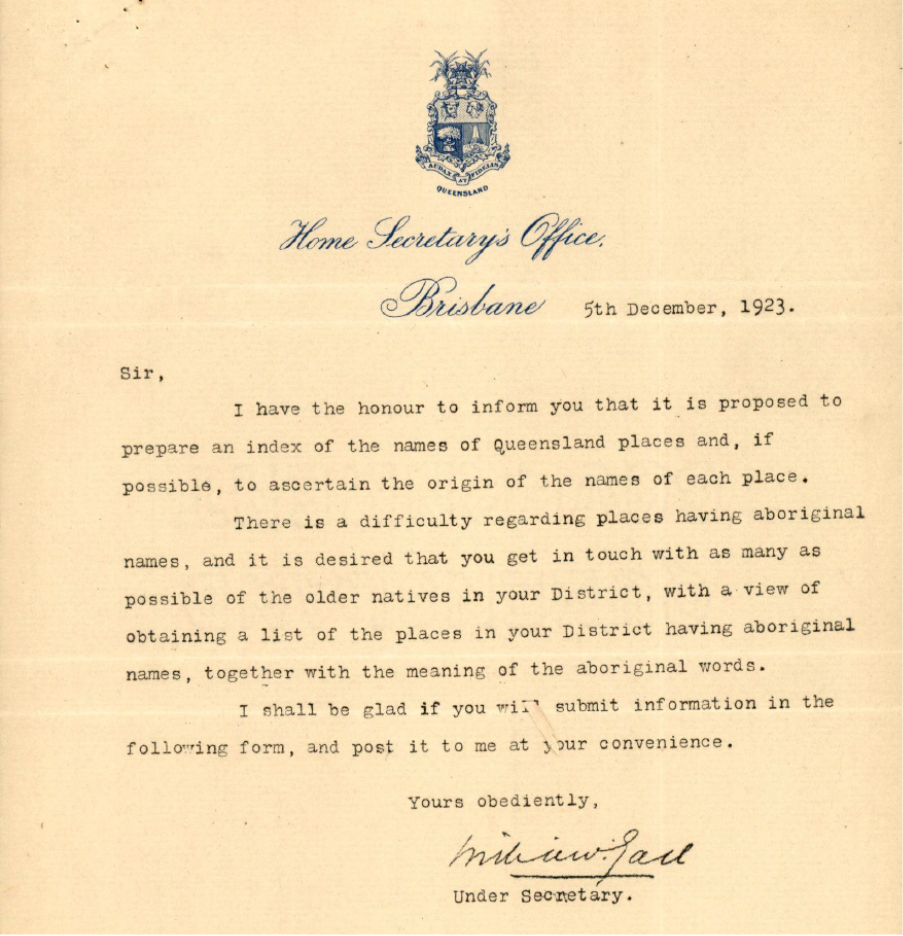
Letter from the Home Secretary’s Office to the Protectors of Aborigines around Queensland. Queensland State Archives, Item ID ITM489478.
Some Protectors responded that there were no Aboriginal place names in their district, others that no Aboriginal people existed to ask, or that the Aboriginal people that were there didn’t know any of the language or meanings of the place names (1). This sparked my interest because many of the place names around Queensland are derived from Aboriginal words. There are also Aboriginal people who are descendants from mobs all around Queensland, so where were their ancestors in 1923–1924 when this place name survey was being conducted? I also wondered what prompted the statewide push to collect Aboriginal place names, and what the Protectors’ relationships were like with the local Aboriginal people. I wanted to know how that aided or hindered their enquiries about the meanings of local Aboriginal place names.
As the 2026 Monica Clare Research Fellow, I am just beginning to shed light on the answers to those questions.
The interest in place names began with the federation of Australia, in 1901. The first Australian Prime Minister, Sir Edmund Barton, noted that there were many instances of duplicated town names across the different states (2). For the next decade or so, with Barton’s encouragement, the states tried various systems for sharing between themselves any adoptions or changes of place names of towns, villages, and railway stations. It created significant amounts of work for the states to report these changes each quarter and there was debate about whether this should be handled through the Surveyor General’s office or the Postmaster’s office. Eventually it became accepted that the authority for naming places would sit with the Lands Department.
In 1922, the focus within Queensland shifted from avoiding duplicate place names to understanding the meaning and history behind the state’s place names. The then Governor of Queensland, the Honourable Sir Matthew Nathan, began a campaign to record the history behind the names of places across the state (3,4). While giving a speech at the Stephens Shire Show, he expressed regret that he did not know of the Stephens after whom the shire had been named, or if Boggo Road had been named such because of its muddy state after rain (4).
What began as the Governor’s personal interest quickly developed into a concerted effort led by the Queensland Place Names Committee. The Committee was jointly started by the Royal Queensland Historical Society and the Queensland branch of the Royal Geographical Society of Australasia (of which the Governor was the president) in July 1922. The Committee consisted of volunteers who were senior public servants, academics, or members of the two founding societies. Most notably William Gall, the Under Secretary of the Home Secretary’s Office, Arthur Melville, Under Sectary to the Department of Public Lands, and Andrew Kennedy, Acting Under Secretary to the Department of Public Instruction. Committee members were charged with researching published works and primary sources (e.g. early colonists’ journals) in search of explanations of place names (2).
In 1922, the focus within Queensland shifted from avoiding duplicate place names to understanding the meaning and history behind the state’s place names.
The Place Names Committee also sent out requests to local councils to help compile the meanings of local place names. Sir Nathan’s dismay at the lack of response from local authorities was reported multiple times in Brisbane newspapers in 1922 (3,4) and 1923 (5–8). One article lamented that of the 134 shires around Queensland, only 19 had responded to the request for information about the origins of the place names in their shire (8).
Not one to be deterred, Sir Nathan used a tour of central and northern Queensland in 1923 to make personal appeals to local officials and private citizens to share their knowledge about the local place names’ histories. Resulting from these appeals were the notable contributions of Edward Armitage of Maryborough, and Reverend John Matthew of the Presbyterian Church, both of whom gave lists and meanings of Aboriginal place name meanings for the Wide Bay region (9).
Through the press, the Place Names Committee kept the public updated on their progress. As a result, newspapers received letters from the readers with their understanding of place names. By October 1923, the Place Names Committee had created thousands of cards, each corresponding to a single place around Queensland (7). State Library of Queensland has retained just one of these cards, for the town of Ellinthorp in south-west Queensland.
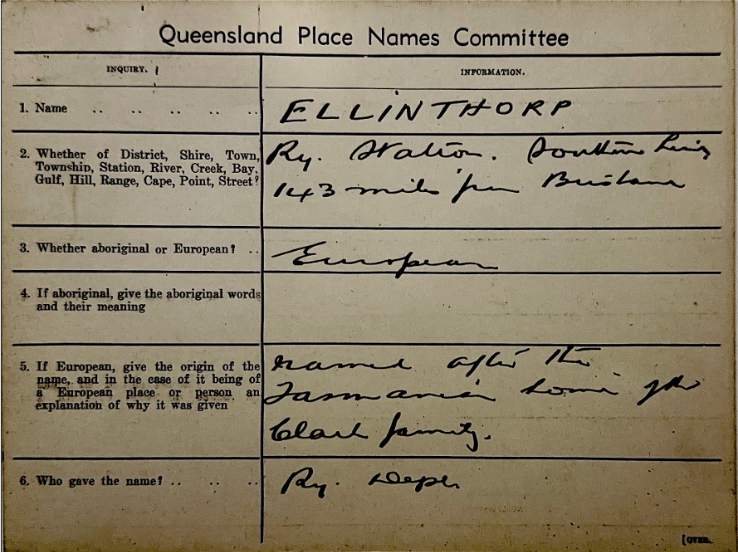
Place Names Committee card. OM90-31, Queensland Place Names Committee Card, John Oxley Library, State Library of Queensland
The Committee achieved a great deal between 1922 and 1925, producing thousands of place name cards and a gazetteer and at least four published reports (10,11), but floundered when Sir Nathan stepped down in 1925 (2). The Committee had a revival in 1936 with Professor Henry Alcock as Chairperson and Sydney May as Secretary, but the voluntary organisation struggled due to the lack of administrative support and clear statutory authority. In 1945, the Surveyor General, Mr J.P. Harvey, supported a move to give the Lands Department the authority over Queensland place names, with the guidance of an Advisory Committee that would function much the same as the Place Names Committee had until that time (2). The role and responsibilities of the Lands Department was finally enshrined in legislation in March 1958 with the Queensland Place Names Act 1958 (12).
Despite the debate over Aboriginal place name repatriation in recent years (13–16), my research has found that retaining Aboriginal place names has been a policy of the colonial government as far back as 1828 by Sir Thomas Mitchell (when Queensland was still part of New South Wales) (11) and reasserted by Queensland’s first Governor, Sir George Bowen, in 1860 shortly after Queensland separated from New South Wales (9). Governor Nathan and the Queensland Place Name Committee continued the tradition of prioritising the recording and maintaining Aboriginal place names in their work. While the Place Names Committee received submissions about Aboriginal place names from many sources, it was their campaign to gather Aboriginal place names through the office of the Chief Protector of Aborigines that is of interest to me. In 1922, Queensland was divided into 83 “protectorates” which governed the lives of Aboriginal people (17), and it was the “Protectors” that oversaw these districts that were asked to supply the information about Aboriginal place names.
In this blog series, I will be examining the protectorate system and how the very system that was intended to protect the lives and culture of Aboriginal peoples did the opposite, including how Protectors helped, or hindered, the recording and preserving Aboriginal place names around Queensland.
In the next blog post, I will go into detail about Queensland’s protectorate system and its protectors and their responses to the Place Names Committee’s 1923 survey.
Dr Rose Barrowcliffe, 2026 Monica Clare Research Fellow
The Monica Clare Research Fellowship is generously supported by The Siganto Foundation.
Read more blogs about Queensland's First Nations history by past Monica Clare Research Fellows.
Bibliography
1. Correspondence from the Home-Secretary, Home Department to all protectors of Aboriginals regarding a survey on Aboriginal place names, Adavale - Yungaburra [title amended] [Papers - place names] [Internet]. 1923 [cited 2026 May 22]. Located at: Queensland State Archives; ITM489478. Available from: https://www.archivessearch.qld.gov.au/items/ITM489478
2. Harvey JP. Report on history of place naming in Queensland. QLD: QLD Surveyor Generals Office; 1945 Feb. Located at: QLD Historical Society
3. Place Names and their Origin. Brisbane Courier. 1922 Oct 23:4.
4. Place Names. Telegraph. 1922 Oct 23:3.
5. PLACE NAMES. Telegraph. 1923 Apr 3:6.
6. Historical Society of Queensland. Brisbane Courier. 1923 Oct 30:4.
7. Historical Society of Queensland. Brisbane Courier. 1923 Oct 30:4.
8. QUEENSLAND PLACE NAMES. Queensland Times. 1923 Nov 5:2.
9. Policy Files: Adoption And Use Of Aboriginal Place Names, Part 1. 1973. Located at: Queensland State Archives
10. Queensland Place Names Committee. Report of Committee on Queensland Place Names. Report of Committee on Queensland Place Names. <Brisbane>: The Committee; 1923. Located at: State Library of Queensland John Oxley Library
11. Queensland Place Names Committee. Fourth report of the Committee on Queensland Place Names. <Brisbane>: Committee on Queensland Place Names; 1925. 17 p. Located at: State Library of Queensland John Oxley Library
12. Queensland Government. Queensland Place Names Act 1958 [Internet]. 1958 [cited 2026 May 25]. Available from: https://classic.austlii.edu.au/au/legis/qld/hist_act/qpnao19587ein10312.pdf
13. Hundreds of places in Australia contain this “racist slur” that experts want changed. ABC News [Internet]. 2025 Feb 4 [cited 2026 May 25]. Available from: https://www.abc.net.au/news/2025-02-05/debate-over-changing-australian-place-names/104816696
14. Barrowcliffe R. The Conversation [Internet]. 2021 [cited 2026 May 25]. Celebrating K’gari: why the renaming of Fraser Island is about so much more than a name. Available from: https://theconversation.com/celebrating-kgari-why-the-renaming-of-fraser-island-is-about-so-much-more-than-a-name-168378 doi:10.64628/AA.mtcrg7px6
15. Wahlquist C. ‘The right thing to do’: restoring Aboriginal place names key to recognising Indigenous histories. The Guardian [Internet]. 2021 May 28 [cited 2026 May 25]. Available from: https://www.theguardian.com/australia-news/2021/may/29/the-right-thing-to-do-restoring-aboriginal-place-names-key-to-recognising-indigenous-histories
16. The fight over the right to name Australian places [Internet]. 2018 Nov 27 [cited 2026 May 25]. Available from: https://www.bbc.com/news/world-australia-46258060
17. Report on the office of the Chief Protector of Aboriginals [Batch file] [Internet]. 1923 [cited 2026 May 25]. Located at: Queensland State Archives; ITM716955. Available from: https://www.archivessearch.qld.gov.au/items/ITM716955
Comments
Your email address will not be published.
We welcome relevant, respectful comments.