Collaboration and conflict: why two Brisbane empire builders fell out
By Robert Allen, 2026 Queensland Business Leaders Hall of Fame Research Fellow | 3 August 2026
Both empire builders in their own way, businessman Thomas Charles Beirne and Archbishop James Duhig were close friends and confidantes for five decades. But did the two men fall out over Duhig’s greatest folly?
Like so many of their nineteenth century compatriots, Beirne and Duhig were born in impoverished rural Ireland and emigrated to Australia seeking a better life. Both men arrived in Brisbane in 1885, mixed in the same social circles and often appeared together on public platforms supporting causes such as Irish Home Rule. (1) Both were men in a hurry. Beirne, a devout Catholic with a keen business acumen, owned three department stores in Fortitude Valley, Ipswich and Mackay by 1902, and was appointed to the Legislative Council aged 45.
Duhig became a Catholic priest after leaving school. He quickly progressed through the hierarchy to become the church’s youngest bishop, appointed to the sprawling Rockhampton diocese aged just 34. By the time he became Archbishop of Brisbane in 1917 the two had known each other for nearly 20 years. Their careers would continue in tandem for the next three decades.
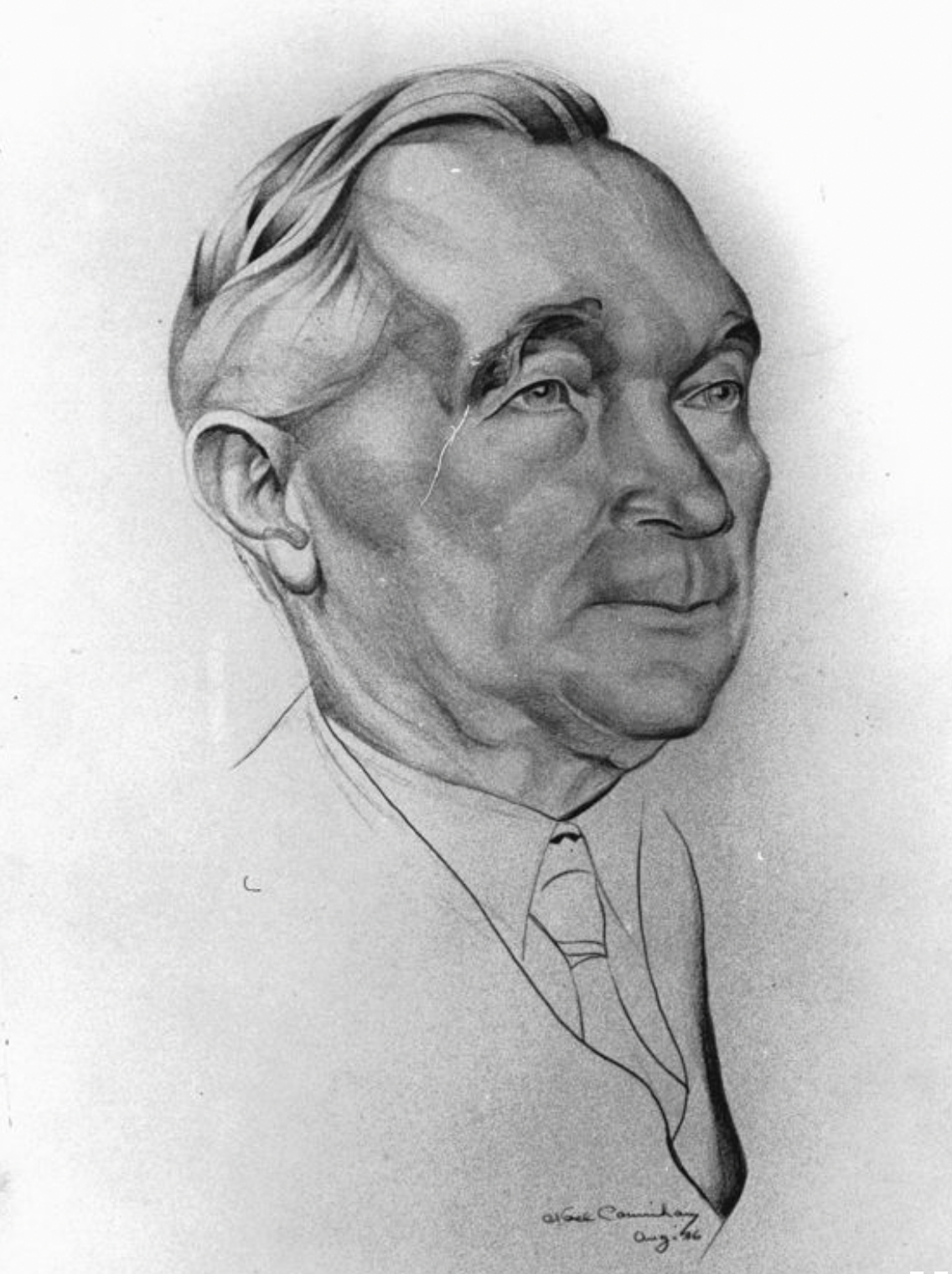
Thomas Charles Beirne, 1936, Noel Cournihan, John Oxley Library, State Library of Queensland. Negative number: 194210

Photograph of Archbishop James Duhig, 1944, John Oxley Library, State Library of Queensland. Negative number: 106508
Physically, Beirne and Duhig were like chalk and cheese. Duhig cut an imposing figure in his ecclesiastical robes while Beirne was slimmer in stature. Duhig was a natural orator while Beirne was a nervous public speaker, although he gained confidence with age. (2)
Philosophically, however, they were cut from similar cloth. Principled yet pragmatic, both men inspired loyalty and affection, realised the value of education as a means of lifting people out of poverty, and knew the power of money to effect lasting change.
Indeed, as his biographers note, Duhig “spent much of his pastoral life raising money and, even more, spending it.” (3) His program of constructing hundreds of new churches, schools and hospitals earned him the nickname ‘James the Builder’. Beirne, a generous benefactor, donated substantial funds to many of Duhig’s projects.
The two dined together regularly and Duhig officiated at the marriages of several of Beirne’s daughters. Duhig’s residence was only a short distance from Beirne’s flagship Valley store, and the church archives contain many receipts detailing his household spending: two singlets and eighteen handkerchiefs here; a pair of shoes there. (4)
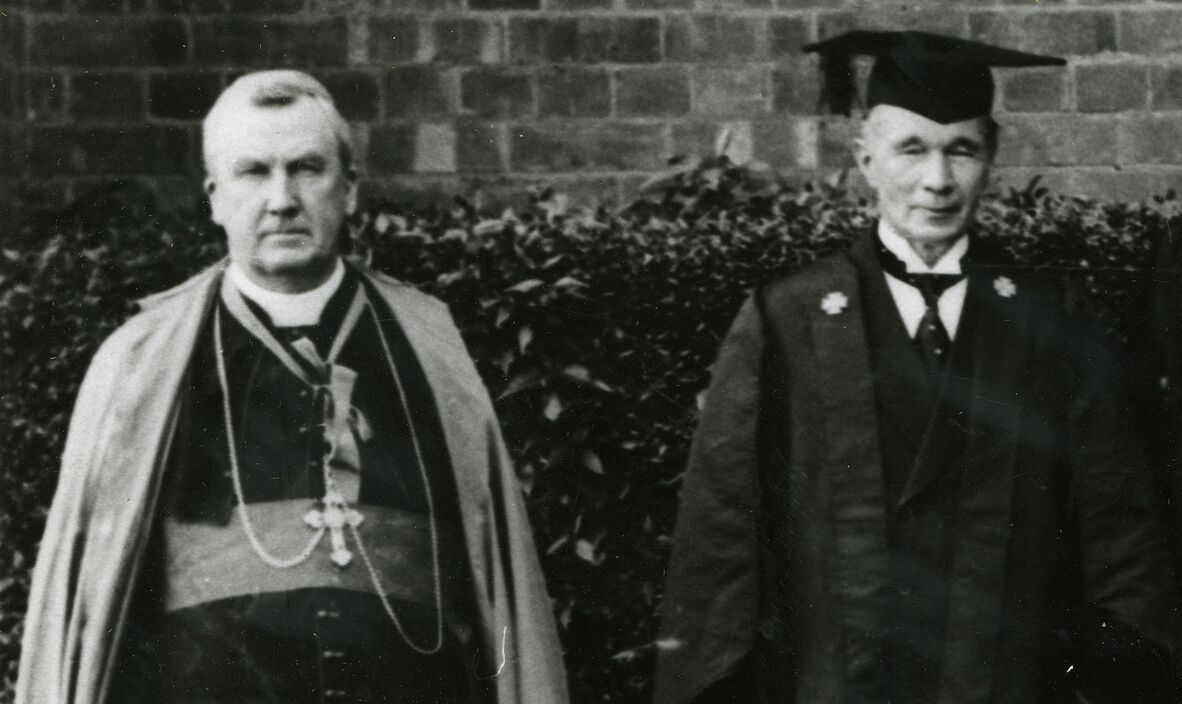
Detail of a 1935 UQ Senate photo with Duhig and Beirne, Fryer Library University of Queensland Photograph Collection
Beirne often spoke in praise of Duhig at church ceremonies and was vice president of the committee that organised the Archbishop’s Silver Jubilee celebrations in 1930. (5) The 2 men mixed in secular circles too: both served on the University of Queensland Senate. Beirne was a foundation member of the Queensland Irish Association and Duhig was a regular honoured guest at their functions. (6)
Duhig was not afraid to seek help from his friend on behalf of a parishioner, often writing to Beirne asking if there was a vacancy in one of his stores. Beirne was usually accommodating, but on one memorable occasion he refused his request, telling him the young man in question had already been fired once from his employ and that “if the boy were mine I would not feed him.” (7)
In 1928, Duhig successfully lobbied the Vatican for Beirne to be appointed a Papal Knight of the Order of Saint Gregory, despite Beirne’s earlier protestations that he could not accept such an honour. (8) In 1940, Duhig officiated at the funeral of Beirne’s wife, Annie, and presided at the unveiling of several stained-glass windows in her memory at St Stephen’s Cathedral the following year. (8)
Despite their obvious closeness over several decades, Beirne and Duhig eventually had a falling out. The biggest clue comes from their respective autobiographies; in them, each mentions the other just once, and then only in passing.
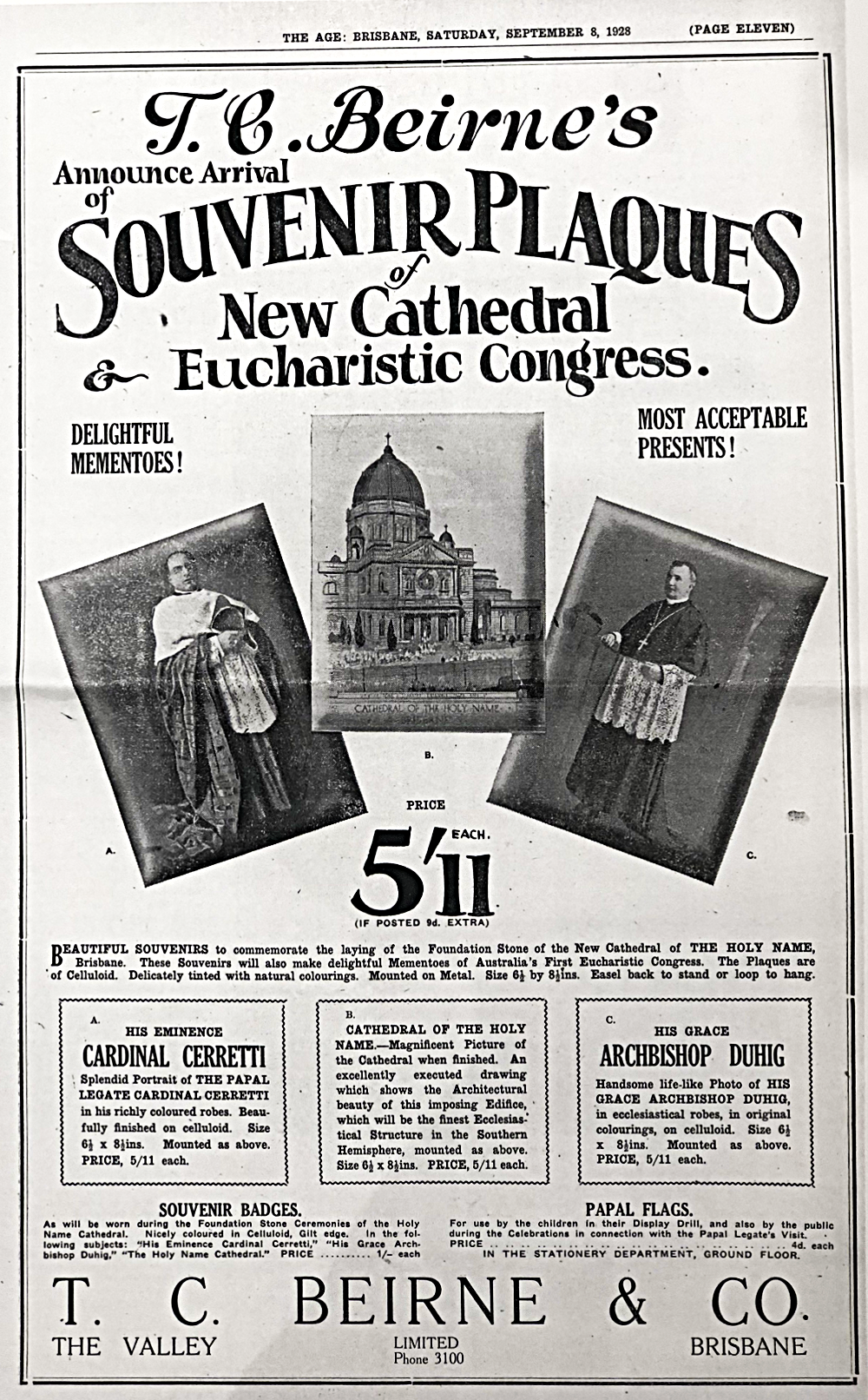
T C Beirne store advertisement for Holy Name Cathedral souvenir plaques, 1928, Brisbane Archdiocesan Archives
The answer can be found in the saga of the Holy Name Cathedral. Years before he became Archbishop in 1917, Duhig was consumed with the idea of building a grand new Brisbane cathedral. He initiated hundreds of new schools, churches and hospitals during his tenure, but he wanted this one project to define his legacy. The cathedral would have filled an entire block in Fortitude Valley, held 4,000 people and been the largest in the southern hemisphere.
More than 40,000 people turned out to witness the laying of the cathedral’s foundation stone in 1928. Beirne – who had helped Duhig turn the first sod the previous year – pledged £5,000 toward its completion and accepted his suggestion to have one of its chapels named after his family. (10)
But the hugely ambitious cathedral project was never finished. Slow fundraising, poor church investments, the Great Depression, mounting debts and the sheer scale of the undertaking meant it did not progress beyond the crypt and the surrounding wall. (11)
Beirne may have foreseen what would happen. In 1928, he had turned down Duhig’s offer to invest in a proposed oil exploration company to help fund the cathedral, noting that “all my life I have kept clear of gambling (commercial or otherwise).” (12) The following year he refused the Archbishop’s request for another £5,000 to pay overdue Council rates. (13)
Beirne’s pledge to fund the family chapel in the new cathedral had been conditional on project milestones being completed. Despite the obvious lack of progress he paid the final instalment, as promised, in 1940. (14)
Further strain may’ve been placed on the friendship because Beirne’s daughter Stella had married the cathedral’s architect, Jack Hennessey, who would later successfully sue the Archbishop for unpaid fees. (15)
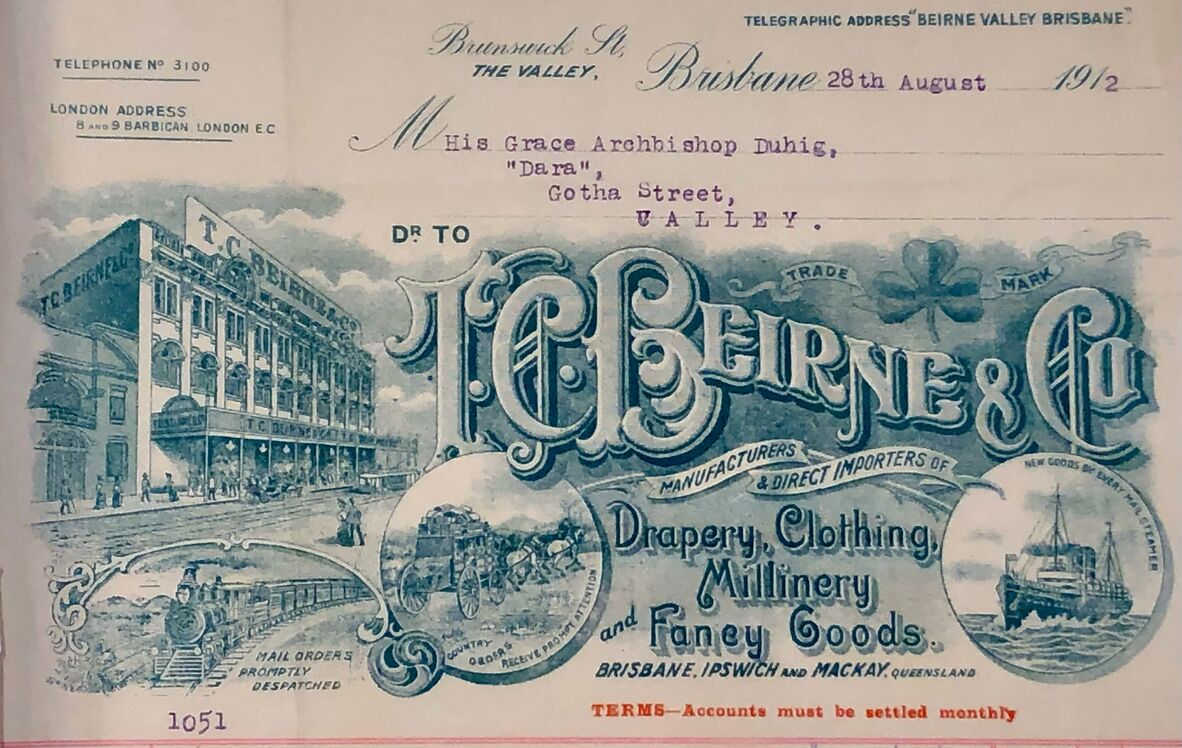
Letterhead on an invoice from T C Beirne to James Duhig, 1912, Brisbane Archdiocesan Archives
Beirne died a very wealthy man in 1949, with an estate valued at £1.25 million. Most of his assets were divided equally among his 5 daughters and his will specifically noted that “I desire to record that I have not made provision for the Roman Catholic church and institutions other than those already made because I have contributed considerably thereto during my lifetime.” (16)
Duhig officiated at Beirne’s funeral, remarking that Brisbane and Queensland were poorer for the passing of a great citizen. (17)
Beirne’s daughter Cecilia later recorded in a memoir that Duhig “was a great friend of father's” but that “in later years father was critical of his extraordinary financial sense and they did not see each other very often.” Despite this, Duhig visited Beirne just half an hour before he died “and to our amazement father put out his hand to shake the hand of his Archbishop.” (18)
It seems the pair of empire builders made peace in the end.
Robert Allen, 2026 Queensland Business Leaders Hall of Fame Research Fellow
The Queensland Business Leaders Hall of Fame Fellowship is generously supported by the John Allpass Charitable Foundation.
Read more blogs about Queensland's business leaders history by past Queensland Business Leaders Hall Research Fellows.
Bibliography
1. 1902 'Home Rule for Ireland', The Age, 20 September, p. 3., viewed 23 Jul 2026, http://nla.gov.au/nla.news-article292095746.
2. In his autobiography, Beirne recalled one early attempt at public speaking, when his knees shook so much that the audience noticed. Eileen Beirne (ed), The Life Story of Thomas Charles Beirne, Truth, 1947, pp 47-8.
3. Rodney and Robin Sullivan, ‘Brisbane’s Holy Name Cathedral: What was Archbishop Duhig thinking?’, Queensland History Journal, vol 26, no 2, May 2025.
4. Beirne store receipts dated 28 February 1935 and 28 February 1941 held in the Brisbane Archdiocesan Archives (BAA).
5. 1911 'AN UNLUCKY NUMBER’, The Age, 8 July, p. 3. , viewed 23 Jul 2026, http://nla.gov.au/nla.news-article291938119 and Souvenir of the Episcopal Silver Jubilee of His Grace the Archbishop of Brisbane the Most Reverend James Duhig D.D., City Hall, Brisbane, 9th December 1930, Catholic Leader, held in the John Oxley Library, State Library of Queensland.
6.Rodney and Robin Sullivan, A Hundred Thousand Welcomes: The History of the Queensland Irish Association, Boolarong Press, 2023.
7. BAA, Letter from Beirne to Duhig, 18 April 1936.
8.BAA, Letter from Beirne to Duhig, 8 July 1927 and letter from Duhig to Cardinal Bonaventura Cerretti, 17 May 1928.
9. BAA, Letter from Beirne to Duhig, 28 March 1940 and ‘NEW WINDOWS DEDICATED: ST STEPHEN’S CATHEDRAL CEREMONY’, The Catholic Leader, 31 July 1941, p. 19.
10. BAA, Letter from Beirne to Duhig, 5 July 1927, 1927 'BRISBANE'S NEW CATHOLIC CATHEDRAL', Freeman's Journal, 16 June, p. 22., viewed 23 Jul 2026, http://nla.gov.au/nla.news-article122919166 and 1928 'Brisbane's Great Week', The Age, 20 September, p. 15., viewed 23 Jul 2026, http://nla.gov.au/nla.news-article291814485.
11. D W Martin, A Hill in the Valley: Dara and the Holy Name Cathedral, Brisbane Archdiocesan Archives, 2018, p. 43.
12. BAA, Letter from Beirne to Duhig, 5 October 1928, quoted in T P Boland, James Duhig, UQP, 1986, p. 227.
13. BAA, Letter from Beirne to Duhig, 16 December 1929, quoted in D W Martin, op. cit, p. 41.
14. BAA, Letter from Beirne to Duhig, 28 March 1940.
15.1950 'COURT REJECTS £25,720 APPEAL BY ARCHBISHOP', Daily Mirror, 22 August, p. 2., viewed 23 Jul 2026, http://nla.gov.au/nla.news-article274493752.
16. 1949 'THIS MAN MADE A MILLION', The Courier-Mail, 23 June, p. 1., viewed 23 Jul 2026, http://nla.gov.au/nla.news-article49688481.
17.1949 'TRIBUTE TO T. C. BEIRNE', Brisbane Telegraph, 22 April, p. 3., viewed 23 Jul 2026, http://nla.gov.au/nla.news-article216575077.
18. Cecilia Douglas, ‘And Long Go It Was’ manuscript, 1963, pp. 9 – 10. Part of the Cecilia Douglas Papers held in the John Oxley Library, State Library.955
Comments
Your email address will not be published.
We welcome relevant, respectful comments.