Remembering Queensland’s last World War I veteran: Ted Smout
By Alaine Baldwin, Engagement Officer, Anzac Square Memorial Galleries | 24 September 2026
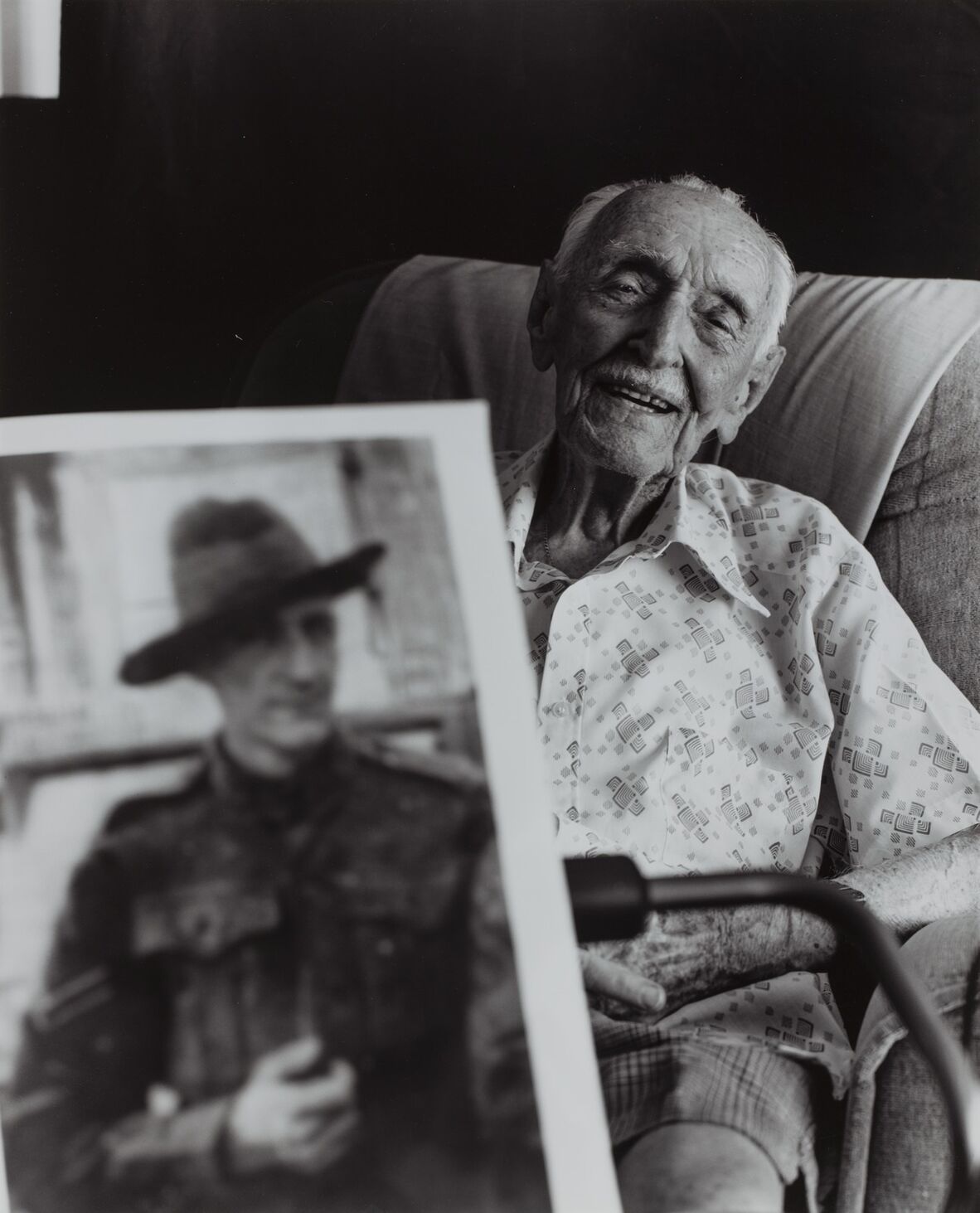
Portrait of Ted Smout, OAM, 2001, 7487 Gift of Presence exhibition images, Clarke, Suzanna, photographer, John Oxley Library, State Library of Queensland. Image no 7487-0001-0014.
Edward ‘Ted’ David Smout lived to be 106 and when he died on 22 June 2004, Queensland lost their last World War I veteran. Ted was born in 1898 and moved from Cunnamulla to Brisbane with his family when he was 7. He spent the majority of his very long life there. He had an older sister and 3 younger brothers. When the family first moved to Brisbane, they lived at Woolloongabba, so Ted attended Dutton Park Boy’s State School. After moving to Kangaroo Point in 1907, he switched to the Kangaroo Point State School. Despite the family moving back to Dutton Park in 1910, Ted walked barefoot for about 2 miles each way for 6 months to continue at the Kangaroo Point School until the end of the year as he hoped to win the medal for Dux of the School. His success in this endeavour shows not only his intelligence, but also his determination.
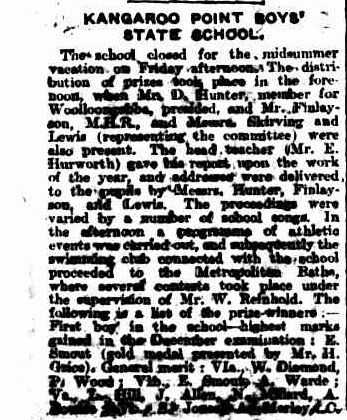
Kangaroo Point Boys' State School, Monday 12 December 1910, The Brisbane Courier, National Library of Australia (Trove). Page no 10.
Having missed the scholarship exam for Brisbane Boy’s Grammar due to a bout of dengue fever, he was instead offered a scholarship for the Central Technical College housed in David Halliday’s building in Ann Street, where he studied for 2 years. French and German were part of his course. When he sat the Junior University Exam in 1913, he finished in the top 7 so in January 1914, at age 16 was offered a position in the Audit Office as a junior clerk. He was working there when war was declared.
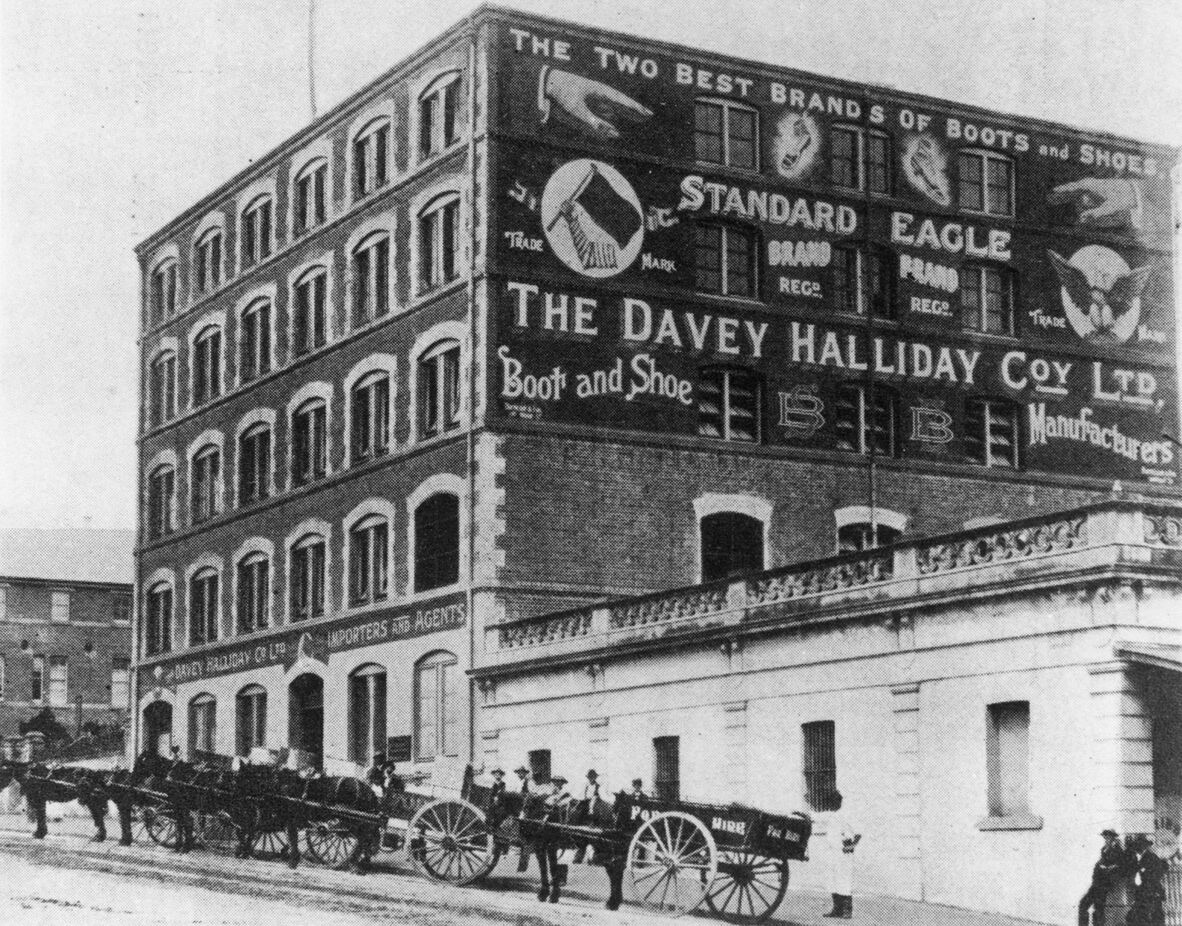
Davey Halliday Company Ltd. on Ann Street, circa 1904, John Oxley Library, State Library of Queensland. Negative no 10183.
In an interview in 2002 Ted said one of the reasons he enlisted was:
‘I was fairly big for my age... and girls used to hand you a white feather meaning you were a coward... it was easier to enlist than to stay at home.’
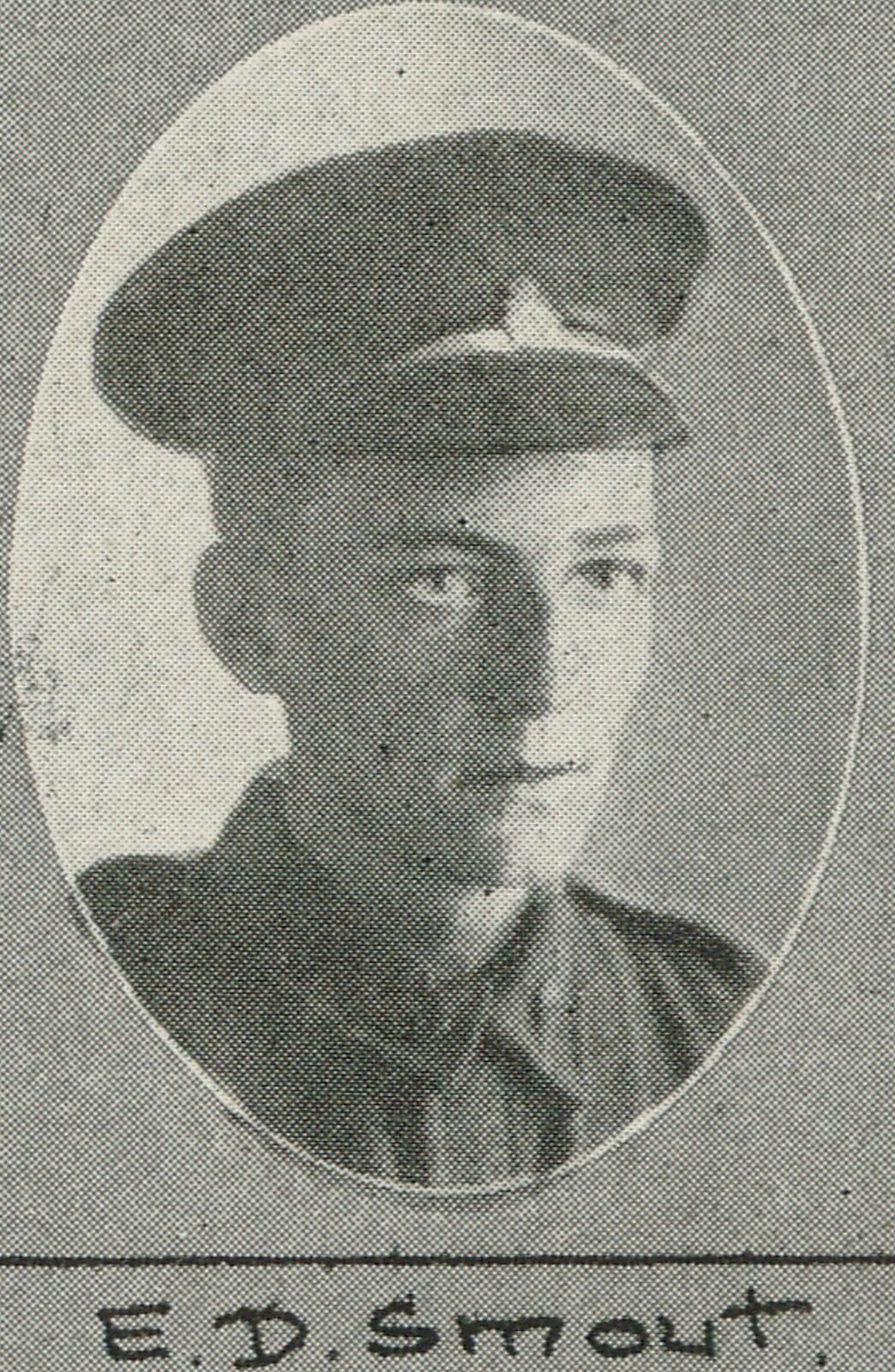
E.D. Smout, one of the soldiers photographed in The Queenslander Pictorial, supplement to The Queenslander, 1916, John Oxley Library, State Library of Queensland. Image no 702692-19160909-s0026-0056.
Most of his mates had enlisted so on 10 September 1915, Ted enlisted in the AIF, aged 17 and 8 months, though his enlistment papers state he was 18 and 8 months. While his father was supportive of his wish to enlist early, his mother needed some convincing. Apparently, when he went to the main recruiting centre in Queen Street, he was recognised by the sergeant major in charge, who knew he was under 18, so was advised to try the office set up in the Adelaide Street Drill Shed. Ted had used the Rifle Range there when he was a Senior Cadet and would later visit the spot when it became Anzac Square in 1930.
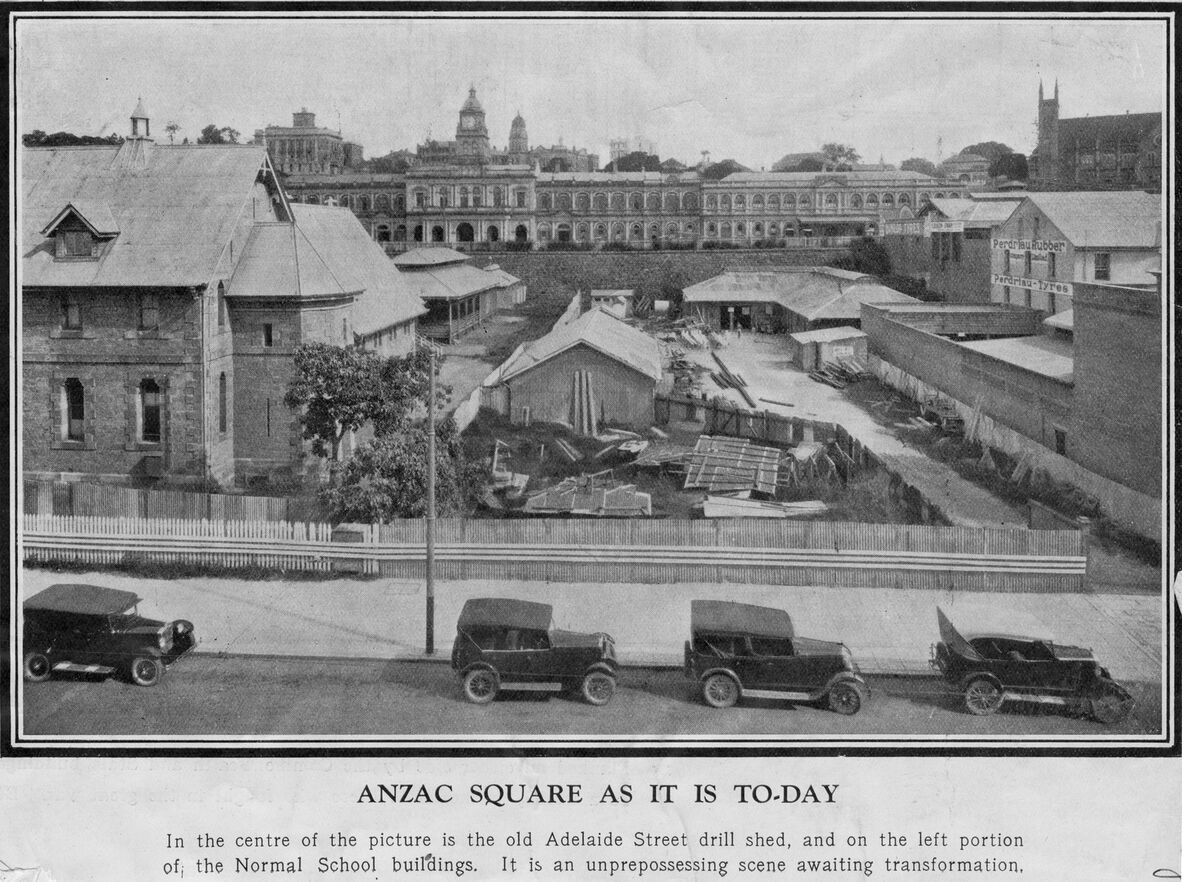
View from Adelaide Street of the Central Railway Station, over Anzac Square, ca. 1926, John Oxley Library, State Library of Queensland. Negative no 65722.
Two of his classmates also signed up at this time, Norman Threlfall, who had just turned 17, and Tom Cameron who was born in Scotland but would have been of a similar age. After being put in different infantry battalions, the boys transferred to the Australian Army Medical Corps (AAMC) so they could serve together. After some basic first aid training they underwent specialist training in Brisbane so when they arrived in France, they joined the 3rd Division as part of the 3rd Sanitary Section of the AAMC. A team of 27, the Sanitary Section was responsible for inspecting the camps and ensuring health requirements were met. This involved plumbers and carpenters setting up latrines and Ted’s job of ensuring safe water supplies. When their Division was involved in battle, the specialists would be called on for first aid and stretcher duties. Ted arrived in France on 24 November 1916 and, after a 3-week delay in quarantine after exposure to mumps, moved to a camp at Armentieres, a quiet sector of the front line, where the troops gained experience of trench warfare.
In April 1917 Third Division moved to the Messines-Wytschaete Ridge section of the line in Belgium. Here, Ted had his first experience with chlorine gas during the Battle of Messines, where his team manned a field hospital and used their ambulance to link up with the field ambulance clearing the wounded from the battlefield. They were then part of the Third Battle of Ypres which ran from 31 July to 10 November 1917. Ted’s mate Norman Threlfall was awarded the Military Medal for his bravery and devotion to duty while stretcher bearing for over 14 hours on 31 July 1917. The assault on Passchendaele Ridge on 10 October 1917 saw the 3rd Division lose almost 3200 men killed or wounded and Ted recalls working for 72 hours with little or no rest. He said the casualties were horrific and when they were stretchering they couldn’t get off the duckboards as the mud was so deep. The memories of men crying out for help that he couldn’t get to haunted him.
Passchendaele was my worst experience in the war, because the battlefield was a quagmire. All the shell holes were full of water and if you stepped off the duckboard you would be immobilised, over knee-deep in mud. The trenches were infested with rats and body lice, and the “rest area” at Poperinghe township was subjected to frequent bombing.
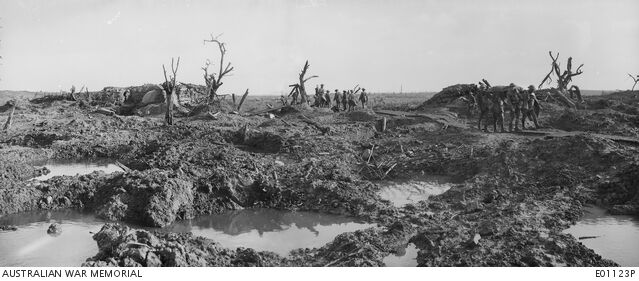
Passchendaele: Stretcher bearers transporting wounded (right), while other troops (centre) move over a duckboard track running across a muddy Anzac Ridge, to the front line in the Ypres sector, 10 October 1917, Australian War Memorial. Accession no E01123P.
By April 1918 the Division had moved to the Somme and Ted states that he was one of the first on site when Baron Von Richtoffen (the Red Baron) was shot down and crashed in Australian lines on 21 April 1918, near Corbie France. While he resisted souveniring The Baron’s boots or Iron Cross, he says he did cut a small section of the plane's timber instrument panel to keep.
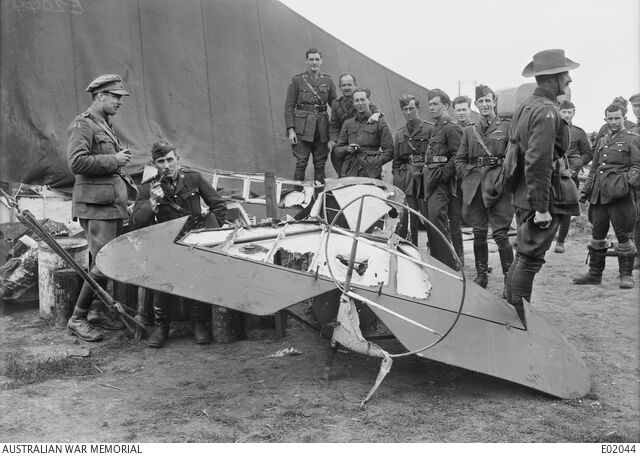
The remains of Baron von Richthofen’s Fokker Triplane at the aerodrome of No. 3 Squadron of the Australian Flying Corps, 22 April 1918, Australian War Memorial. Accession no E02044.
When the Armistice came on 11 November 1918, Ted was in a rest camp in a small village called Fouquohertnesle, where the pub owner offered free drinks for all. The next day he hopped on a train to Paris where he had 10 days celebrating before he was caught by a British MP and sent back to his unit. Despite being fined 14 days' pay, he says it was worth it. When he got back to England, he spent 6 months in London working for the Australian Army Pay Office. The three friends who had signed up together in 1915 all made it home at varying times in 1919; Norman and Tom a little before Ted who arrived August 9, 1919.
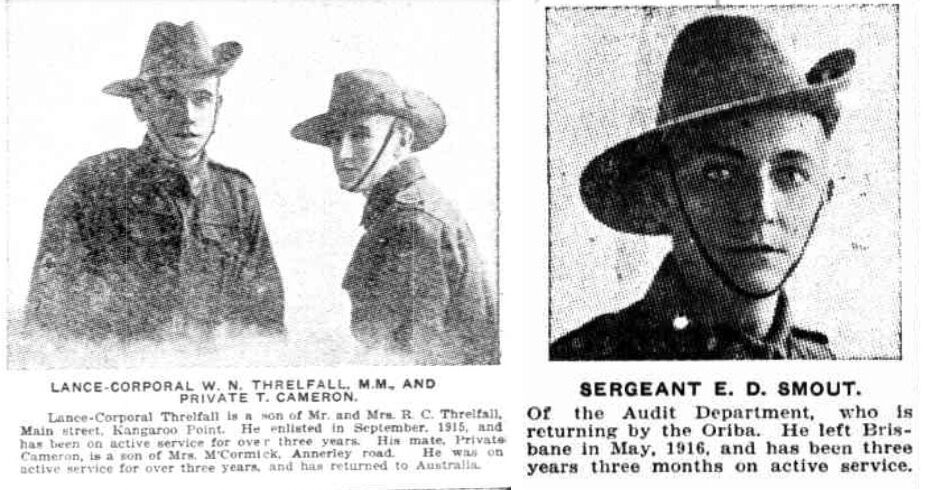
Lance Corporal W.N. Threlfall, M.M. and Private T. Cameron, Saturday 28 June 1919, The Telegraph, National Library of Australia (Trove). Page no 9; Sergeant E.D. Smout, Saturday 9 August 1919, The Telegraph, National Library of Australia (Trove). Page no 9.
Unfortunately, after a few months back at the Auditors Office he had a breakdown, a delayed action from shellshock.
In 1920 I was suffering from delayed shell shock to such an extent that my health deteriorated. I became an absolute wreck, physically and mentally.
With no help available from the Army, he set about getting himself better. His 6-month plan included 3 months out on a property in Cunnamulla, where he regained his physical health. Then he decided to learn singing and dancing, two things that terrified him. He felt this experience taught him to always tackle tough jobs first. He left the Auditors Office in 1922 and joined Equitable Life, a newly formed Insurance company. In 1923 he married Ella Annie Grace Stevens after an 18-month courtship. He said it was the best thing he ever did and began a wonderful marriage that lasted 69 years until Ella’s death in 1992. They had three children, Westell, Betty, and John, who were raised in the house they built under the War Service Homes Scheme in Clayfield. Always giving to his community Ted joined Legacy in 1936 and served on their committee as well as being a member of the Brisbane Rotary Club.
During World War II Ted once again felt the need to contribute. The Governor of Queensland asked him to work for the Red Cross Appeal, so he dedicated his efforts to raising funds for them for the duration of the war and was incredibly successful. He also served in the Volunteer Defence Corps (VDC) during the war and oversaw a Bofor anti-aircraft gun unit at Newstead House. The VDC covered the night shift on the guns, though they never had to fire them. Ted’s eldest son, Westall David Smout, enlisted in the Royal Australian Air Force in February 1943, when he was 18, and served for 3 years.
Brisbane during the war years became more or less an occupied city, with thousands of U.S.A. troops stationed here and thousands more passing through, on being deployed to offensive positions in the Pacific area
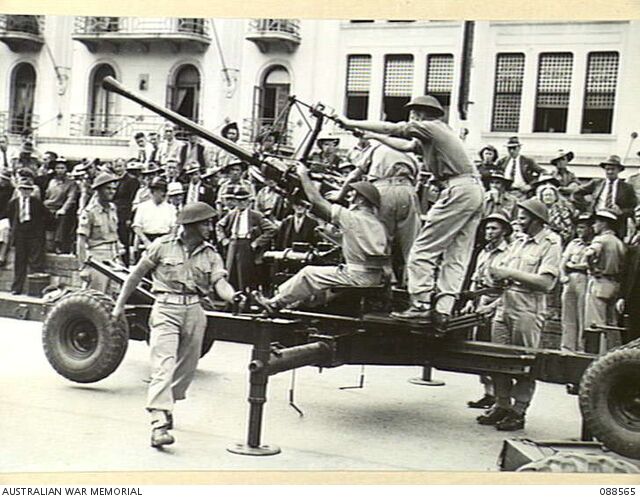
Bofors 40mm anti aircraft guns in ‘snap action’ during an army display in King George Square, Brisbane, 16 April 1945, Australian War Memorial. Accession no 088565.
Post World War II, in 1950, Ted moved to Hawthorne but was only there for 2 years before he was appointed to the head office of the Prudential Assurance Company in Sydney, which he had joined in 1935 when they first opened a branch in Queensland. He remained Agency Manager for Australia until his retirement in October 1961. After 12 years in Sydney, he and Ella returned to their home in Hawthorne. They eventually sold the Hawthorne home and moved to Sandgate, where once again Ted became active in community work including the Sandgate Senior Citizens Building Committee, Sandgate Meals on Wheels, Sandgate Rotary, the Widow Fund and the Probus Club. For his efforts in ‘Community Service’ he was awarded the Order of Australia Medal in 1978 as well as being named the Combined Sandgate Services Clubs ‘Leading Citizen of the year.’
In August 1993 the Australian Commonwealth Government sent a mission to France to mark the 75th anniversary of the Armistice of World War I. Ted was one of the 14 World War I diggers who were part of the official party and attended 6 days of official functions, including a combined ceremony with the French Army at the Tomb of the Unknown Soldier, at the Arc de Triomphe in Paris.
It was a very emotional and fairly strenuous trip. All the functions were attended by large crowds of adults and children waving Australian flags, indicating the high regard the French people had for Australian soldiers.
He would visit France again in 1998 for the 80th anniversary of the Armistice but this time there was only 4 diggers and Ted himself was 100 years old. On July 4, at the Australian National Memorial at Villers – Bretonneux the diggers were awarded the medal of the Legion of Honour, the highest French award. Ted did state that he accepted the medal on behalf of all Australian soldiers who served on the Western Front.
Having been a resident of Sandgate for several decades, it is not surprising that when a new 2.7km bridge was opened between Clontarf and Brighton, 6 years after his death, on July 11, 2010, it was named the Ted Smout Memorial Bridge in his honour.
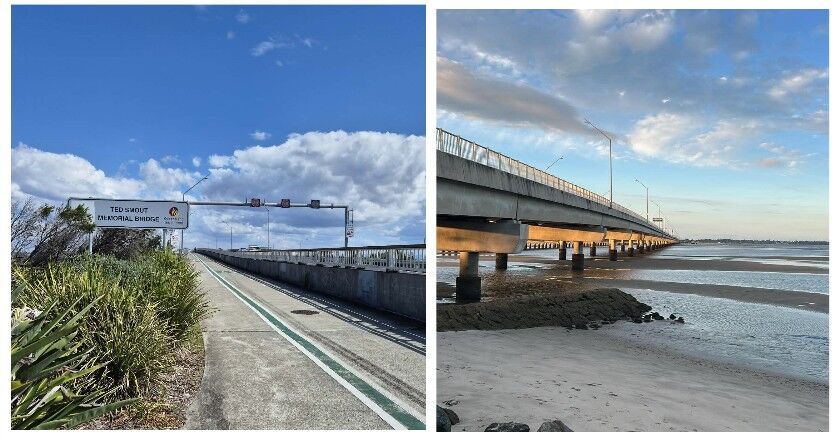
Ted Smout Memorial Bridge, a 2.74km road and pedestrian bridge that links the Brisbane suburb of Brighton to the Redcliffe suburb of Clontarf, opened July 11, 2010. Photos taken by Anzac Square staff members.
Despite all his service during both WWI and WWII, Ted wanted those he spoke to about his experiences to realise that war wasn’t glorious, it was horrible and did nothing but maim men. He felt every war was a terrible thing and wars didn’t solve problems.
This Remembrance Day we remember and honour all those who have lost their lives in service as well as the men and women like Ted who have served their country in war and times of peace.
Resources
Comments
Your email address will not be published.
We welcome relevant, respectful comments.