The Origins of the Triple Zed Joint Effort
By John Stanwell | 5 November 2025
Live gigs are a fundamental part of rock music, so for progressive rock-music station 4ZZZ-FM, that was a given. However in 1975, for this new FM radio station opening within the cultural backwater of Brisbane, live gigs were much more.
They were a connection to the growing radio audience, and a chance for the listeners to connect with each other. They were an outlet for bands, local and beyond, as new music now had a real chance to build a following. Most importantly, they were a way for the station to earn income to help keep it on air. And at the heart of all this was the Joint Effort.
Brisbane had a history of successful community-run multi-medium events built around rock music - Foco at Trades Hall in 1968 & ’69, and HARPO (How About Resisting Powerful Organisations) at Queensland Uni in 1971 - ‘73. I was involved in both, and then contributed to the early planning for the station, so it was somewhat inevitable that I would do the live-music promotions for Triple Zed.

Design by Jenny Mortimer, 1984.

Design by Damien Ledwich, 1981.
The Joint Efforts were always planned as large events, with multiple bands, lightshow, great P.A., films, quiet space, bars, and food – because this used the lessons from Foco and HARPO, and allowed maximum opportunities for bands, but it also meant that the financial return-to-effort ratio would be maximised. The Students Union complex at Queensland University was the perfect venue since there were multiple spaces, the radio station was already in partnership with the Union, and the campus enjoyed considerable disinterest from the Police (who often harassed patrons at smaller music venues).
We only had to devise a way to secure the wide-open front entrance, solved by large removeable gates built by a station volunteer. As with everything we did in the early years, volunteers were critical to our success. For the Joint Efforts, this meant around 60 people, working in two shifts – we booked the bands, did the set-up, sold the tickets, ran security, screened the films and poured the beers. It is worth noting that this reflected the same multi-skilling and dedication that we had seen during the construction of the St Lucia studios, and in the erection of the transmission tower and hut on Mt Coot-tha. Yes, we did all that too.

Design by Allan Martin, circa late 1970s.

Design by Damien Ledwich, 1981.
The most asked question, by the way, is where did the name Joint Effort come from. It was suggested at a planning meeting by another early Triple-Zed volunteer. Everyone immediately liked it, particularly for the double meaning. First, the obvious one about the shared effort required to create and run both the station and the Joint Efforts themselves. The second meaning referenced a very popular pastime in the ‘60s and ‘70s; in fact, a second line was added for a while: ‘Joint Effort – you’d be a dope to miss it’.
Obviously, the most critical element of the Joint Effort was the bands. We began primarily with known local bands, but as the influence and confidence of the station grew, we were able to bring bands from Sydney and Melbourne. And then, in large part due to the exposure we were able to offer, both on air and at our live gigs, new bands and new music emerged rapidly.

Artist unknown, 1985.

Design by Terry Murphy, 1978.
The first two Joint Efforts were held on the same weekend, just two months from when the station opened. Joint Effort #1, on Friday 20 February 1976, featured the Carol Lloyd Band, Bob Hudson (from Sydney), Quasar and Moonlight, and JE #2, on Saturday 21, had Sydney’s Crossfire, Quasar, Moonlight and Marga.
In those early years, a few of the more memorable bands included Stiletto, Captain Matchbox, Railroad Gin, Kevin Borich Express, Survivors and Moonlight. Skyhooks and The Boys Next Door opened the Queen’s Hotel.
Even in the heyday of the Joint Efforts, the station also presented artists that required more intimate venues, often at Mayne Hall. In my time as Promotions Coordinator, the best gig we presented was Split Enz at Mayne Hall, on 10 March 1976. The band had only recently moved to Australia. They came on stage in full strobe light (not possible today), all together in a huge moving sack, emerging to expose their Noel Crombie-designed costumes and hairdos. Oh, and the music was exceptional as well.

Design by Damien Ledwich and Terry Murphy, 1976.
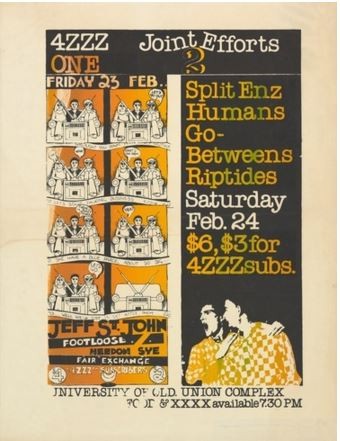
Design by Terry Murphy and Allan Martin, 1979.
As well as live music, there were other key aspects of the station’s fundraising. In the beginning, this meant seeking grants and sponsorship, the largest of which was the contribution towards building and outfitting the studios from the UQ Union. Other contributors included the QIT (now QUT) Students Union, several Hi-Fi manufacturers/retailers, and the Building Workers Union. The record companies were slow to come to the party because we weren’t interested in playing their Top-40 artists. Once the station was on air, the 4ZZZ-FM Subscription Scheme kicked in, where listeners paid an annual membership to support the station. Finally, in January 1978, we ran the first Radiothon, an annual on-air drive for donations and Subscriptions.
But it was music promotions, and the Joint Efforts in particular, that generated the most significant, the most reliable, and the most popular stream of income for the station.
Over time, the increased offers of bands from interstate, the increase in new local bands, and the huge demands on staff and volunteers required for Joint Efforts, meant that new and smaller venues were needed. When the Queen’s Hotel was opened as a Triple Zed venue in May 1978, the ‘demise’ of the Joint Effort was inevitable. The large gigs at UQ continued for a while, although less often, and the name was often used for gigs at Cloudland (which began for Triple Zed in 1979), but the baton had been passed to a new era.

Design by unknown artist, 1977.

Design by unknown artist, date unknown.
As time has shown, the creation of smaller venues was essential for diversity and growth. It is also worth noting that the opening of the Queen’s signalled the post-Disco rebirth of ‘Pub Rock’ in Brisbane. Once again, Triple Zed was helping bands by playing their music on air, and providing venues for them to play live.
The original Joint Effort was a critical part of Triple Zed’s history. Not surprisingly, one of the key events created for ZED 50 in 2025, the station’s 50th anniversary, is Joint Effort 50, featuring bands who have played at Triple Zed gigs over the years.
--
John Stanwell
John Stanwell is one of the founders of 4ZZZ-FM and his Joint Effort and 4ZZZ posters and ephemera will be donated to State Library's collection late in November 2025.

Design by unknown artist, 1980.

Design by Allan Martin, 1979.
4ZZZ 50th Celebrations
For five decades, Brisbane’s community radio station 4ZZZ has amplified the voices, sounds and stories of a changing city.
Watch rare 1975 footage of 4ZZZ’s studio being built at the University of Queensland and its first trial broadcast rehearsal — silent but powerful glimpses into the station’s DIY beginnings.
Volunteers and passionate promoters like David Darling have once again pulled together a Joint Effort - 50 Years, with a historic line-up featuring key acts from the posters featured above, 8 November at the Hamilton Hotel.
And don't forget to join State Library of Queensland as we celebrate 50 years of independent broadcasting with Stranded — a festival of conversations, workshops, showcases and collection highlights exploring 4ZZZ’s radical roots, origins of punk and enduring influence on Queensland’s culture.
Hear from some of Brisbane's key figures in independent media and music, including Kellie Lloyd, Stephen Stockwell, Patience Hodgson, Stefan Armbruster, in our Stranded conversations. We’ll explore the subcultures, stories, and voices that changed Brisbane — from punk and underground gigs to Murri Radio, Queer Radio, Dykes on Mics, and more.
https://www.slq.qld.gov.au/stranded
Comments
Your email address will not be published.
We welcome relevant, respectful comments.