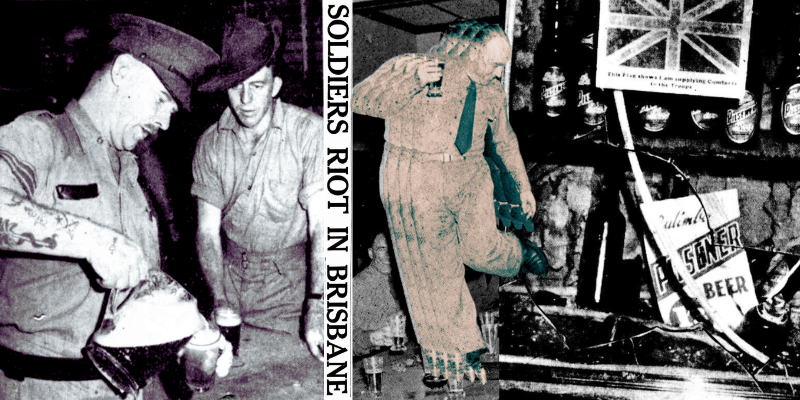
The 'Battle of Brisbane' – the notorious skirmish between Australian and American troops and military police – is an infamous and well-covered chapter in Brisbane's history. But did you know that 2 years before Australian soldiers rioted in the streets of the city?
The reason? A clock ...
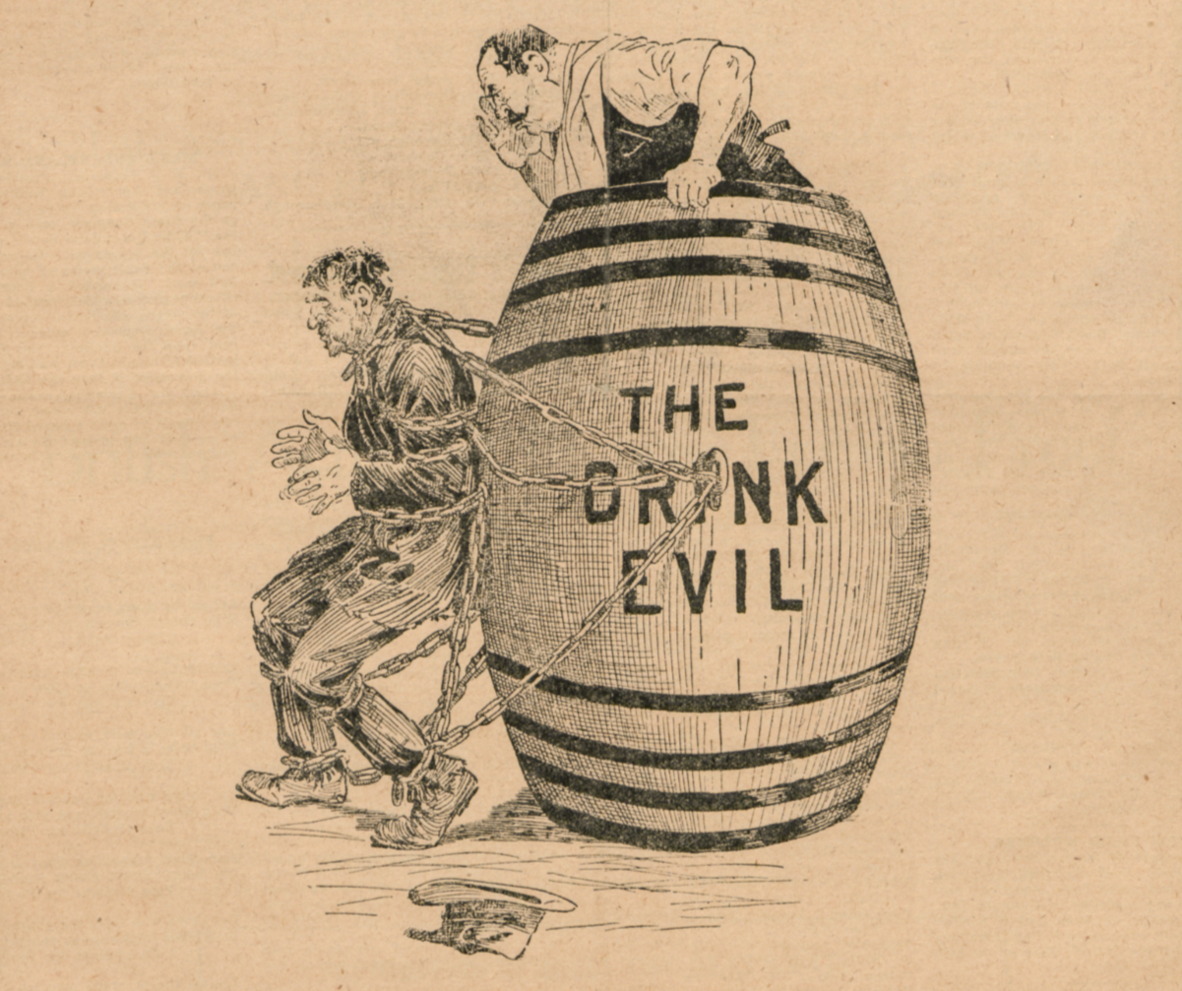
A less-than-subtle editorial illustration from 'Strength of Empire : official organ of the Strength of Empire Movement and the temperance societies of Queensland.' 16 August, 1920.
High and dry
In 1916, a concerted national temperance campaign led several states – including New South Wales, Victoria, South Australia and Tasmania – to introduce 6 pm closing times for hotels. This was a wartime measure intended to reduce drunkenness and improve public discipline. Queensland debated the idea but never legislated any change.
In 1923, the Sunshine State finally amended its liquor laws to require hotels to trade between 8 am and 8 pm Monday to Saturday (no trade on Sundays), replacing the previous trading hours of 6 am to 11 pm.
Many hoteliers – believing the laws to be commercially ignorant – simply rejected the mandated curfew, most without consequence. The serving of ‘sly grog’ outside of the permitted hours became a tolerated grey area that kept drinkers happy and hotels profitable.
In late 1940, however, authorities decided to crack down. Police began actively enforcing liquor laws in Brisbane hotels, and particularly the 8 pm close.
By this time, Brisbane was a major wartime training and transit centre for Australian troops – including Imperial Force (A.I.F.) volunteers awaiting overseas deployment – for whom drinking was a valued leisure activity, especially as all canteens at Brisbane army barracks canteens were 'dry'.
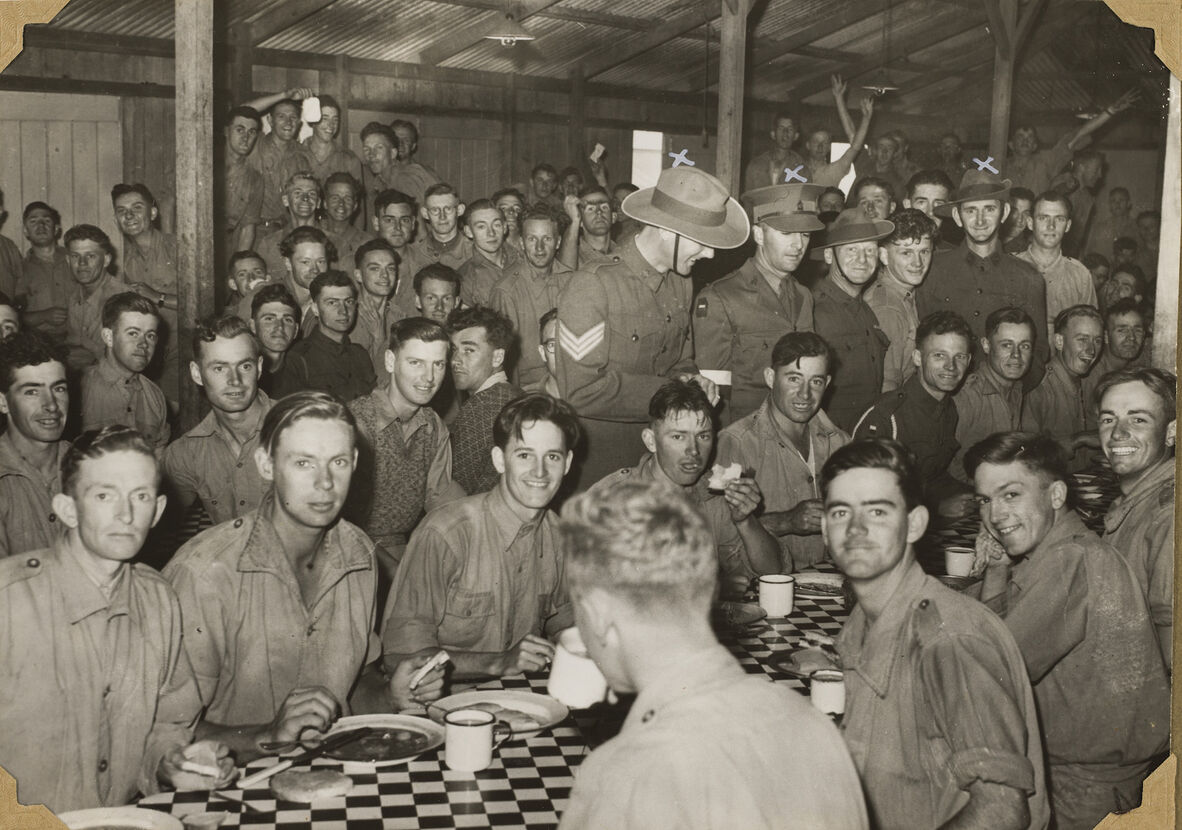
Soldiers in the mess at Lytton, 1940.
Closing time
On Saturday 26 October, tensions broke. Just after 8 pm, a group of soldiers were ordered out of a Queen Street hotel in which they had been enjoying a drink. A few began scuffling on the footpath. A passing police officer attempted to intervene. Before long hundreds of other soldiers and civilians had joined the fray.
As it became clear a full-blown riot was developing, scores of civilian and military police poured into Brisbane’s CBD. By the time the initial riot was quelled more than 4 hours later, 'hundreds of pounds worth' of plate glass windows and doors from the Grand Central and His Majesty’s hotels had been smashed, a beer keg rolled down Queen Street (reportedly accompanied by strains of Roll Out the Barrel), and trams appropriated by soldiers chanting ‘we want beer!’.
Very few images remain of the riot, as soldiers reportedly threatened photographers and journalists trying to get close to the action.
Twelve soldiers, reportedly 'not taking part in the disturbance', were injured in the riot, with some taken to hospital.
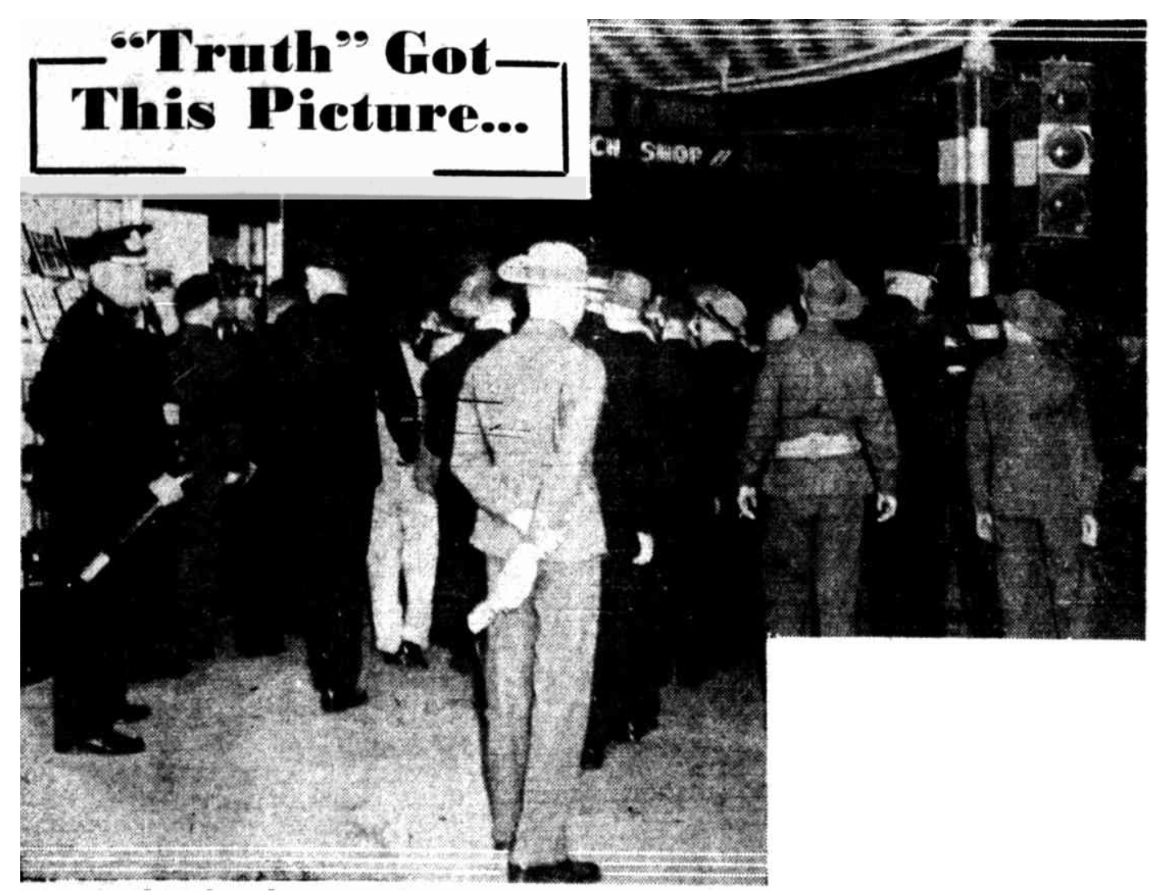
The only apparent recorded picture of the riots in action.
According to a Courier-Mail report, the soldiers then marched across Victoria Bridge to the Palace Hotel on the corner of Stanley and Melbourne streets, where they smashed an inside door and broke bottles, refrigerators and furniture.
At midnight there remained ‘fully 5,000 people still congregated in Queen Street’. Just after 1 am an effort was apparently made to appeal to the troops' innate training. A pair of soldiers with a drum and cornet tried to lead the rioters in a marching order by playing ‘military melodies’ to lead them away from Queen Street, accompanied by Brisbane band-leader 'Billo' Smith and his wife, at the head of the procession.
Reports do not mention how effective this was, but by 2 am the soldiers had been shepherded onto Adelaide Street and taken back to military camps.
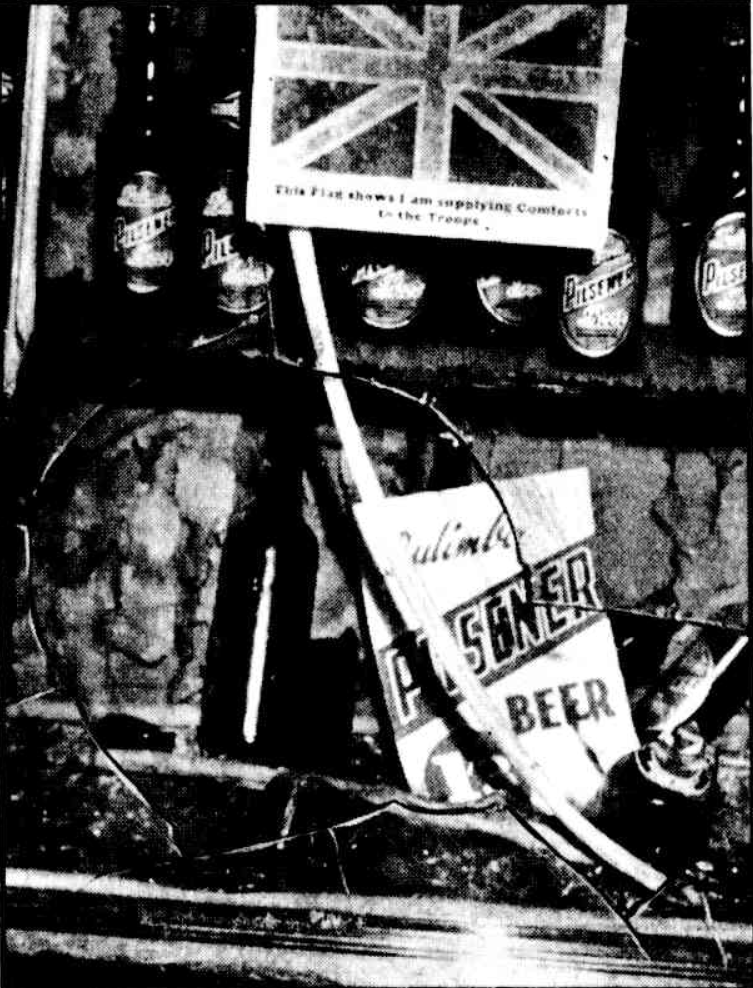
A wrecked show case at the Palace Hotel, South Brisbane. Note the line beneath the Union Jack: 'This Flag shows I am supplying Comforts to the Troops.'
We want beer!
While the Brisbane beer riot has attracted some notoriety, what does not appear to have ever been acknowledged is that it wasn't confined to a single night.
The next evening at 6:45 pm, hundreds of soldiers gathered near King George Square and marched arm-in-arm down Adelaide Street repeating their chorus of 'we want beer!'.
They were matched by 500 members of military police and 'all available’ civilian police who had been sent out to avoid a repeat of the night before, along with hundreds of civilian spectators, who were perhaps hoping it would repeat.
A group of soldiers attempted to enter Labour League Club on Isles Lane (where hundreds of soldiers had allegedly signed up as honorary members to obtain liquor out of hours) but were blocked by police.
Another group attempted to overturn a military truck further up Queen Street, before marching into Creek Street where they broke the glass doors of the Gresham Hotel and pulled down tram trolley poles.
Eventually the soldiers were corralled into Anzac Square where some were arrested and sent back to their barracks. Later that night around 100 soldiers returned to Adelaide Street opposite Anzac Square. Police were rushed from Roma Street and ‘at what was presumably a prearranged signal, charged the demonstrators with their batons'. Then began a 'running fight' towards City Hall where further arrests were made.
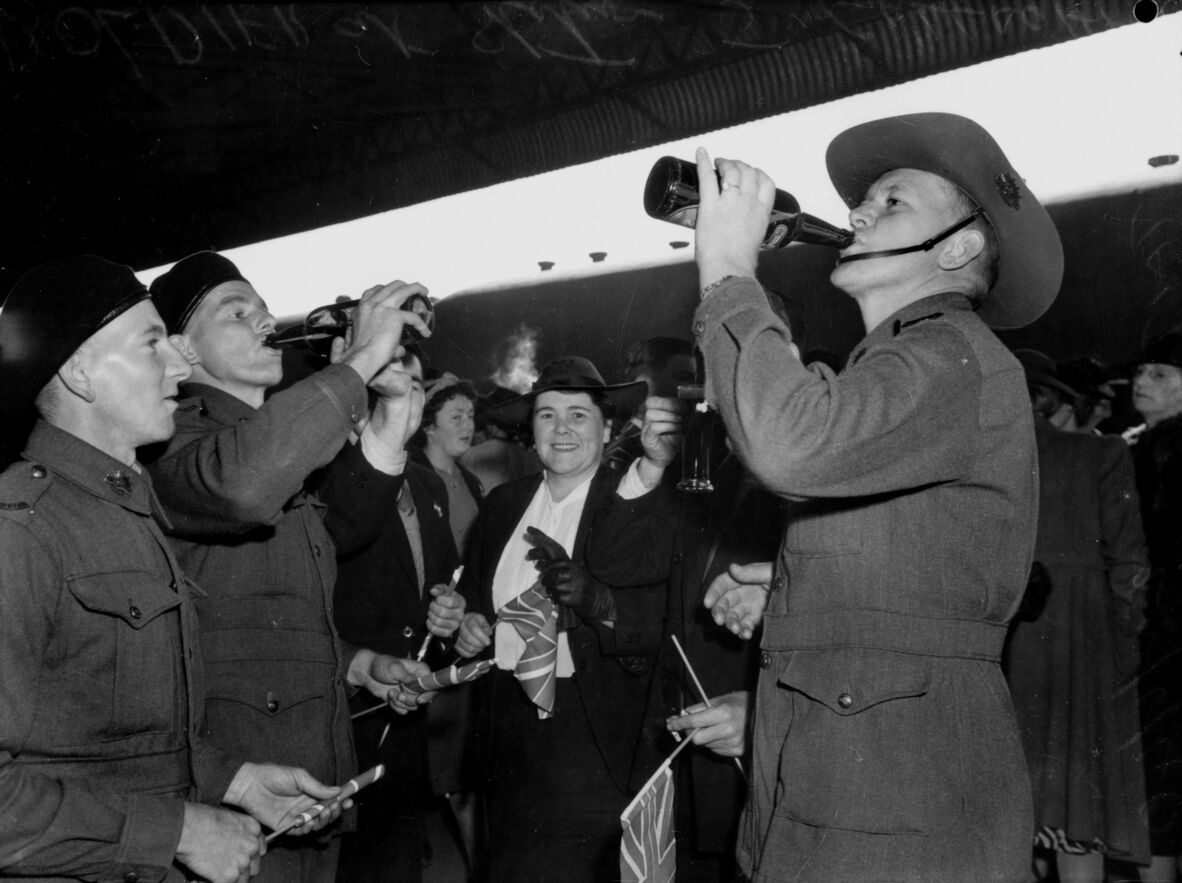
Soldiers enjoying a last drink on the train platform at South Brisbane Station, June 1940.
A couple of quiet ones
On the evening of Monday 28 October, over 500 military, plain clothes and uniformed police waited in the city. They were, according to newspaper reports ‘armed with riding crops and batons’.
The group of soldiers was this time joined by 'streaming crowds' of civilians, evidently curious to see what a third night would bring. An estimated 5,000 people 'jammed tightly into Edward and Adelaide Streets', setting the stage for another explosive evening.
Around 8:30 pm, an argument between a military policeman and two soldiers turned into a minor scuffle. Within seconds, the group was surrounded by a 'dense throng' of civilians, soldiers and police. Just as events were set to escalate, a military truck full of 'steel helmeted’ police pulled up alongside, its presence calming what could have been an all-in brawl.
Aside from a few broken bottles, the rest of the night was quiet.
By now, reports had surfaced of authorities suspecting the hand of ‘some organisation’ in fomenting the extra days of rioting. Brisbane newspaper the Truth (whose reporting, it must be said, did not always live up to its name) suspected communist agents, while an editorial from Bundaberg Daily News-Mail compared the actions of the soldiers to Hitler and Mussolini.
Police patrolled the city on Tuesday night, but their services weren't required. Thankfully, the riots resulted in limited injuries and only a few charges laid.
Solider Alfred Torpey was one of a handful of soldiers charged for his part in the riots. At his hearing for a charge of having used obscene language in Queen Street, Torpey told the Magistrate he was ‘a bit full’ when he had attempted to unlawfully direct traffic during the Monday riots (he was fined £1 and sentenced to 3 days’ imprisonment).
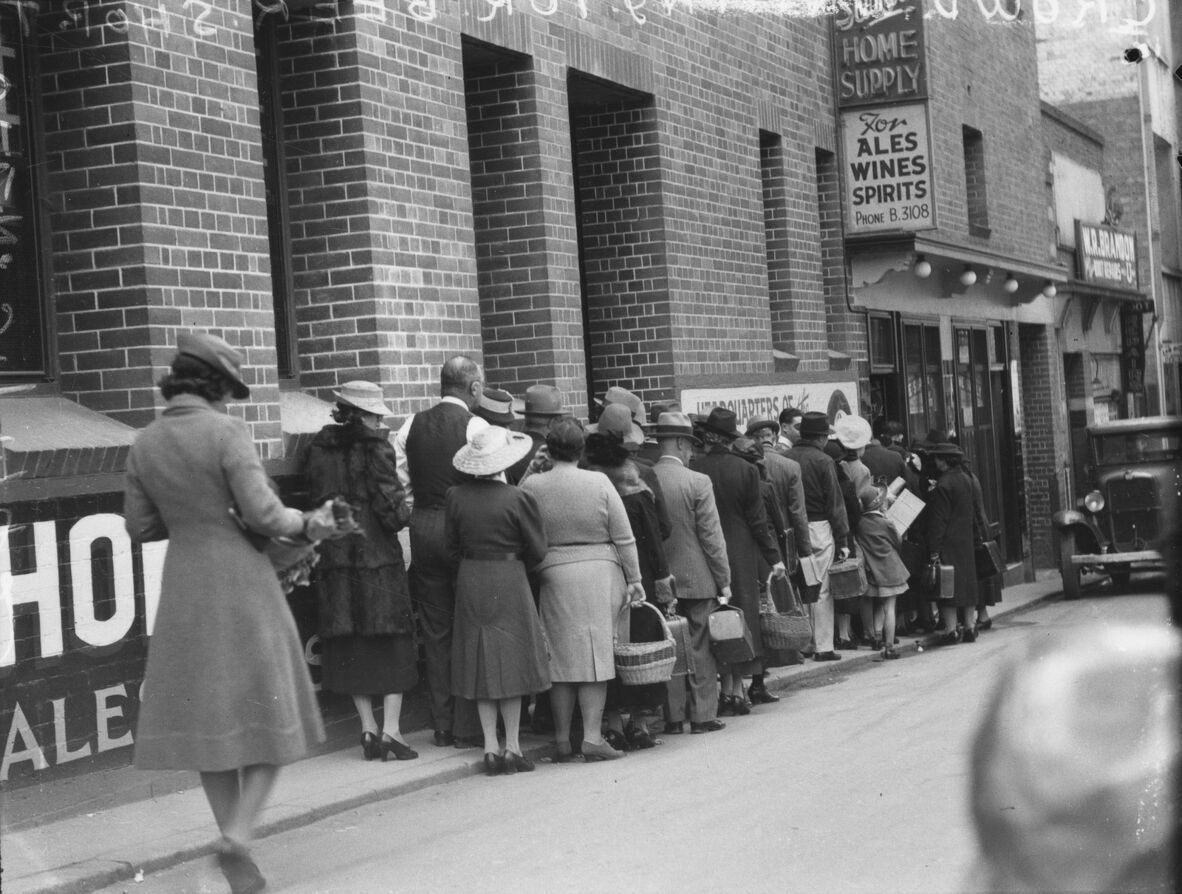
'A crowd waiting for the beer shop to open.' Burnett Lane, Brisbane, 1942.
The problem of 'wet canteens'
While the rioting had ended, the discussion around how and why it had happened was only beginning.
By Thursday 31 October a special military court of of inquiry had been appointed, presided over by Brigadier F. North of the 11th Infantry Militia Brigade, Townsville.
Premier William Forgan-Smith said the disturbances ‘provided another example of the fact that men in the mass would do things that, as individuals, they would never dream of doing.’
Minister for the Army Percy Spender promised to ‘give immediate consideration to the trouble and the causes of it.’ He suspected it may have ‘some relation to the problem of wet canteens.’ Prime Minister Robert Menzies favoured dry canteens and indicated that ‘a strong argument’ would be required to change his mind. Reports on 31 October discussions by the War Cabinet revealed that Spender had submitted a policy recommending that dry canteens be banned.
On 6 November, Prime Minister Menzies said that if most of the Federal Cabinet thought there should be wet canteens it would only be because the members considered it 'in the best interests of the soldiers.'
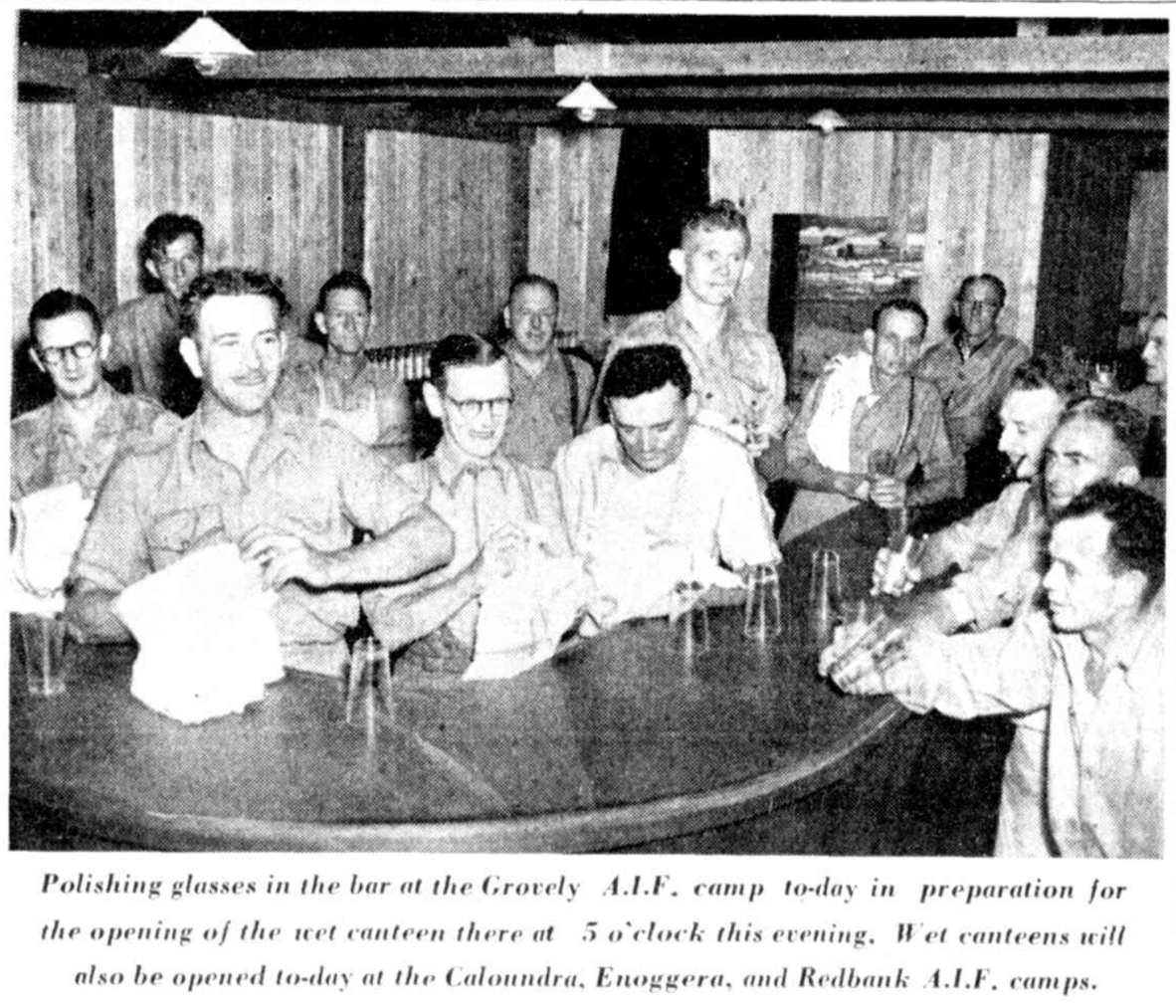
Soldiers polishing glasses at Grovely A.I.F. camp in anticipation of the opening of a wet canteen.
Drinking time
Wet canteens opened at A.I.F. camps at Redbank, Grovely, Enoggera and Caloundra at 5 pm on Friday November 15. Soldiers bought beer tickets in sets of 2 for 9d (just under $4 today), good for 2 10-ounce pots. There would be no limit to the number of drinks ‘provided the man’s conduct is good.’ Weekday hours were 5–8 pm, Saturdays 2–9 pm and closed on Sundays.
The canteens were, unsurprisingly, very well received by troops, but there were no reports of any drinking-related issues. Despite concerns from the Queensland Temperance League (who, ironically had supplied many of the refrigerators now keeping the beer cold), Mr Spender reported that for every 5 pints of beer drunk at military camps, 6 pints of ‘milk and cordials’ were consumed. He even invited representatives of the League to visit canteens.
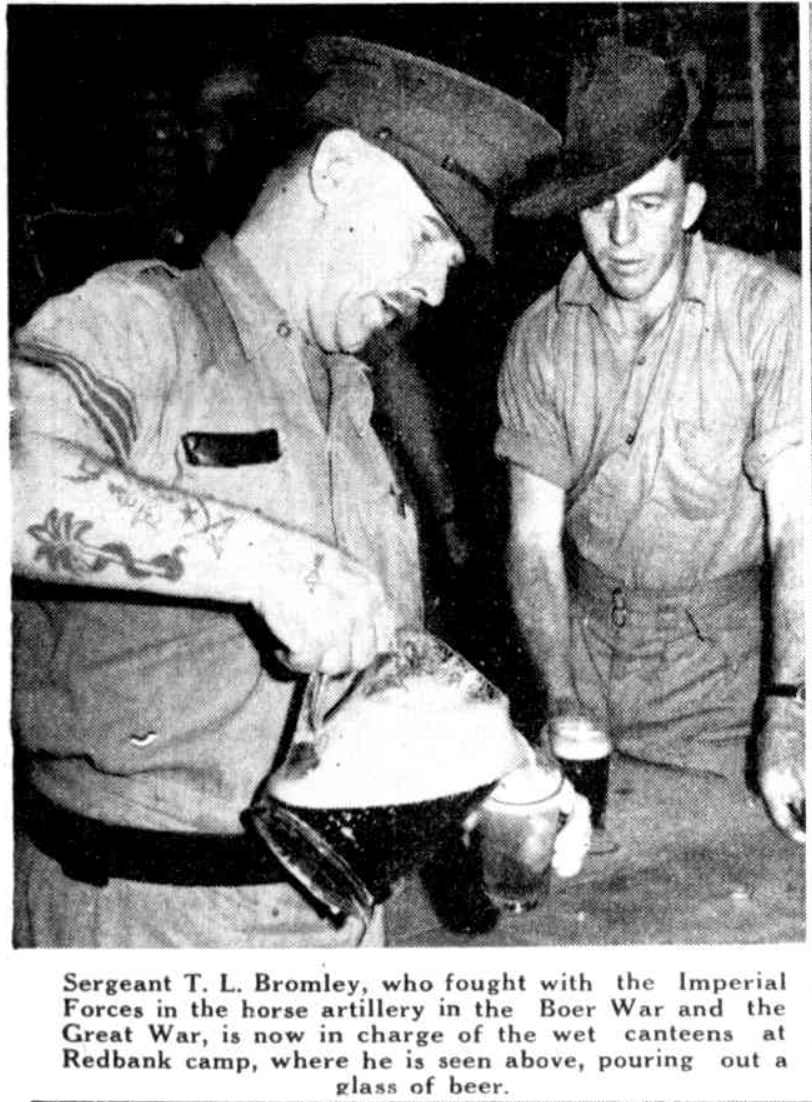
In December it was announced that liquor would be allowed in officers and sergeants’ messes at Militia camps, a rule extended to all Militia messes in March 1942.
By this time, more allowance had been made for creature comforts in existing wet canteens. The once-spartan spaces had become more akin to "gentleman's clubs", notably the giant new Services Club at Desmond Chambers, Adelaide Street (“wet” opening hours: 11 am – 2 pm and 4–8 pm).
A national poll in April 1942 showed 8 in 10 Australians were now in favour of wet canteens.
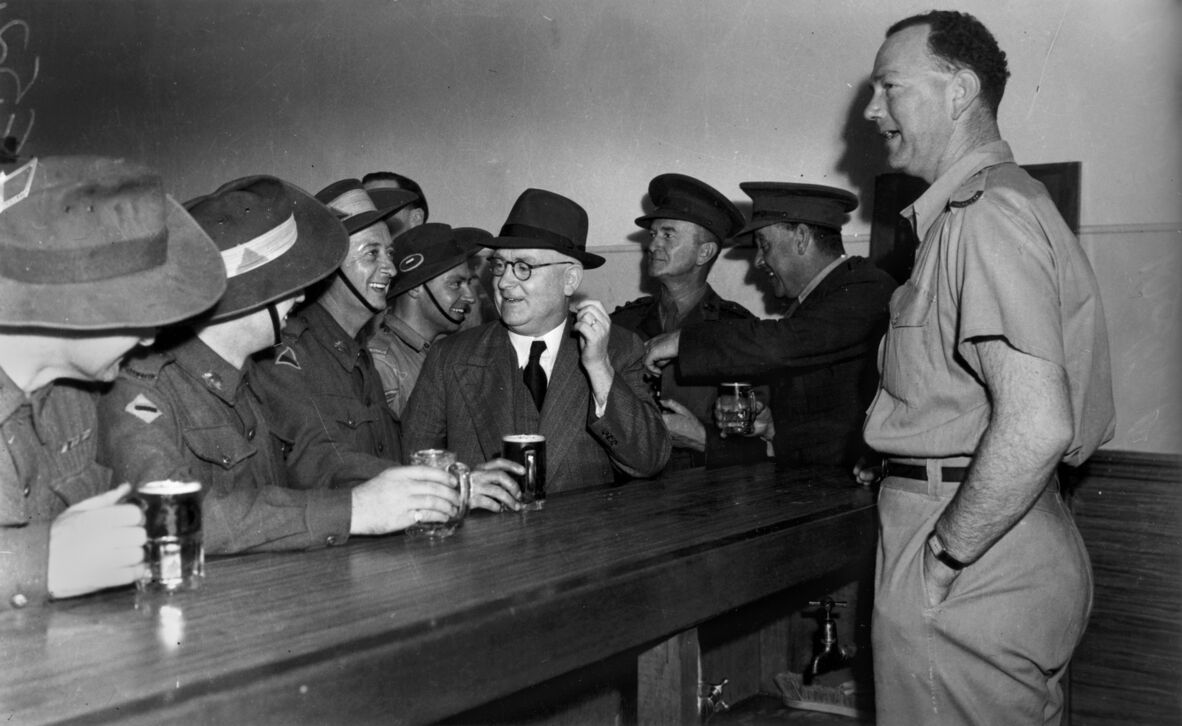
Soldiers having a drink at the Army Service Club canteen wet bar, Brisbane, 1942.
The Battle of Brisbane
By now, Brisbane streets were no longer the sole purview of Australian troops. In December 1941, following the Japanese attack on Pearl Harbour, American GIs arrived en masse.
Tensions arose from the start. Aside from the well-publicised complaints that US troops were better paid, better resourced and more attractive to local woman, drinking once again played a part.
American soldiers were not only allowed to also visit Australian canteens (a courtesy not returned to Australian troops), they could purchase cigarettes and snacks duty free. In turn, US troops accused Brisbane hoteliers of profiteering on the liquor sold to non-local drinkers.
Minor scuffles between Australian and American soldiers became common at canteens and city bars throughout 1942. On 17 August, Australian troops were finally allowed to drink at American canteens. It was hoped this would ease the antagonism.
As history tells us, it did not. On Thursday 26 November, tensions spilled over between Australian and American soldiers in the well-documented Battle of Brisbane, sparking fresh debate over soldiers and alcohol.
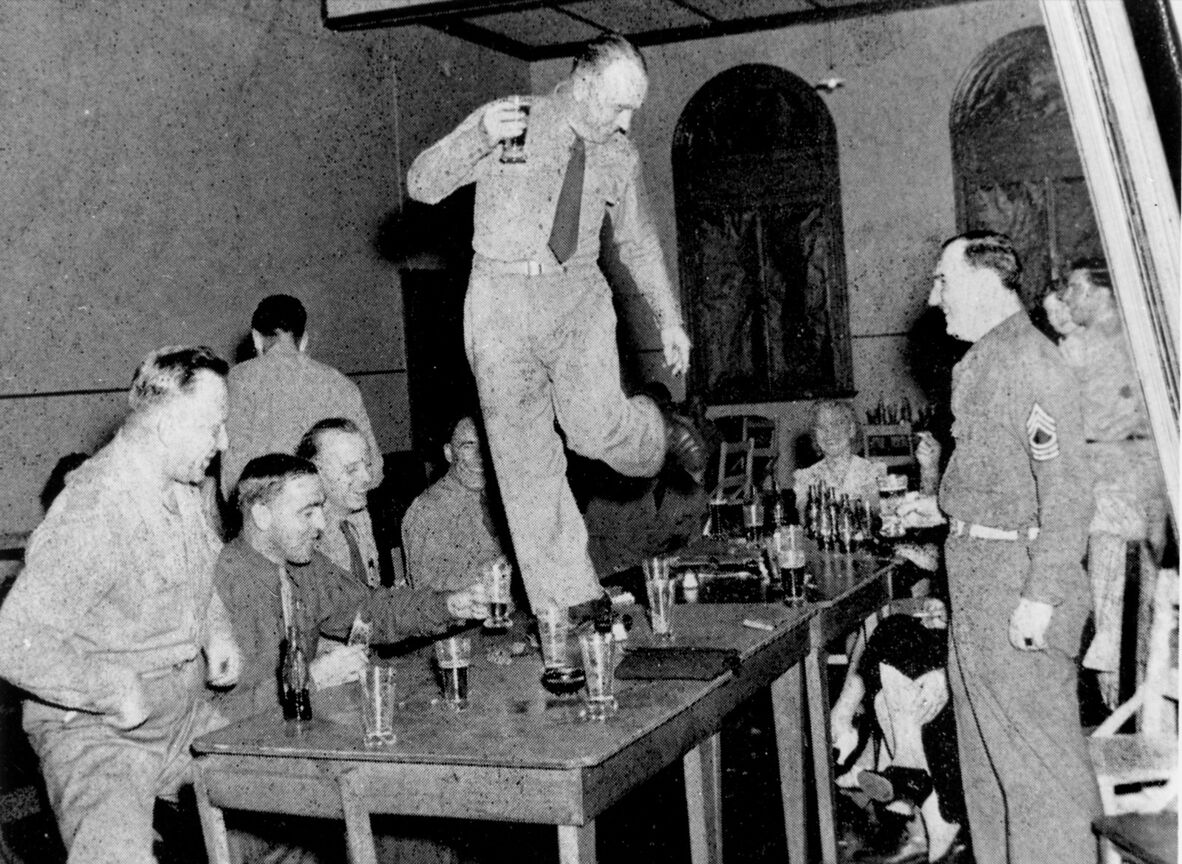
United States Army soldiers of the 81st Air Depot Group stationed at Eagle Farm Brisbane, ca. 1943.
Resources
1940 Beer riot in Brisbane, Australian Food Timeline website, accessed 15 October 2026
Brisbane Beer Riot, Beer et seq. website, accessed 15 October 2026
Cryle, Mark (2018). "Poor little Queensland": resisting six o'clock closing in the "Hot-bed of Disloyalty", 1915-1918. Australian Journal of Politics and History 64 (3) 464-479
Sobriety in ruins - Demolition of The Canberra Hotel, Myles Sinnamon, State Library of Queensland website, accessed 15 October 2026
The Temperance Movement in Queensland: 175 years - Resource List, Libby Fielding, State Library of Queensland website, accessed 15 October 2026
Trove website (various pages), accessed 15 October 2026
'We want beer': State Library of Queensland looking back at Brisbane's 1940 beer riots, ABC News website, accessed 15 October 2026
Comments
Your email address will not be published.
We welcome relevant, respectful comments.