State Library of Queensland

Old black and white photograph of soldiers leaning out of a train carriage window and waving.

They shaped our story. Discover theirs this Anzac Day.

Commemorate at Anzac Square & Memorial Galleries

Learn more

Search the catalogue

Access State Library collections through One Search

Catalogue help

Getting started

Using the libraryebookseresourcesBook spaces and equipmentFamily historyTeachers and students
Man reading newspaper at the library
Membership
Access more benefits online and onsite when you become a State Library member. Membership is free. Access is immediate.
Learn more
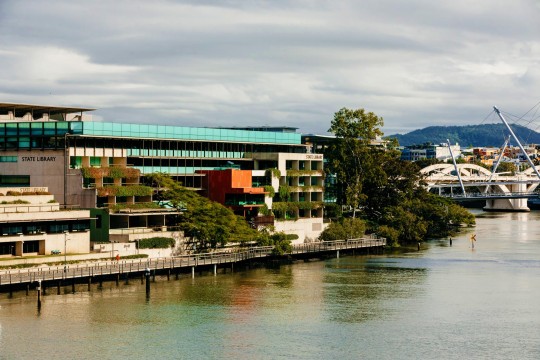
The State Library building from the opposite side of the Brisbane River.
Visit
There is so much on offer at State Library. Explore ways to make the most of your visit before you arrive.
Learn more

What's on

Italian prisoners of war at Beattie's Calico Creek farm, Queensland, 1940s
Booking required
My playmates were Italian prisoners of war

Sun 17 May · 10:30–11:30am

Join us on Sunday 17 May to hear poignant stories of Italian prisoners of war interned on Queensland farms during World War II. Many farming children of the 1940s thought that it was ‘normal’ to have Italian prisoners of war living on the farm, but the placement of Italian prisoners of war was an unconventional solution to the dire shortage of farm labour experienced in rural industries. This is a rich and unique history; a time when unguarded prisoners of war lived and worked in nine Queensland rural districts. This is a history which offers fascinating insights into life on the ‘home front’ during World War II; a time when prisoners of war taught children how to twirl spaghetti with a fork and spoon, sang lullabies to babies and made a little girl her first ‘new’ shoes. Come on a journey of discovery and meet some of the farmers, children and Italians who are part of this story.This talk will be presented by special guest speaker Joanne Tapiolas who is an independent researcher and author, a history teacher and high school Deputy Principal, a family historian and business owner. The granddaughter of Spanish and Italian migrants, she has an intimate understanding of displacement, prejudice and living in an unfamiliar world. Her passion for family history and insight into social history has inspired Australians and Italians from around the world, to become part of her projects and share their stories. After the talk, visitors can stay to explore the Memorial Galleries, embarking on an interactive journey from the First World War to today, before taking time to reflect on the remarkable stories of bravery and sacrifice in the tranquil parklands. Anzac Square Memorial Galleries is located at 285 Ann Street, Brisbane. Entry is through the double brass doors located beneath the Shrine of Remembrance. Book now to secure your tickets!
Event details
A section of the new ward at Rosemount Military
Booking required
Caring for the wounded: Rosemount repatriation hospital

Sun 14 Jun · 10:30–11:30am

Join us on Sunday 14 June for a free talk exploring the history of Rosemount Military hospital and the crucial role it played caring for returned service personnel. ‘Many Brisbane residents have visited the Rosemount Military Hospital at Windsor, and have realised the care and attention bestowed on the “Diggers” there.’ (Cairns Post 1924) The advancement of weaponry during World War I significantly increased the severity of wounds for both allied and axis forces. Countless Australian soldiers returned home with complex medical conditions resulting from their service. The ongoing care of these individuals represented a logistical challenge for families and governments alike. In response repatriation hospitals, such as Rosemount, were established throughout Australia to provide medical care, rehabilitation and long-term treatment for World War I veterans. Rosemount, located at Windsor, was opened in 1915 as 1 Australian Auxiliary Hospital (AAH), later becoming the 27 AHH. It specialised in the rehabilitation of orthopaedic and spinal injuries with massage, physiotherapy and amputee services. Such was the demand as World War I ended that Rosemount struggled to cater for its ever-growing patient lists, with the site requiring numerous additions. This important historical site is a testament to the those who survived the war and a reminder of the long-lasting health implications many suffered. Moreover, Rosemount draws attention to the essential role that medical staff played in the ongoing rehabilitation of wounded soldiers. This talk will be presented by special guest Associate Professor Clifford Pollard, who served in Bougainville and East Timor as a member of the Royal Australian Army Medical Corps. He is the former Chair of the Queensland Trauma Clinical network, and previous Director of Trauma Services at the Royal Brisbane and Women’s Hospital, and Director of the Queensland Trauma Registry at the Centre of National Research in Disability and Rehabilitation Medicine, The University of Queensland. After the talk, visitors can stay to explore the Memorial Galleries, embarking on an interactive journey from the First World War to today, before taking time to reflect on the remarkable stories of bravery and sacrifice in the tranquil parklands.Anzac Square Memorial Galleries is located at 285 Ann Street, Brisbane. Entry is through the double brass doors located beneath the Shrine of Remembrance.Book now to secure your tickets.
Event details
Australian Field Ambulance officers sheltering in trench
Booking required
So, you want to storm a Trench?

Sun 26 Jul · 10:30–11:30am

Attend a free talk on Australia’s involvement in World War I trench warfare, discussing tactics, technologies and the human experience. Few things are more central to our popular memory of the Western Front in World War I than the trench. Trench warfare, with its mud and men going ‘over the top’, is frequently depicted in photography, cinema, games and literature about the war. Yet, the planning and engineering that shaped the battlefields is often simplified or omitted from such media. The trenches were muddy and rat-infested, but they were also a prepared and layered warren of crenelations, hard points, listening posts and bunkers. Likewise, battlefield advances involved highly detailed firing plans of creeping and box barrages, observation and strafing by aircraft, and grenadier teams.This talk draws on archival material, published histories and personal stories to explore the practical realities of trench warfare on the Western Front in World War I. It will cover how the design of trenches developed over the war alongside methods for assaulting them. How soldiers were equipped and trained for trench warfare, and how they described their experiences. And it will shed light on why the Western Front was so deadly, despite tactical and mechanical innovations aimed at breaking the stalemate.So, if you’ve ever wanted to storm a trench, this is the guide for you.After the talk, visitors can stay to explore the Memorial Galleries - embarking on an interactive journey from the First World War to today, before taking time to reflect on the remarkable stories of bravery and sacrifice in the tranquil parklands.Anzac Square Memorial Galleries is located at 285 Ann Street, Brisbane. Entry is through the double brass doors located beneath the Shrine of Remembrance.
Event details
All events
Skip to next item

Collections