- Home
- John Oxley Library Medal
/
John Oxley Library Medal
About the Medal
The John Oxley Library Medal recognises an individual who has made an outstanding contribution to the appreciation of Queensland history. The Medal is granted annually to promote the value of pursuing historical knowledge and its role in shaping Queenslanders' understanding of themselves and each other. Nominate an individual who is championing Queensland history today.
Please read the Application Guide for the 2027 program. See our frequently asked questions page for more information.
For more information, please email fellowships@slq.qld.gov.au.
2026 John Oxley Library Medal
The 2026 John Oxley Library Medal was awarded to Janeth Deen OAM.
Janeth Deen has made a significant contribution to Queensland history by documenting and preserving the stories of Muslim communities in Brisbane and beyond. As co-founder and president of Queensland Muslim Historical Society, she has collected artefacts, oral histories, and records that highlight the rich heritage of Queensland’s Muslim population. Through exhibitions, research, and community engagement, Janeth has raised awareness of Queensland’s cultural diversity, fostered understanding, and promoted social cohesion. A respected leader and the first woman to join the Queensland Islamic Council, Janeth was awarded an Order of Australia for her service to multiculturalism, making her a role model in both the historical and multicultural sectors.

Janeth Deen OAM, 2026 John Oxley Library Medal recipient and Debbie Best, Chair Library Board of Queensland.
John Oxley Library Medal Alumni Address
Each year at the annual State Library Fellowships and Medals announcement event, a previous John Oxley Library Medal recipient is invited to deliver a short address on a topic of their choice related to Queensland history.
The inaugural address in 2025 was delivered by Matthew Condon OAM, 2013 recipient. In Rediscovering Memory: A Story of Truth, Family, and the Power of Writing, Matthew reflects on how memory and storytelling shape identity and legacy. Through personal anecdotes, he highlights the transformative power of uncovering hidden truths and the enduring impact of sharing our stories.
In 2025, Professor Kay Saunders AO, the 2010 recipient, presented the address. Drawing on her experiences as a researcher—from her early work in 1969 to contributing to State Library’s publication Between the Covers in 2006—Kay reflected on the expertise and diligence of librarians.
2025 John Oxley Library Medal Alumni Address by Matthew Condon OAM.
2026 John Oxley Library Medal Alumni Address by Professor Kay Saunders AO.
Past John Oxley Library Medal recipients
The 2025 John Oxley Library Medal was awarded to Marianne Taylor (the House Detective)
Marianne Taylor, also known as the "House Detective," is a devoted architectural historian with her own business and a role as a volunteer researcher. She uncovers the hidden histories of houses, helping community members connect with their home's heritage. Beyond her professional work, she generously offers talks at history groups, libraries, and heritage events. Her social media presence further shares her discoveries, engaging followers and supporters. Passionate about heritage, Marianne enriches Queensland’s historical community, making her an invaluable asset in promoting knowledge of place, architecture, and local history.

Marianne Taylor, The House Detective, 2025 John Oxley Library Award recipient.
EP 01 - Who is the House Detective?, 2021, The House Detective YouTube channel.
The 2024 John Oxley Library Medal was awarded to Dr Robert (Uncle Bob) Anderson OAM.
Dr Robert (Uncle Bob) Anderson OAM, a distinguished Ngugi Elder, made history as the first Indigenous Australian to lead the Building Workers Industrial Union from 1951 to 1978. Known for his fierce advocacy for workers' rights, he played a pivotal role in key labour disputes, including the Mount Isa Copper Mine Lock-Out and South African Springboks rugby tour.
In addition to his labour activism, Uncle Bob chaired the Aboriginal and Torres Strait Islander Advisory Board and has been an advocate for reconciliation. His dedication has earned him numerous awards, including the Order of Australia Medal (OAM) and recognition as one of the Queensland Greats. Anderson Street in Kangaroo Point is named in his honour.
You can watch an extended interview with Uncle Bob on Vimeo.
Read more about the 2024 Queensland Memory Awards on our blog.
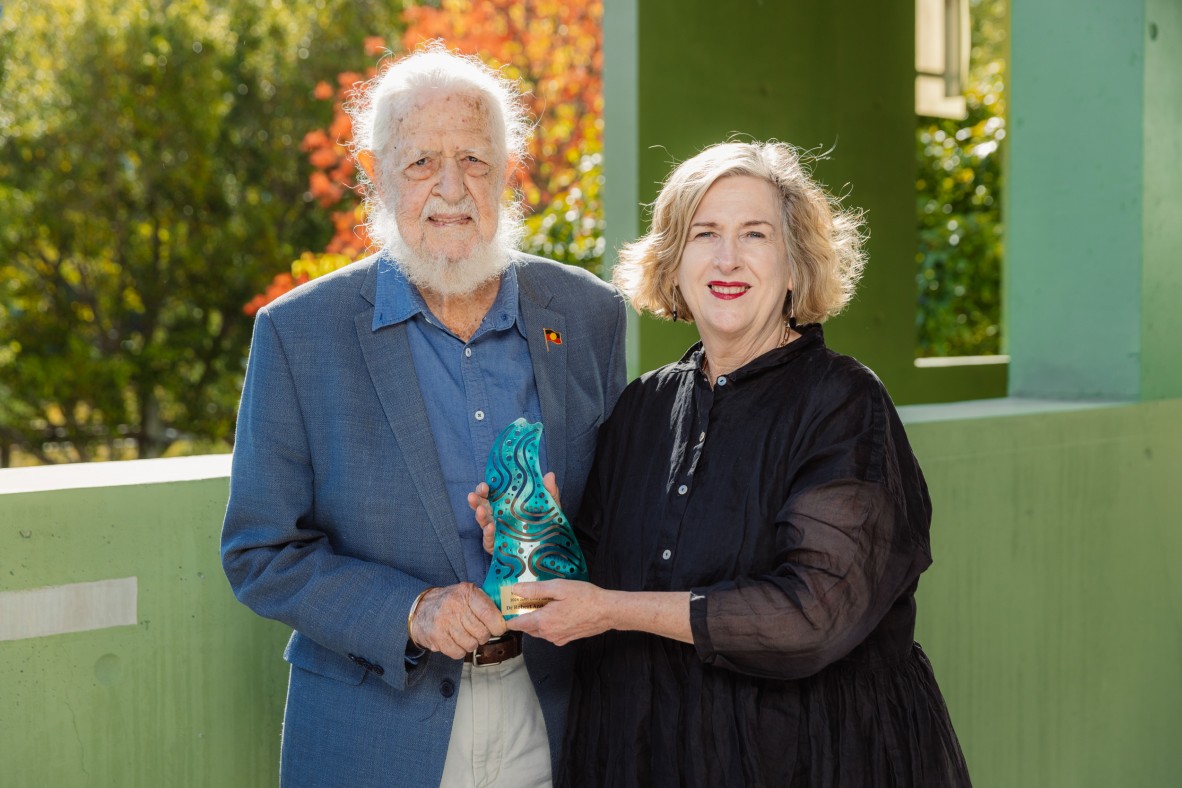
Dr Robert (Bob) Anderson and Vicki McDonald AM FALIA.
Dr Robert Anderson OAM 'Uncle Bob' digital story
The John Oxley Library Medal was awarded to Dr Jackie Huggins.
Dr Jackie Huggins AM FAHA a member of the Bidjara and Birri Gubba Juru peoples, is currently leading the work for Treaty/Treaties in Queensland. In popular demand as a speaker on Aboriginal issues, she is a well-known historian and author, with articles published widely in Australia and internationally. Her acclaimed biography of her mother, Auntie Rita, was published in 1994. Keeping it in the family, in 2022 her biography of her father, Jack of Hearts: QX11594 was published.
Jackie was the former Co-Chair National Congress of Australia’s First Peoples, former member of the National Council for Aboriginal Reconciliation, Co-Chair Reconciliation Australia, the State Library Board of Queensland and the Australian Institute of Aboriginal and Torres Strait Islander Studies. She was Co-Commissioner for Queensland for the Inquiry into the Separation of Aboriginal and Torres Strait Islander Children from Their Families.
Jackie’s outcomes and behaviors embodied the award’s selection criteria of significance, impact, professionalism and leadership.
2022 John Oxley Library Medal recipient, Dr Jackie Huggins
The 2021 John Oxley Library Medal was awarded to Tracey Olivieri and Chris Dawson for their work with the group Friends of South Brisbane Cemetery
Tracey Olivieri explains her association with the group:
"I founded the Friends of South Brisbane Cemetery in 2005 with 2 dear friends, Marilyn Paul and Roma Waldron. The cemetery was unkempt, and I felt I had to do something to help protect this special heritage place. I grew up in the local area and used to spend a lot of time at the cemetery so it became a very special project for me.
"We photographed every grave, embarked on re-mapping and compiling a database of the residents. We helped family historians locate graves and recorded many known and unknown stories of the residents. This was all done along with trying to clean the cemetery. All of this is still being done on a larger scale today with Chris Dawson working equally hard alongside me. Many amazing volunteers come and clean on our 'guardian angel' cleaning days. We share many of the stories through publications, tours, public talks, facebook and our website. We have plans for more and new things over the years ahead."
Chris Dawson explains his association with the group:
"Our historical cemetery work in recent years has included recording, mapping and maintaining graves, biographical research, writing, tour guiding, public talks, family history assistance, website and social media development, lobbying for cemetery improvements; and generally encouraging visitation and engagement with the cemetery as a heritage place.
"This is very much public history. One of our proudest achievements has been to build a community of wonderful people around this project, people we did not know a few years ago, but who are now friends and partners in the work. This has probably been our happiest achievement because the underlying principle of everything we do is that the more people know about the place, and the more they engage with it, the more they will care about it and want to protect it into the future. What we have achieved so far has built a strong foundation for us to do even better in the future."
Tracey talks about her work with the Friends of South Brisbane Cemetery group in the video below.
Read more about the 2021 Queensland Memory Awards on our blog.
2021 John Oxley Library Medal recipient Friends of South Brisbane Cemetery.
The 2021 John Oxley Library Medal was awarded to Joanne Tapiolas for her project Footprints of Italian Prisoners of War in Queensland
Footprints of Italian Prisoners of War in Queensland is an international community project spearheaded by Joanne Tapiolas. Through her website and her book, Walking in their Boots, Joanne has brought to life Queensland’s little-known history about the Italian prisoners of war who worked on Queensland farms.
A proud Queenslander, Joanne's passion for family history and insight into social history has inspired Queenslanders and Italians from around the world, to become part of this project and share their stories.
Joanne Tapiolas’s research is comprehensive and diverse due to the project’s collection of and access to stories, letters, photographs, testimonies, artefacts, embroideries and music. It provides valuable perspectives – including farmers and their families, the town kid, an Australian Army interpreter, children of Italians prisoners of war, Italian prisoners of war, a local nurse, a mother of an ex-POW have all contributed to this colourful and vibrant Queensland history.
In March 2021, Joanne received international acknowledgement from one of Italy's major daily newspapers, Corriere della Sera for her project and research into Italian prisoners of war in Australia during the Second World War.
Blog: International spotlight shines on Italian prisoners of war project

Joanne Tapiolas, 2020 John Oxley Library Medallist
Paul Lyons was recognised for his dedication to the recording and sharing of North Queensland news and history, and his efforts to preserve Townsville news archives. Paul was responsible for rescuing 40 years' worth of North Queensland news and television history from a dumpster bin after the local television station was shut down. An experienced cameraman and producer, Paul spent the next decade protecting the archive before finding it a permanent home at his local library.
Ian Poole made significant contributions to Australian photography – not just as a Queensland photographer, but also as a teacher and mentor, writer, curator, a critic and judge, an aficionado of the art, and active participant in industry groups. In March 2011, Ian donated an archive of some 100,000 original negatives, colour transparencies, photographic prints and scrapbooks to the State Library of Queensland.
Ian's collections held by the John Oxley Library:
Dr Spencer Routh OAM made life-long contributions to the library and information sector. A self-proclaimed “lover of libraries”, Spencer was appointed the first Reference Librarian at the University of Queensland in 1959 and spent 42 years dedicating himself to “becoming a true partner in the transaction to find information”. He was awarded a Medal of the Order of Australia for his services to libraries in Queensland. Starting in 1975, Spencer was a Queensland contributor to the Australian Dictionary of Biography. In 2003 he received the Australian Dictionary of Biography Medal, referring to Spencer as the "Sherlock Holmes of researchers".
Spencer has been visiting and using the State Library of Queensland and our collections since 1948. Known to multiple generations of State Library staff, his frequent presence in our research spaces will be dearly missed; Spencer passed away in 2022.
In 2015, State Library conducted an interview with Spencer reflecting on his life and career – 30055 Spencer Routh papers and oral history interview.
Kim Wilson for her innovative work recording the history of local architecture and initiating and leading the Brisbane Art Deco Project.
The 2015 joint recipients were:
Trevor Newman
Trevor Newman coordinated the popular blog Your Brisbane: Past and Present. Trevor's blog compiled valuable information about Brisbane's buildings, those we consider landmarks, as well as many others.
Trevor's blog is archived through the National Library of Australia's PANDORA web archive.
Trisha Fielding
Trisha Fielding coordinates the popular blog North Queensland History. She writes a weekly history column for the Townsville Bulletin and is a regular contributor to local ABC Radio. In 2010, Trisha published her first book, Flinders Street Townsville: A pictorial history, which was awarded a high commendation by the National Trust of Queensland and an award for writing at the Townsville Arts Awards. Trisha is an active member of local studies groups.
Richard Stringer has enjoyed a long and distinguished career as a photographer of Queensland’s landscape and architecture. For more than 40 years he has advocated to preserve Queensland heritage and has actively contributed to our historical record by documenting much of the now vanished built environment throughout the State. His credentials and practice as an architect informs his photography. Queensland’s most prominent architectural photographer, Stringer's work has been included in landmark publications and exhibitions.
Matthew Condon for Three Crooked Kings, his recent investigative work into corruption in the era of former Police Commissioner Terry Lewis. A multi-award winning author and journalist, Condon was also awarded in recognition of his ongoing contributions to telling Queensland stories and his commitment to bring pertinent issues to the forefront of our state's social consciousness.
Filmmakers Sean Gilligan and Adrian Strong were awarded for their documentary Fantome Island. The film tells the story of Joe Eggmolesse who was diagnosed with leprosy in 1945 at the age of 7. He was then taken from his family and incarcerated on Fantome Island, an isolated tropical island off the coast of North Queensland.
Dr Ross Johnston had a long and illustrious academic career at the University of Queensland. He was the author of many publications, among them ground-breaking works that pioneered local and regional history studies and inspired a generation of researchers. A powerful advocate for the study and teaching of Queensland history in its own right, he remains heavily involved in studying and sharing Queensland and Australian history. Dr Johnston is a key member of the Queensland consultative committee for the Australian Dictionary of Biography.
Professor Kay Saunders was recognised for her extensive body of research on Queensland history, and her important role mentoring generations of students. Professor Saunders has spent many hours over several decades researching in the John Oxley Library, and is recognised as a pioneering female historian, particularly in the disciplines of gender and race studies in Queensland.
Dr Raymond Evans was awarded for his outstanding work documenting the state’s past. He taught for many years at the University of Queensland and as an adjunct professor in the Centre for Public Culture and Ideas at Griffith University. Professor Evans has been writing about Queensland and Australian history since 1965. His book, A History of Queensland (Cambridge University Press, 2007), was short-isted for the 2008 Prime Minister’s Literary Award for non-fiction.
The Nambour Chronicle Digitisation Team was awarded for the development of an online version of the Nambour Chronicle from 1903–1955. This fully searchable website ensures that the heritage of the area is more accessible to all in an innovative way. The project demonstrates an excellent example of collaboration between library staff of different councils.
Queensland Family History Society Publication Group received the award for raising the profile of Queenslanders from all walks of life who have contributed to our history, not just the leaders in politics and business.