A panorama tells a thousand words
Select the small image to view the high resolution version and then you can scroll through the entire panorama.
-

Brisbane Flood 1893
Large File Size: 563KB! -

Ekka c.1909
Large File Size: 584KB! -

Holy Name Cathedral 1928
Large File Size: 585KB! -

World Expo Site 1986
Large File Size: 572K! -

World Expo 1988
Large File Size: 587KB!
Panoramic photography was quickly taken up by early colonial photographers. It had immediate appeal for capturing large vistas and topographical views. As a new photographic format, it fulfilled the desire to document the settlement of Queensland, the gradual urbanisation of the capital and regional centres, as well as its large expanses of natural beauty and open space.
The panoramas, with their encompassing views, reflected the power and position of the colonising Europeans. Not only for private commission and local appreciation, some were also destined for abroad and presented in international and intercolonial exhibitions to promote the new colony and its government.
Apart from the role they play in recording the landscape and industrial progress of society, panoramic photographs with their broad field of vision, were also popular for other subject matter.
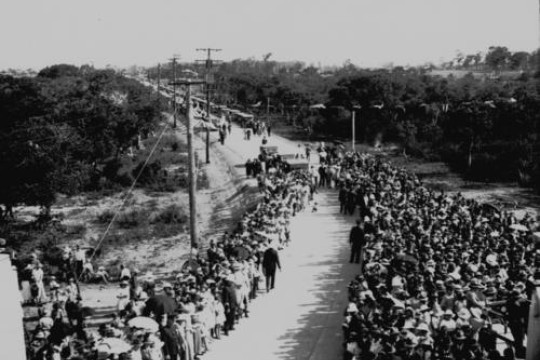
Panoramas were ideal for photographing crowds and large groups of people, either informally from a distance or posed in group shots. The Brisbane exhibition panorama of 1909 captures the throng of the annual show crowd. Panoramic photographs were also used for official processions and important civic occasions such as the 1925 Mackay Anzac Day parade.
The panoramic camera’s capacity to capture an extended horizon was employed in recording disasters, natural catastrophes and significant events. They were used on the battlefront and behind the lines in war as well as on the spot to document other calamities, such as fires, floods, earthquakes and train wrecks. All have an impact on the physical landscape. The flooding of the Brisbane River was photographed in panoramic format in 1893 to show the full extent of the damage to the fledgling capital city.

Other significant Queensland events were documented, such as the laying of the foundation stone of the Holy Name Cathedral, a church which, had it eventuated, would have been largest in the southern hemisphere. Before and after shots of the World Expo site during construction and on the opening day reveal the changes the event had on the cityscape - a cultural coming of age for Queensland on the international arena.
Celebrate the soundtrack of our state as SLQ sets the stage for the music of Queensland.
Open till 17 Nov
19th century pastoral life on the Darling Downs comes alive in this intimate exhibition of treasures at SLQ
State Library of Queensland provides special library services for members who have an SLQ membership card (formerly known as an e-services card).